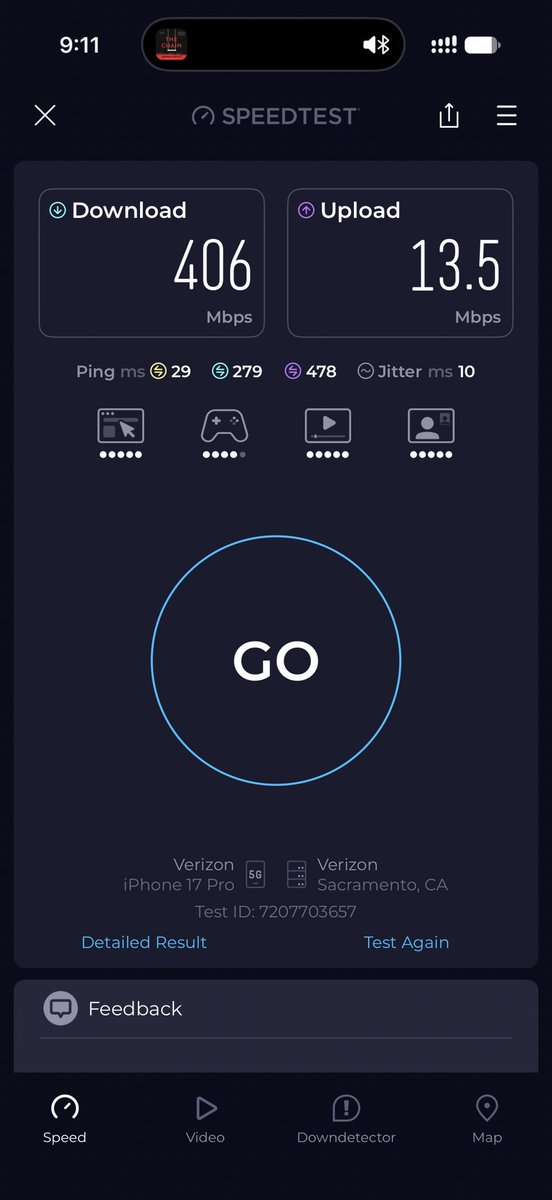
A real-world demonstration posted by @wholemars on August 25 captured something that would have sounded like science fiction a few years ago: a Tesla driving itself through California while streaming satellite internet at 400 Mbps. The clip is a useful stress-test of where Tesla's Starlink integration actually stands — and it raises a lot of questions worth answering clearly.


Does Starlink actually work while the car is moving?
Yes — and this demonstration is evidence of it performing well in motion. The Cybercab is the first Tesla to ship with Starlink hardware built directly into the body, using the Starlink V5 terminal. That hardware is rated at 375 Mbps or higher under normal conditions, and Starlink's Performance Kit is capable of exceeding 400 Mbps. The 400 Mbps figure shown in this demo sits at the top end of what the V5 terminal is rated for, so it's a strong result, though speeds in California typically range from 50–200 Mbps under standard conditions, with Priority plan users seeing spikes above 250 Mbps.
Does the car need Starlink to drive itself?
No. Tesla's VP of AI, Ashok Elluswamy, has been explicit on this: the self-driving system operates independently of the satellite connection. FSD processes everything locally using the car's onboard hardware and cameras. Starlink is layered on top for navigation and mapping updates, fleet management, customer service connectivity, and — as Elon Musk has noted — entertainment like 4K streaming. If the satellite link dropped mid-trip, the car would keep driving itself without interruption.
Which Tesla models are getting Starlink?
The Cybercab is first — it was showcased with integrated Starlink at Tesla's Santana Row showroom in California in late July 2026. Beyond that, Elon Musk confirmed on July 22 and again on August 12, 2026, that Starlink will be integrated into all future Tesla vehicles, initially rolling out in regions where Starlink service is operational. A specific timeline for which models come next — and whether existing vehicles can be retrofitted — has not been announced.
What is the Starlink V5 terminal, and why does it matter for a car?
The V5 is a significant step forward in making satellite hardware practical for automotive integration. Compared to the previous V4, it weighs 1.1 kg (62% lighter) and draws only 35–50 watts of power (roughly half of V4). For a vehicle where every kilogram and every watt affects range, those numbers matter. The fact that it can be integrated flush into the Cybercab's body without a bulky roof mount is what makes this viable at scale.
What will owners actually use the connection for?
The primary use cases, according to Tesla's own framing, are practical rather than flashy: keeping navigation maps current, enabling over-the-air updates in areas with weak cellular coverage, and maintaining a reliable channel for customer service. The entertainment angle — streaming video for passengers while FSD handles driving — is the headline-grabbing use case, and 400 Mbps is more than sufficient for 4K content. For owners who regularly drive through rural areas or dead zones, the connectivity backstop alone could be genuinely useful.
Is 400 Mbps in a moving car actually impressive?
In context, yes. Standard Starlink residential service delivers speeds that vary considerably by location and time of day. In California specifically, typical speeds sit between 50 and 200 Mbps, with higher figures on Priority plans during off-peak hours. Hitting 400 Mbps in a moving vehicle — where the antenna is constantly adjusting its satellite lock — represents a near-ceiling result for the V5 hardware. It won't be the everyday experience for most users, but it establishes what the system is capable of when conditions align.
The broader picture here is that Tesla is assembling a vehicle that handles both driving and connectivity at a level that would have required multiple separate systems just a few years ago. Whether that 400 Mbps ceiling becomes a floor as Starlink's network matures — the company has targeted gigabit speeds for its Performance Kit in 2026 without requiring hardware changes — is the question worth watching.
🚕 Following the Robotaxi rollout? See every operating city, launch date and announced market in our Tesla Robotaxi Tracker.
Related Gear
Gear up your Tesla with tested, custom-fit BASENOR accessories — shop Tesla accessories →
Sources & reporting notes
The links below identify the material source records used for this report.
- @wholemars on X (2026-08-25T16:11:53.000Z) — Direct source
Source links are preserved as published or accessed. See our editorial standards and corrections policy.
The BASENOR Editorial Desk covers Tesla, SpaceX, and related technology, curating reporting from primary sources — official accounts, regulatory filings, and software release data. Every article passes source-record and fact-checking review before publication. About the newsroom.
This report was curated by the BASENOR Editorial Desk from the sources listed above. Read our editorial standards or email editorial@basenor.com to report an error.