📌 UPDATE — March 6, 2026
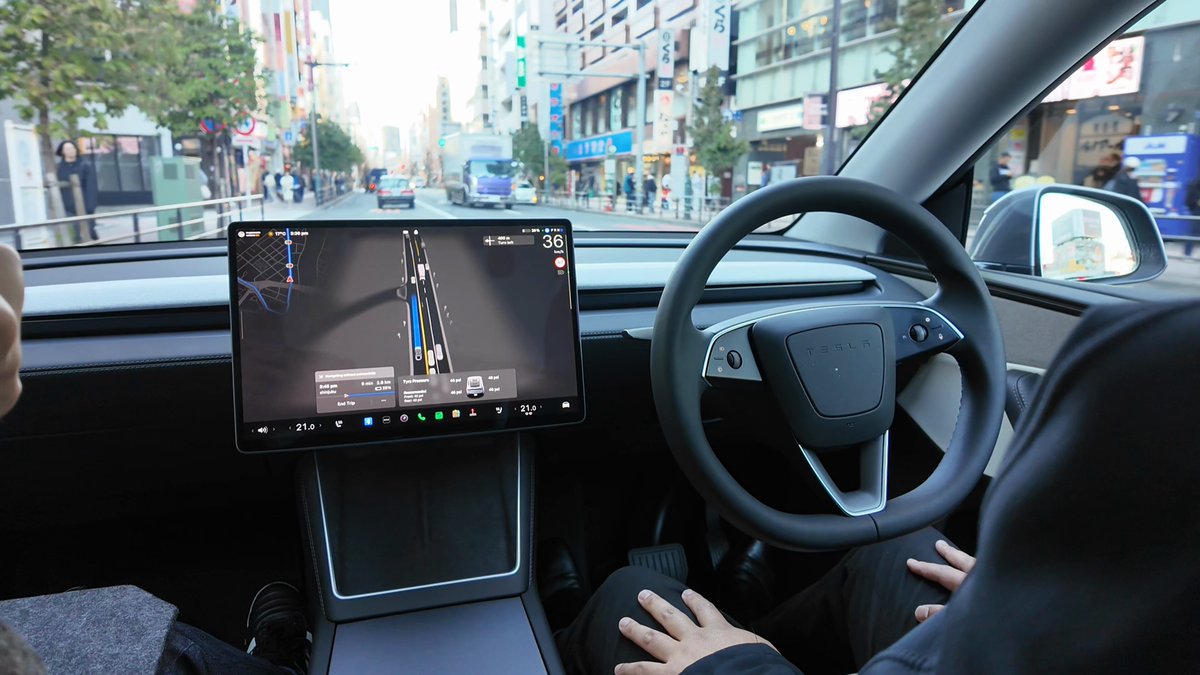
Tesla AI has officially shared a public demo video of FSD Supervised operating in Japan, posted directly to the @Tesla_AI account on March 6, 2026. This is the first time Tesla has publicly showcased the system navigating Japanese roads, marking a notable milestone beyond the internal testing reported since August 2025. The footage — shot in 4K — suggests the system is handling Japan's left-hand traffic, narrow urban streets, and unique road signage with meaningful capability. While no official launch date has been confirmed beyond the previously stated 2026 target, this public demo signals Tesla's confidence in the system's Japan-specific progress.
@Tesla_AI · March 6, 2026"FSD Supervised demo in Japan"

👍 458 · 🔁 72 · 👁 12,666 — Watch on X
📌 UPDATE — March 5, 2026
Tesla has officially kicked off FSD (Supervised) ride-alongs in Japan, marking a concrete step beyond internal testing toward a public rollout. According to Sawyer Merritt, the first ride-alongs began today and early impressions are positive — FSD reportedly "handles everything well" on Japanese roads. This milestone suggests Tesla's 2026 Japan launch timeline is on track, with the ride-along phase typically preceding broader customer access.
@SawyerMerritt · March 5, 2026NEWS: The first FSD (Supervised) ride-alongs in Japan have officially started.
FSD handles everything well.
30-Second Brief
The News: Tesla is officially targeting a 2026 launch for FSD (Supervised) on public roads in Japan, with testing active since August 2025 and a Model Y now added to the test fleet alongside the original Model 3.
Why It Matters: Japan represents one of the most complex regulatory markets for autonomous driving technology — a 2026 target signals Tesla is making real progress toward bringing FSD to one of its most demanding international markets.
Source: @TeslaNewswire on X
Tesla FSD (Supervised) Is Coming to Japan — 2026 Target Confirmed, Test Fleet Expanding
Tesla has officially set its sights on a 2026 launch for FSD (Supervised) in Japan, marking a significant milestone for the company's international expansion of its advanced driver-assistance technology. For the first time, the company has expanded its Japan test fleet to include a Model Y, joining the Model 3 that has been running public-road trials since August 2025.

📊 Key Figures
| Metric | Detail |
|---|---|
| Target Launch | 2026 (possibly as early as May 2026, pending regulatory approval) |
| Testing Start Date | August 2025 |
| Test Fleet (Original) | 1× Model 3 |
| Test Fleet (Current) | Model 3 + Model Y (newly added) |
| Regulatory Body | Ministry of Land, Infrastructure, Transport and Tourism (Japan) |
| Current Status | Active testing with safety drivers on public roads and highways |
From One Car to a Fleet: How Japan Testing Has Evolved
When Tesla quietly began FSD testing on Japanese public roads in August 2025, it started with a single Model 3. That low-profile approach made sense — Japan's road infrastructure is among the most demanding in the world, with narrow urban streets, complex intersection layouts, and unique traffic signage that differs significantly from North American or European norms.
The addition of a Model Y to the test fleet is a meaningful signal. It suggests Tesla's engineers are satisfied enough with the Model 3's performance data to begin validating FSD behavior across a second platform. Expanding the fleet also accelerates the data collection process, giving Tesla's neural networks more exposure to Japan's specific edge cases in parallel rather than sequentially.
According to background research, Tesla employees are conducting these trials with safety drivers actively monitoring system performance — consistent with how FSD (Supervised) operates globally, where the driver must remain attentive and ready to intervene at all times. This is not unsupervised autonomy; it's a sophisticated ADAS system being validated for a new regulatory environment. For more context on how FSD has evolved globally, see our FSD coverage.
The Regulatory Hurdle: Japan's Unique Approval Path
Japan's regulatory framework for autonomous driving technology is notably rigorous. The Ministry of Land, Infrastructure, Transport and Tourism has been making incremental progress — including allowing Tesla vehicles already sold in Japan to receive software updates that activate self-driving features — but full public approval for FSD (Supervised) has not yet been granted as of early 2026.
The May 2026 window cited in some reports should be understood as an optimistic scenario contingent on regulatory approval moving on schedule. Tesla has navigated similar approval processes in other markets, but Japan's standards are among the strictest globally, and timelines can shift based on the pace of government review.
🔭 The BASENOR Take
Timeline: Testing since August 2025 → Fleet expansion March 2026 → Target launch 2026 (May earliest)
Impact Level: 🟡 Medium-term — significant for Japanese Tesla owners, but not an immediate change
Confidence: 🟢 High on testing progress | 🟡 Medium on 2026 timeline (regulatory-dependent)
Analysis: The expansion from one Model 3 to a multi-vehicle fleet after roughly seven months of testing is a positive sign that Tesla's validation process is progressing. Japan is not a small market for Tesla — it's a prestige market where FSD availability would meaningfully differentiate the brand. The fact that Tesla is publicly confirming a 2026 target (rather than staying vague) suggests internal confidence in the timeline. That said, regulatory approval is the single biggest variable here. Japanese owners who already own a Tesla should watch for official announcements from Tesla Japan, as background research indicates that existing vehicles sold in Japan are expected to receive the FSD update upon release — not just new purchases.
📰 Deep Dive
Japan presents a genuinely different challenge for FSD compared to markets where Tesla has already launched the feature. The country drives on the left, features some of the densest urban road networks in the world, and has highly specific rules around pedestrian crossings, school zones, and narrow residential streets. For Tesla's AI training pipeline, this means Japan isn't just a new market — it's a new dataset. Every hour of supervised driving in Tokyo or Osaka feeds edge cases back into the system that simply don't exist in Fremont or Austin.
The choice to include the Model Y in testing now is strategically smart. The Model Y is Tesla's highest-volume vehicle globally, and in Japan it has become increasingly popular as Tesla has worked to adapt its lineup to local preferences. Validating FSD on the Model Y in parallel with the Model 3 means that when regulatory approval does come through, Tesla can launch across both platforms simultaneously rather than staggering the rollout.
For Japanese Tesla owners watching this closely, the key date to track isn't a specific software version — it's the regulatory calendar. Once Japan's Ministry of Land, Infrastructure, Transport and Tourism formally clears FSD (Supervised) for public use, the OTA update pathway is already established. The ministry's earlier decision to allow software retrofits via updates is a foundational piece of infrastructure that makes a relatively fast rollout possible once the green light arrives.
Looking at the broader picture, Japan joining the FSD (Supervised) market would mark a significant step in Tesla's global autonomy rollout. It signals that the company is not treating FSD as a North America-only feature, and that the regulatory groundwork being laid in Japan could serve as a template for other complex international markets where Tesla has yet to launch the feature.
Related Gear
Gear up your Tesla with tested, custom-fit BASENOR accessories — shop Tesla accessories →
Sources & reporting notes
The links below identify the material source records used for this report.
- @TeslaNewswire on X (2026-03-05T14:29:41.000Z) — Direct source
- @SawyerMerritt on X (2026-03-05T15:30:10.000Z) — Direct source
- @Tesla_AI on X (2026-03-06T01:26:55.000Z) — Direct source
Source links are preserved as published or accessed. See our editorial standards and corrections policy.
The BASENOR Editorial Desk covers Tesla, SpaceX, and related technology, curating reporting from primary sources — official accounts, regulatory filings, and software release data. Every article passes source-record and fact-checking review before publication. About the newsroom.
This report was curated by the BASENOR Editorial Desk from the sources listed above. Read our editorial standards or email editorial@basenor.com to report an error.