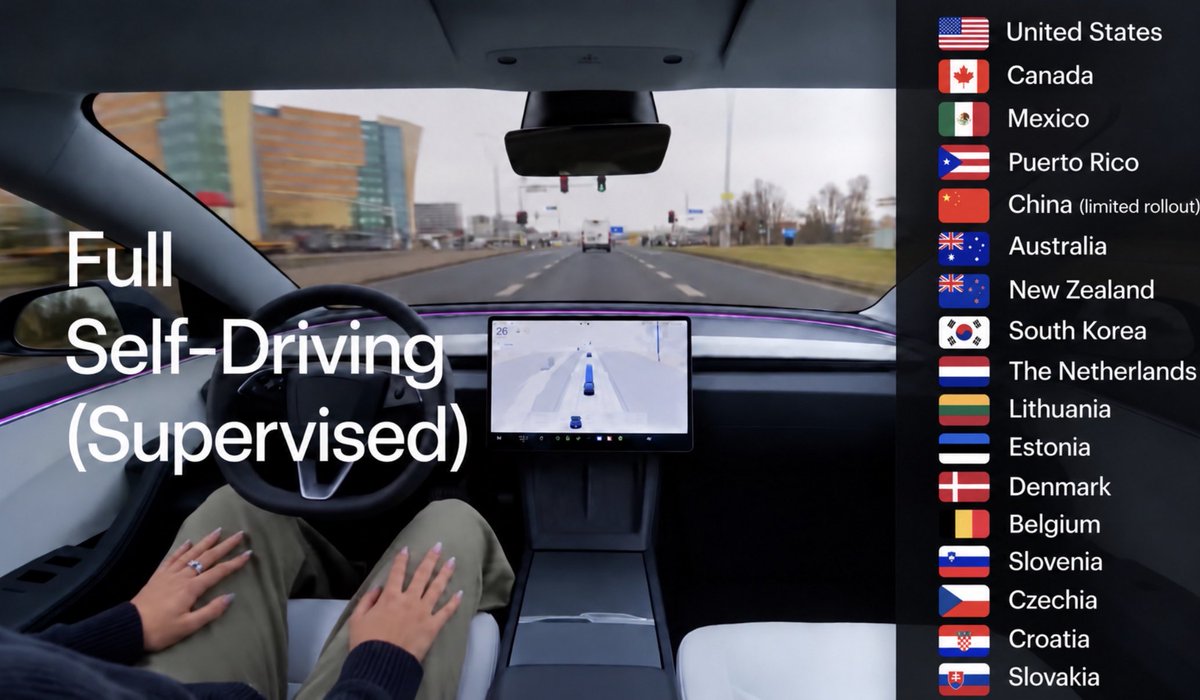
Tesla's Full Self-Driving (Supervised) footprint has quietly become a global one. As of October 16, 2026, the system is live in 17 countries across four continents — a milestone driven largely by a steady drumbeat of European Union approvals and the long-awaited (if limited) China rollout earlier this year. For a product that spent most of its life confined to North America, the geographic spread is the biggest structural change FSD has seen since the V12 end-to-end neural net transition.
The count was pushed to 17 on the same day Slovakia became the ninth EU country to approve the system, according to coverage from Tesla North and Drive Tesla Canada. Tesla's own marketing still rounds down — the official website continues to say "about 15 countries" — but the regulatory map has moved faster than the copywriting.

Where FSD (Supervised) Is Live Today
The 17-country list spans three distinct regulatory environments — North America's self-certification regime, the EU's type-approval process routed through the Netherlands, and bespoke national frameworks in Asia-Pacific.
| Region | Countries | Notes |
|---|---|---|
| North America | United States, Canada, Mexico, Puerto Rico | Running the V14 build |
| European Union | Netherlands, Lithuania, Estonia, Denmark, Belgium, Slovenia, Czech Republic, Croatia, Slovakia | Branded "Tesla Assisted Driving" on EU sites |
| Asia-Pacific / Oceania | China (limited), South Korea, Australia, New Zealand | China runs a localized build |
The European Chain Reaction
The EU expansion traces back to a single pivotal event: on April 10, 2026, the Netherlands granted provisional EU type approval for FSD (Supervised), according to Drive Tesla Canada and fsdtracker.eu. Because EU type-approval decisions can be referenced by other member states, that Dutch green light became the lever Tesla has used to unlock country after country.
Slovakia's October 16 approval, reported by Tesla North, makes it the ninth EU market to sign off. Interestingly, Tesla has quietly rebranded the system in Europe — the EU-facing websites now call it "Tesla Assisted Driving" rather than "Full Self-Driving (Supervised)," per Tesla North's reporting. The software itself is unchanged; the renaming appears to be a regulatory-friendly posture ahead of the broader EU-wide approval vote, which fsdtracker.eu and Drive Tesla Canada report is not expected before December 2026.
For owners in approved EU countries, the practical takeaway is that activation still happens on a per-market basis today. Pan-European functionality — the ability to drive from Lisbon to Tallinn under FSD supervision without worrying about which borders you cross — remains gated behind that pending EU-wide vote.
China: Available, But Not Unleashed
China's inclusion on the list comes with the biggest asterisk. Tesla officially confirmed FSD (Supervised) availability in China on May 21, 2026, but according to notanfsdtracker.com and other outlets tracking the rollout, the system is running a limited, localized build distinct from the V14 release deployed in North America.
The commercial model is also different. In China, FSD is a one-time purchase priced at 64,000 CNY — roughly $9,420 USD — rather than the subscription-first approach Tesla uses elsewhere. And despite being purchasable, full nationwide deployment across every eligible vehicle is still pending final regulatory clearance, according to coverage from globalchinaev.com.
Tesla has publicly denied rumors that it is scaling back its China FSD ambitions, and the company has confirmed its Shanghai data center remains operational with development work ongoing. For Chinese owners, that means the feature exists, the money changes hands, but the day-to-day experience is still narrower than what a California driver gets on V14.
Why This Matters for Owners
The 17-country figure is more than a vanity metric — it has concrete implications for the Tesla ownership experience in three ways.
Resale and feature portability. As FSD approvals widen, cross-border Tesla ownership becomes more viable. A Model Y purchased in Belgium with FSD can increasingly be driven (or sold) into neighboring approved markets without the feature going dark at the border.
Software parity pressure. With North American vehicles running V14 while Europe and China run older or localized builds, the gap between "the FSD you see on YouTube" and "the FSD you can actually use in your country" is still substantial. Tesla has not committed to a timeline for bringing all markets onto a single global build.
Pricing structure. The China one-time-purchase model stands out against the subscription-dominant approach elsewhere. If Tesla's EU-wide approval lands and triggers a continental price reset, owners who bought FSD outright in earlier markets may find themselves evaluating a very different value proposition than new buyers.
What to Watch Next
- EU-wide approval vote — not expected before December 2026, per multiple European tracking sources. This is the single biggest unlock remaining on the map.
- Remaining large EU markets — Germany, France, Spain, and Italy are notably absent from the 17-country list. Individual national approvals for any of these would significantly reshape FSD's European footprint before the pan-EU vote lands.
- China V14 parity — whether Tesla's Shanghai data center work produces a build closer to the North American version, and when the pending regulatory clearance for broader deployment is granted.
- The next additions — the United Kingdom, Japan, and the UAE have all been floated in prior Tesla communications as near-term candidates. None are on the current list.
Four continents, 17 countries, and a product that still carries a "(Supervised)" parenthetical. The map is expanding faster than the capability tier is — and for now, that's the honest shape of global FSD in late 2026.
Related Gear
Gear up your Tesla with tested, custom-fit BASENOR accessories — shop Tesla accessories →
Sources & reporting notes
The links below identify the material source records used for this report.
- @TeslaNewswire on X (2026-10-16T17:10:03.000Z) — Direct source
Source links are preserved as published or accessed. See our editorial standards and corrections policy.
The BASENOR Editorial Desk covers Tesla, SpaceX, and related technology, curating reporting from primary sources — official accounts, regulatory filings, and software release data. Every article passes source-record and fact-checking review before publication. About the newsroom.
This report was curated by the BASENOR Editorial Desk from the sources listed above. Read our editorial standards or email editorial@basenor.com to report an error.