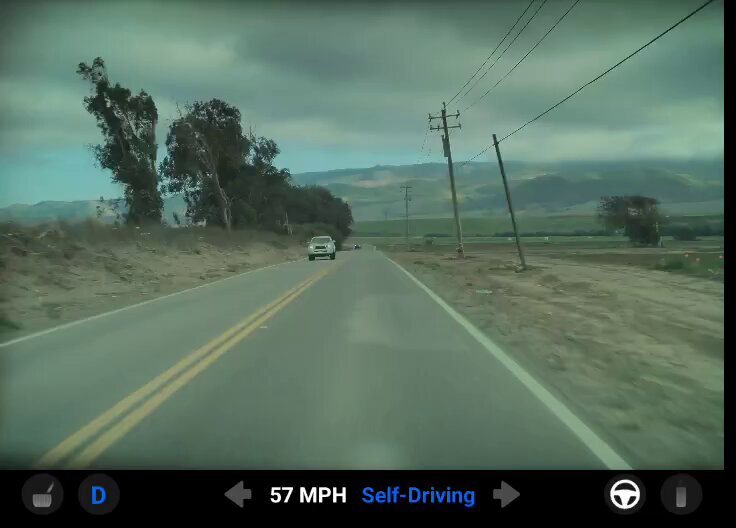
A video circulating on X shows Tesla's FSD (Supervised) system executing a sharp collision-avoidance maneuver on a curved road, steering clear of a pickup truck crossing into the vehicle's lane. The footage — shot from multiple camera angles with live self-driving data overlays — offers a rare, detailed look at how FSD V14 responds in the fraction of a second before a potential head-on impact. Tesla's official account responded with a single line: "Like having a fighter pilot behind the wheel."

What FSD V14 Actually Did
The incident occurred on August 16, 2026, and was first shared by Tesla commentator Sawyer Merritt. According to the footage, the vehicle was navigating a curve on a highway when an oncoming pickup truck drifted into its path. FSD (Supervised) detected the threat and steered away autonomously — the kind of split-second response that's difficult even for an alert human driver on a blind curve.
Tesla AI engineer Yun-Ta Tsai also shared the video, lending weight to its authenticity. The multi-angle footage with sensor overlay data makes this one of the more transparent real-world FSD safety demonstrations to date.
This isn't an isolated showcase. On August 14, Tesla's European account released a compilation of FSD Supervised avoiding accidents across 19 European countries — including head-on collisions with trucks and pedestrian near-misses. According to that release, the system has accumulated over 2.2 million kilometers of training tests across Europe.
The specific capability on display here is tied to a documented change in V14: Tesla officially listed "Improved Collision Avoidance" in the V14 release notes, describing enhanced reward predictions that better prevent potential collisions. This video appears to be a direct, real-world demonstration of that improvement working as intended.
Is Your Tesla Running FSD V14?
Whether you have access to this version depends on your hardware generation. Here's where the rollout stands right now:
- Hardware 4 (HW4) vehicles: FSD v14.3.7 is currently rolling out. If you haven't received it yet, you may be in a later wave.
- Hardware 3 (HW3) vehicles: FSD v14.1 Lite (firmware 2026.21.6) began a limited early access wave around August 8–9, 2026. Broader rollout is ongoing.
Not sure which hardware you have? Check your car's touchscreen under Controls → Software → Additional Vehicle Information. The Autopilot computer line will show either "Full Self-Driving Computer" (HW3) or "Full Self-Driving Computer (HW4)".
Action Plan: Make Sure You're Ready
If you want to ensure your Tesla has the best available collision avoidance capability, work through these steps:
- Check your current software version. Go to Controls → Software. If you're on HW4 and not yet on v14.3.7, or on HW3 and not yet on v14.1 Lite, your update may still be queued.
- Enable Advanced Download. In Controls → Software, turn on Advanced under Software Updates. This allows Tesla to pre-download updates over Wi-Fi so they're ready to install faster.
- Connect to Wi-Fi when parked at home. OTA updates download significantly faster over a home network than over LTE. Large FSD updates especially benefit from a stable connection.
- Don't delay installation. Once the update is available, install it promptly. Safety-related improvements like collision avoidance are exactly the kind of change worth prioritizing over convenience.
- Verify FSD is active on your account. Go to Controls → Autopilot and confirm Full Self-Driving (Supervised) is listed and enabled. If you purchased FSD or have an active subscription, it should appear here.
- Review your FSD settings after updating. Occasionally, updates reset certain driver assistance preferences. After installing, check Controls → Autopilot to confirm your preferred settings — particularly Autopilot activation style and lane change confirmations — are still set the way you want them.
The collision avoidance improvement in V14 is active whenever FSD (Supervised) is engaged, but it also informs the underlying Autopilot stack. Keeping your software current is the single most direct thing an owner can do to benefit from Tesla's ongoing safety improvements — and this video is a concrete reminder of why that matters.
Related Gear
Gear up your Tesla with tested, custom-fit BASENOR accessories — shop Tesla accessories →
Sources & reporting notes
The links below identify the material source records used for this report.
- @TeslaNewswire on X (2026-08-17T06:18:31.000Z) — Direct source
Source links are preserved as published or accessed. See our editorial standards and corrections policy.
The BASENOR Editorial Desk covers Tesla, SpaceX, and related technology, curating reporting from primary sources — official accounts, regulatory filings, and software release data. Every article passes source-record and fact-checking review before publication. About the newsroom.
This report was curated by the BASENOR Editorial Desk from the sources listed above. Read our editorial standards or email editorial@basenor.com to report an error.