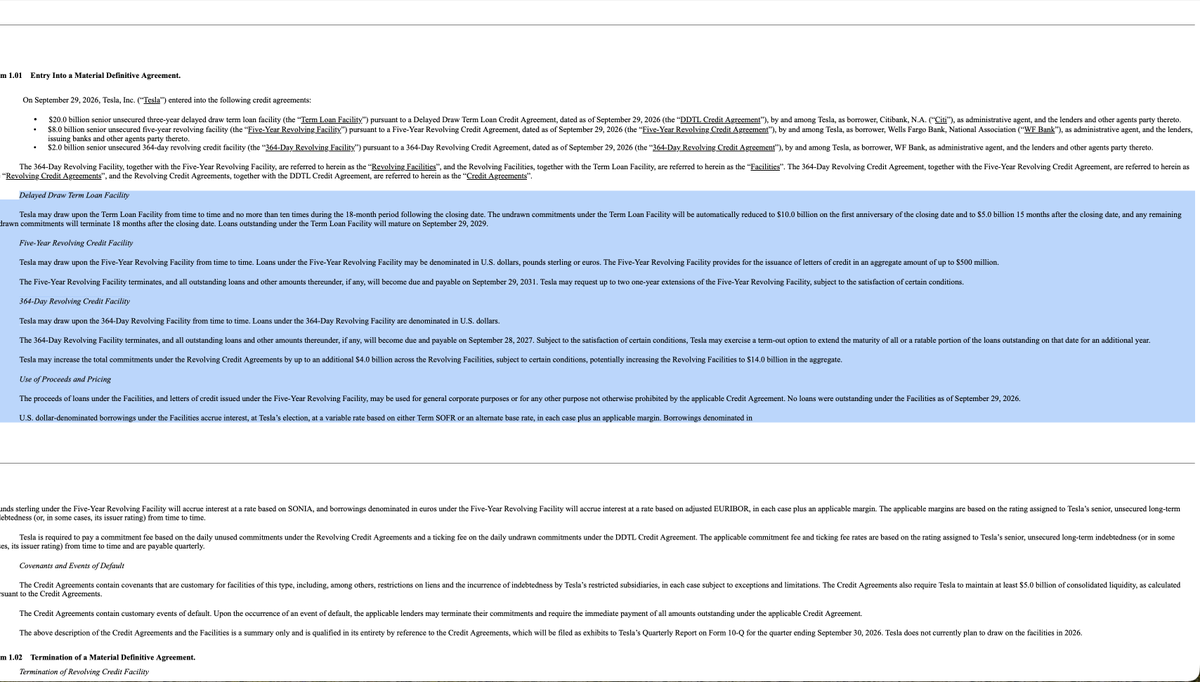
Tesla has secured a new $30 billion financing package, according to an SEC filing dated September 29, 2026. The multi-tranche deal dramatically expands the automaker's available borrowing capacity and replaces a smaller $5 billion revolving credit line that had been in place since January 2023. As of the filing date, Tesla has not drawn any funds from the new facilities and says it does not plan to in 2026 — this is dry powder, not immediate spending.

The Three Tranches
The package is structured across three separate facilities, each with a different purpose and maturity profile. Together, they give Tesla flexibility to fund large capital projects, cover working capital, and manage short-term liquidity without tapping public debt markets.
| Facility | Size | Term | Administrative Agent |
|---|---|---|---|
| Delayed-draw term loan | $20B | 3 years (matures Sep 29, 2029) | Citibank, N.A. |
| Revolving credit facility | $8B | 5 years (matures Sep 29, 2031) | Wells Fargo Bank |
| 364-day revolver | $2B | 364 days (matures Sep 28, 2027) | Wells Fargo Bank |
According to the SEC filing details reported by StockTitan and StreetInsider, the $20 billion delayed-draw term loan is the most unusual piece of the structure. Tesla can pull from it up to ten times during an 18-month window after closing, letting the company stagger drawdowns to match project timing rather than taking the full amount at once. The five-year revolver includes an option for two one-year extensions, and the 364-day facility carries a potential one-year term-out extension.
Tesla also has the option to increase revolving commitments by up to an additional $4 billion across the two revolvers, which would push total revolving capacity to $14 billion and the overall package to $34 billion.
What Replaced What
Concurrent with the new agreements, Tesla terminated its prior $5 billion revolving credit facility originally dated January 20, 2023. Per the filing, there were no outstanding borrowings on that facility and no early termination penalties. Practically, this is a 6x expansion of Tesla's committed bank credit capacity in a single move — from $5 billion to $30 billion, with headroom for another $4 billion on top.
The agreements do carry one notable covenant: Tesla must maintain at least $5 billion in consolidated liquidity. Given Tesla ended recent quarters with cash and investments well above that threshold, the covenant is not restrictive at current levels — but it does formalize a floor.
Why Now
Tesla has historically funded growth from operating cash flow and equity raises, not bank debt. The company's use of revolving credit has been minimal for years. Securing $30 billion in committed capacity — without drawing on it — signals preparation for a capital-intensive phase rather than an immediate cash need.
Several near-term programs plausibly justify the buffer: Cybercab production ramp, expanded Optimus manufacturing at Fremont (where Model S and Model X production ended earlier this year to convert the line), continued Megapack factory buildouts, and ongoing AI compute infrastructure spending. Locking in credit lines now, before drawing them, also lets Tesla secure terms at current rates and bank relationships before any potential shift in credit markets.
What It Means for Tesla Owners and Shareholders
For owners, this doesn't change anything about your vehicle, software updates, or Supercharger access — it's a treasury move, not a product announcement. But it does have indirect implications worth tracking.
A larger liquidity backstop reduces the pressure on Tesla to fund capex through equity issuance, which would dilute existing shareholders. It also gives the company more room to sustain aggressive spending on Cybercab, Optimus, and AI infrastructure even if quarterly automotive margins compress. For anyone watching Tesla's ability to fund its stated roadmap — robotaxi rollout, humanoid robot production, energy storage expansion — this filing meaningfully lowers execution risk on the financing side.
What to Watch Next
Three signals matter from here:
- First drawdown timing. Tesla says no draws are planned in 2026. The first actual use of the term loan will be a real-time indicator of when capital deployment ramps.
- Q3 2026 earnings commentary. Expect management to be asked directly about intended uses of the facility on the next earnings call.
- Any exercise of the $4B upsize option. If Tesla moves to expand revolver capacity toward the $14 billion cap, that would suggest larger-than-currently-guided spending on the horizon.
For now, the takeaway is straightforward: Tesla just built itself a much bigger runway, and it did so before actually needing to run.
🚕 Following the Robotaxi rollout? See every operating city, launch date and announced market in our Tesla Robotaxi Tracker.
Related Gear
Gear up your Tesla with tested, custom-fit BASENOR accessories — shop Tesla accessories →
Sources & reporting notes
The links below identify the material source records used for this report.
- @SawyerMerritt on X (2026-09-29T20:48:46.000Z) — Direct source
- @SawyerMerritt on X (2026-09-29T20:48:47.000Z) — Direct source
Source links are preserved as published or accessed. See our editorial standards and corrections policy.
The BASENOR Editorial Desk covers Tesla, SpaceX, and related technology, curating reporting from primary sources — official accounts, regulatory filings, and software release data. Every article passes source-record and fact-checking review before publication. About the newsroom.
This report was curated by the BASENOR Editorial Desk from the sources listed above. Read our editorial standards or email editorial@basenor.com to report an error.