30-Second Brief
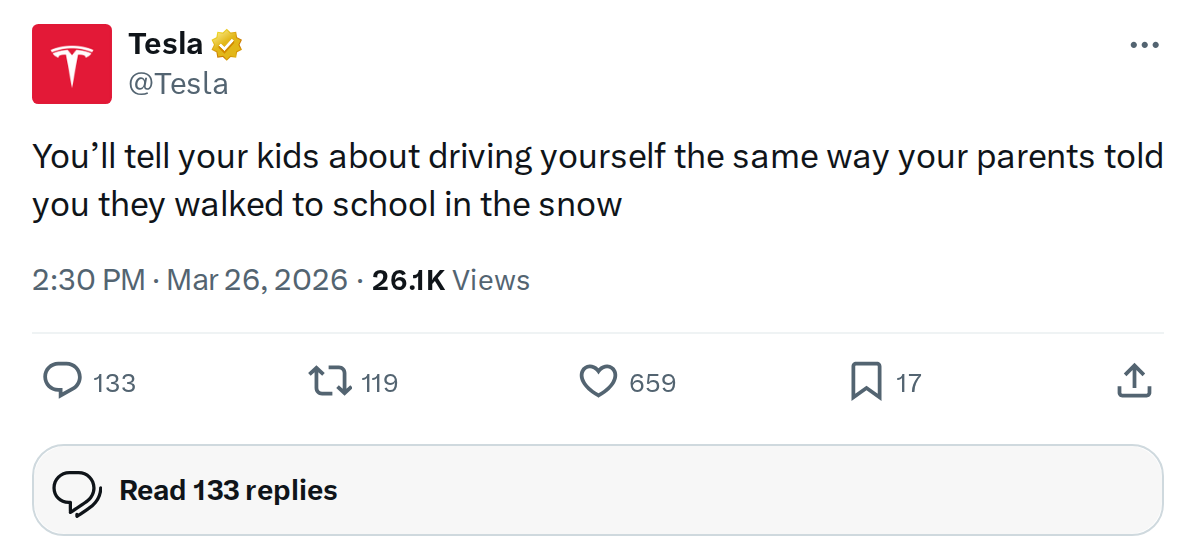
The News: Tesla's official account posted a pointed statement positioning manual driving as a soon-to-be historical curiosity — the kind of thing you'll explain to your grandchildren.
Why It Matters: This isn't just brand messaging. It's a signal of where Tesla's entire product roadmap — FSD v14.3, Cybercab, Robotaxi expansion — is converging in 2026.
Source: @Tesla on X
Tesla Says Manual Driving Will Be a Story You Tell Your Kids — Here's How Close That Future Actually Is
Tesla doesn't do subtle. This morning, the company's official account dropped a line that cuts straight to the core of its entire mission: "You'll tell your kids about driving yourself the same way your parents told you they walked to school in the snow."

It's a throwaway line on the surface. But coming from Tesla's official account — not Elon's personal feed — it carries weight. This is the company publicly committing, again, to a world where human-operated vehicles are the exception, not the rule. The question worth asking: how far away is that world, really?
Closer than most people realize. And 2026 is shaping up to be the year the gap between vision and reality narrows dramatically. Here's where things actually stand, for our FSD coverage.
📊 Key Figures
| Metric | Value | Context |
|---|---|---|
| FSD Supervised cumulative miles | 8.2B+ | As of Feb 19, 2026 |
| Daily FSD miles (Q1 2026 avg) | 20M+ | All-time high |
| FSD collision rate (Supervised) | 1 per 5.3M miles | vs. US avg 1 per 660K miles |
| Robotaxi cities targeted (H1 2026) | 8 cities | Austin live + 7 planned |
| Cybercab production start | April 2026 | Gigafactory Texas |
| Autonomous Teslas projected (late 2026) | Millions | Per Elon Musk |
The Software Stack Is Almost Ready
Tesla's current production FSD version for Hardware 4 vehicles is v14.2.2.5, rolling out since mid-March 2026. But the version everyone is watching is FSD v14.3 — currently in testing and expected to reach the broader fleet within weeks. Musk has described it as a "landmark release" that will deliver a "qualitative leap in driving behavior." His words: the car will "feel almost like it is a sentient being."
That's not marketing copy. Tesla's FSD safety data backs up the trajectory. Vehicles with FSD Supervised engaged record approximately one major collision every 5.3 million miles — compared to the U.S. national average of one every 660,000 miles. That's an 8x safety advantage, and it's improving with every release.
For owners on Hardware 3, FSD v14 Lite — bringing the core improvements of the v14 generation to older vehicles — is anticipated for late June 2026. No one gets left behind, just slightly delayed.
Robotaxi: From Pilot to Network
Tesla's Robotaxi service launched in Austin, Texas, in June 2025 with a modest fleet of 10–20 Model Ys and human safety monitors. By January 2026, unsupervised vehicles began operating — though as of mid-March 2026, that unsupervised component remains limited to a single vehicle in a restricted part of the Austin service area.
The expansion plan is aggressive: Dallas, Houston, Phoenix, Miami, Orlando, Tampa, and Las Vegas are all targeted for the first half of 2026. Testing has already been spotted in Phoenix. This isn't a science project anymore — it's a scaling operation.
Cybercab: The Vehicle Built for a Driverless World
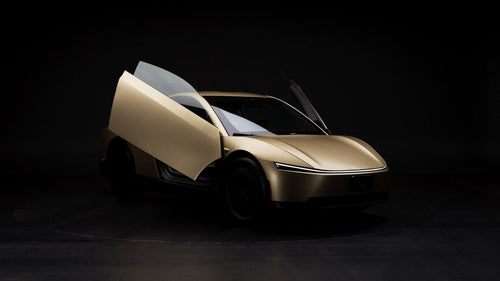
The Cybercab is Tesla's clearest architectural statement about the future. A two-seater with no steering wheel, no pedals, and no accommodation for a human driver — it's a vehicle that cannot be driven manually by design. Production is expected to begin in April 2026 at Gigafactory Texas, optimized specifically for the lowest cost per mile in autonomous mode.
When Tesla says your kids won't know what it's like to drive, the Cybercab is the physical embodiment of that bet.
🔭 The BASENOR Take
Tesla's tweet is casual in tone but deliberate in timing. With FSD v14.3 weeks away, Cybercab production imminent, and Robotaxi expansion accelerating, the company is building a narrative arc — and they want owners and observers to feel its momentum.
The "walking to school in the snow" framing is effective because it's generational, not technical. It doesn't ask you to understand neural networks or sensor fusion. It asks you to imagine explaining to a child why you used to sit behind a wheel and steer. That's a story Tesla is actively writing the ending to — and 2026 may be the year the first chapter closes.
The caveats are real: unsupervised Robotaxi is still operating at extremely limited scale, regulatory approvals vary by city, and Musk's timelines have historically run optimistic. But the underlying data — 8.2 billion FSD miles, an 8x safety advantage over the national average, daily mileage at all-time highs — tells a story that the tweet's bravado is at least partially earned.
For current Tesla owners, the practical takeaway is this: every FSD update you install, every mile you drive with it engaged, is feeding the training data that makes this future arrive faster. You're not just a customer. You're part of the dataset that makes the story Tesla is telling actually come true.
📋 Tracking Tesla software? See every firmware, FSD and app version in one place in our Tesla Software Update Tracker.
🚕 Following the Robotaxi rollout? See every operating city, launch date and announced market in our Tesla Robotaxi Tracker.
Related Gear
Gear up your Tesla with tested, custom-fit BASENOR accessories — shop Tesla accessories →
Sources & reporting notes
The links below identify the material source records used for this report.
- @Tesla on X (2026-03-26T06:30:51.000Z) — Direct source
Source links are preserved as published or accessed. See our editorial standards and corrections policy.
The BASENOR Editorial Desk covers Tesla, SpaceX, and related technology, curating reporting from primary sources — official accounts, regulatory filings, and software release data. Every article passes source-record and fact-checking review before publication. About the newsroom.
This report was curated by the BASENOR Editorial Desk from the sources listed above. Read our editorial standards or email editorial@basenor.com to report an error.