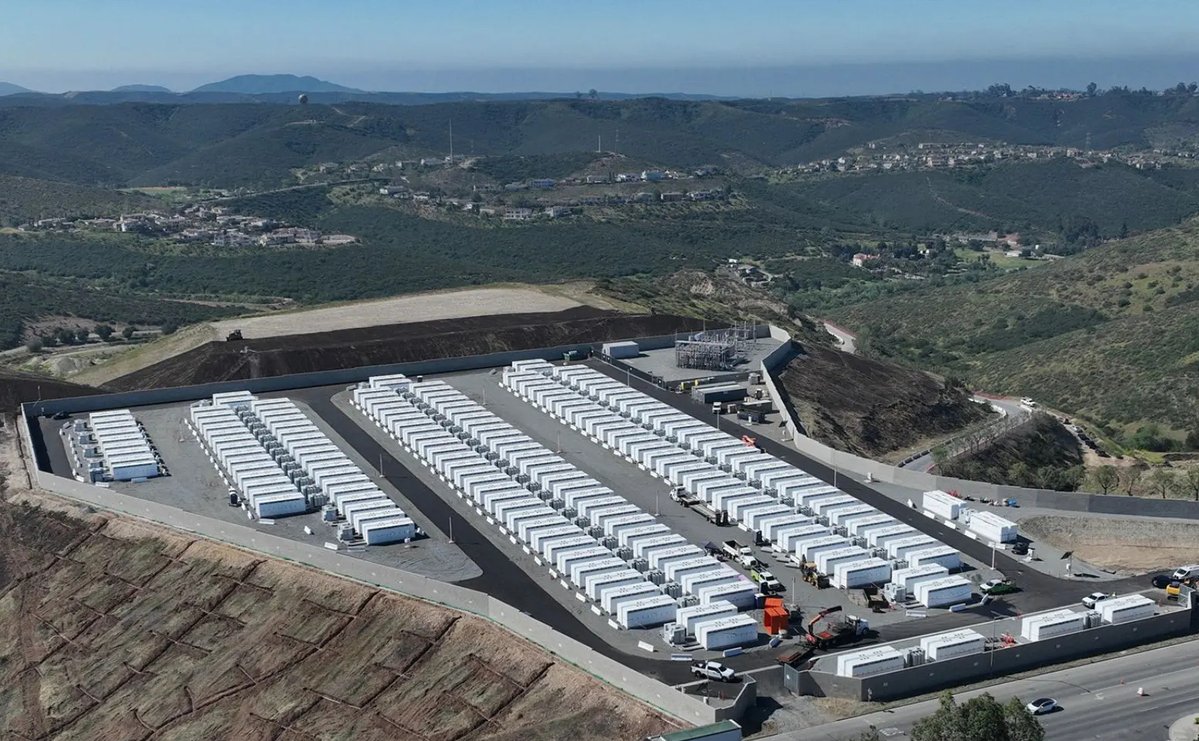
A $290 million Tesla Megapack installation has officially gone live in Poway, California, marking one of the most significant grid-scale battery deployments in the state's history. Developed and operated by Arevon Energy, the Nighthawk Energy Storage Project began commercial operation on August 12, 2026 — and the scale of it is worth pausing on.

What the Nighthawk Project Actually Is
The facility comprises 329 individual Tesla Megapack units, each based on lithium iron phosphate (LFP) chemistry — a technology chosen specifically for its safety profile and long operating lifespan. Together they deliver 300 MW of power output and 1,200 MWh of total storage capacity. To put that in practical terms: the system can discharge enough electricity to power up to 385,000 homes for four consecutive hours during peak demand.
That four-hour window is the key metric for grid operators. California's most acute reliability stress — the late-afternoon demand surge as solar generation fades and air conditioning loads peak — typically lasts three to five hours. A 1,200 MWh asset positioned in the San Diego region is sized precisely to bridge that gap.
Arevon holds a long-term energy and resource adequacy agreement with Pacific Gas and Electric Company (PG&E) to deliver power from the project, according to project filings. The arrangement gives the facility a guaranteed revenue stream while providing the utility a dispatchable clean resource it can call on when the grid tightens.
The Numbers Behind the Project
| Metric | Figure |
|---|---|
| Power capacity | 300 MW |
| Energy storage | 1,200 MWh |
| Tesla Megapack units | 329 |
| Homes powered (4 hrs) | 385,000 |
| Project cost | $290 million |
| Total financing closed | $920 million |
| Debt facility | $482 million |
| Preferred equity investment | $169 million |
| Tax credit transfer agreement | $268 million |
| Projected lifetime property tax revenue | $30 million+ |
| Peak construction jobs | 130+ local workers |
Sources: Arevon Energy, igrownews.com, energy-storage.news
Why the Financing Structure Matters
The $920 million total financing package is notably larger than the $290 million project cost — and that gap is intentional. The $268 million tax credit transfer agreement reflects the Inflation Reduction Act's investment tax credit provisions for standalone storage, which allow developers to monetize federal tax credits by selling them to third-party investors. That mechanism has become a primary driver of utility-scale battery deployment across the US, and Nighthawk is a textbook example of how it works at scale.
For Tesla Energy, a deal of this size represents 329 Megapack units moving through its Lathrop, California manufacturing facility — a meaningful volume order that speaks to the continued ramp of that production line.
Context: California's Storage Push
California has been the most aggressive US market for grid-scale battery storage, driven by a combination of renewable integration mandates, wildfire-related reliability concerns, and CPUC procurement orders requiring utilities to contract for dispatchable resources. The San Diego region specifically has faced transmission constraints that make local storage assets more valuable than imports from elsewhere on the grid.
Nighthawk joins a growing list of large-scale Megapack installations in the state, but its 1,200 MWh capacity puts it among the larger single-site deployments completed to date. The ribbon-cutting ceremony held this week with Arevon and state officials signals that this project carries political visibility — not just commercial significance.
The long-term PG&E agreement also deserves attention. PG&E has been under sustained pressure to demonstrate grid reliability after years of wildfire-related outages and infrastructure criticism. Contracting for resource adequacy from a new 300 MW storage asset in Southern California is part of a broader strategy to diversify its dispatchable portfolio beyond gas peakers — assets that are increasingly difficult to permit and finance.
For the Megapack business, Nighthawk is another data point in a consistent trend: the largest energy storage projects being built in the US are increasingly built around Tesla hardware. Whether that lead holds as competitors scale their own LFP manufacturing will be one of the more consequential industrial storylines of the next few years.
Related Gear
Gear up your Tesla with tested, custom-fit BASENOR accessories — shop Tesla accessories →
Sources & reporting notes
The links below identify the material source records used for this report.
- @SawyerMerritt on X (2026-08-16T22:55:16.000Z) — Direct source
Source links are preserved as published or accessed. See our editorial standards and corrections policy.
The BASENOR Editorial Desk covers Tesla, SpaceX, and related technology, curating reporting from primary sources — official accounts, regulatory filings, and software release data. Every article passes source-record and fact-checking review before publication. About the newsroom.
This report was curated by the BASENOR Editorial Desk from the sources listed above. Read our editorial standards or email editorial@basenor.com to report an error.