📌 UPDATE — July 22, 2026
During Tesla's Q2 2026 earnings call, Elon Musk was directly asked about the possibility of combining Tesla and SpaceX — and notably deferred to a lawyer rather than answering himself. While this is not a confirmation that a merger or integration is being planned, it signals the topic is being treated with enough legal seriousness that Musk declined to speak off the cuff. It's the closest thing to an on-record acknowledgment that the question is no longer purely hypothetical. As always, any such combination would ultimately require Tesla shareholder approval — the key point outlined in the original article below.

Speculation about a potential Tesla-SpaceX merger has been circulating for months, and commentary is now sharpening around a question that often gets buried in the noise: who actually decides? Prominent Tesla commentator @wholemars pushed back on a line of questioning Tuesday, arguing that the framing itself misses the point — shareholders, not management, hold the ultimate vote, and they'll weigh the deal on its full merits. Here's what that means in practice.

1. There Is No Merger Proposal on the Table
As of July 15, 2026, no official merger proposal between Tesla and any other company has been filed or formally announced. What exists is analyst speculation and public commentary — not a term sheet. Any article treating a potential deal as imminent is getting ahead of the facts. The conversation matters, but the starting point has to be accurate: this is still hypothetical.
2. Shareholders Are the Decision-Makers — Not Management
This is the core point @wholemars made, and it's worth stating plainly. Under corporate governance rules, a merger of this scale would require a formal shareholder vote. Tesla's board can negotiate and recommend, but the owners of the company — its shareholders — cast the binding votes. Management influence is real, but it does not override that process. The framing that Elon Musk or Tesla's executive team could simply approve a merger misunderstands how M&A governance works.
3. Musk's Voting Power Is Significant — But Not Controlling
After exercising his 2018 compensation award on June 16, 2026, Elon Musk increased his direct Tesla voting stake to approximately 20%, according to public filings. That's meaningful influence in any shareholder vote, but it falls well short of a controlling majority. A contested merger vote would require Musk to bring a large portion of the remaining institutional and retail shareholder base along with him — which is far from guaranteed, particularly if the deal terms are perceived as unfavorable to Tesla's standalone value.
4. SpaceX's IPO Changed the Merger Math
SpaceX completed its IPO on June 11, 2026, valuing the company at $1.77 trillion at $135 per share and raising approximately $85 billion, according to public market data. That valuation is notably higher than Tesla's market capitalization of approximately $1.4 trillion as of early July. The existence of publicly traded SpaceX shares makes a stock-for-stock merger structurally possible in a way it wasn't before — but it also raises the exchange-ratio question that shareholders would scrutinize most closely. Paying a premium for SpaceX in Tesla stock would be dilutive; the math has to work.
5. Shareholders Will Evaluate the Deal Holistically — Not on Arbitrary Benchmarks
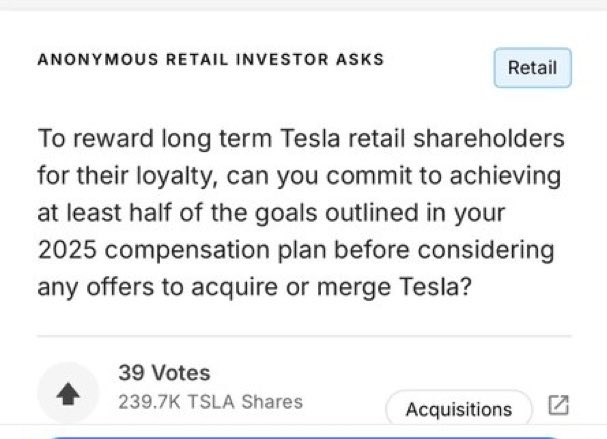
The specific pushback in @wholemars's post targets the idea that shareholders might judge a merger based on whether Tesla met some partial threshold — like "half the goals in the comp plan." That's not how institutional investors evaluate transformative transactions. They'll model combined revenue, synergy potential, debt load (SpaceX reported a net loss of $4.28 billion and $60.5 billion in total liabilities for Q1 2026), and long-term return on equity. Tesla entered Q1 2026 with $44.74 billion in cash and equivalents and $84.1 billion in stockholders' equity — a strong balance sheet that shareholders will want any deal to protect, not erode.
Tesla's Q2 2026 earnings report, expected July 22, will be the next major data point investors use to calibrate Tesla's standalone value — and by extension, any deal's attractiveness. Until a formal proposal exists, the shareholder vote remains a theoretical exercise. But the governance reality is clear: if a merger ever does reach a ballot, it will be Tesla's owners — not its executives — who write the final answer.
Related Gear
Gear up your Tesla with tested, custom-fit BASENOR accessories — shop Tesla accessories →
Sources & reporting notes
The links below identify the material source records used for this report.
- @wholemars on X (2026-07-15T20:50:32.000Z) — Direct source
Source links are preserved as published or accessed. See our editorial standards and corrections policy.
The BASENOR Editorial Desk covers Tesla, SpaceX, and related technology, curating reporting from primary sources — official accounts, regulatory filings, and software release data. Every article passes source-record and fact-checking review before publication. About the newsroom.
This report was curated by the BASENOR Editorial Desk from the sources listed above. Read our editorial standards or email editorial@basenor.com to report an error.