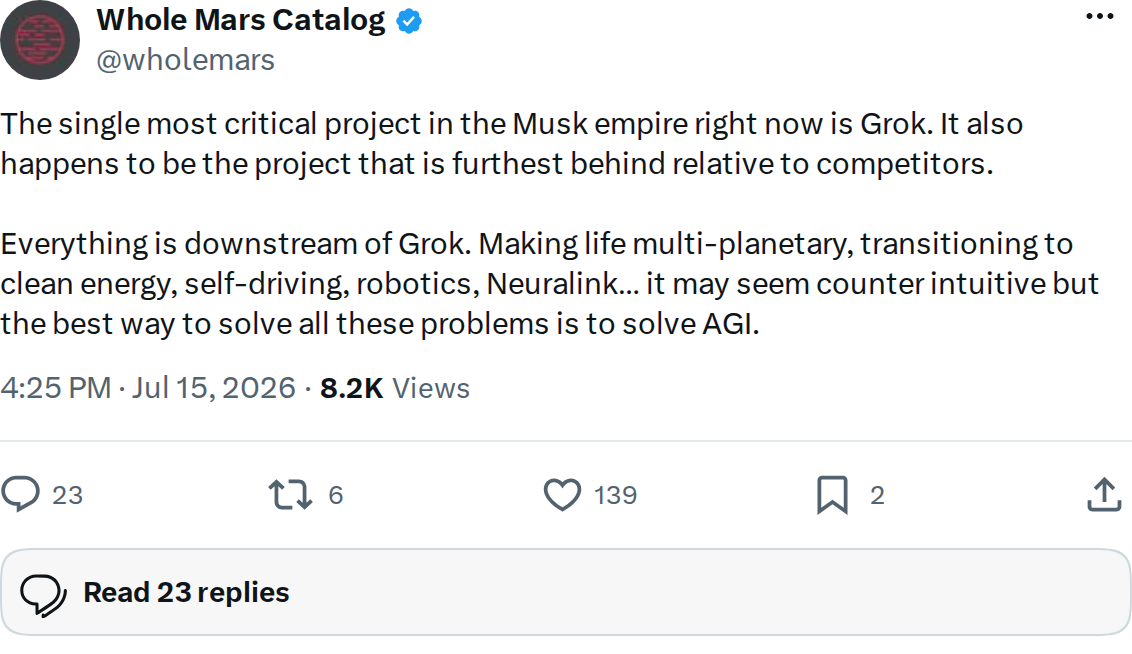
Whole Mars Catalog, one of the more analytically sharp voices in the Tesla community, posted a blunt assessment on July 15: Grok is the most important project across all of Musk's ventures — and right now, it's also the one lagging furthest behind its competitors. That framing deserves unpacking, because if the argument holds, it has direct implications for everything Tesla owners care about: self-driving, Optimus, and the software experience inside their cars.

What exactly is Whole Mars Catalog arguing here?
The claim is that Grok — xAI's large language model — is foundational infrastructure for every major goal in the Musk portfolio. The post lists multi-planetary life, the clean energy transition, self-driving, and robotics as downstream beneficiaries. The logic: advanced AI reasoning is the common thread that makes each of those things possible at scale. Without a world-class AI model, the rest of the roadmap stalls or depends on competitors' technology.
How is Grok actually connected to Tesla specifically?
More directly than most people realize. Grok was integrated into eligible Tesla vehicles — Model 3, Y, S, X, and Cybertruck — via OTA update 2025.26 in July 2025 in North America, and the European rollout followed in February 2026 with update 2026.2.6. Inside the car, it functions as a conversational AI assistant. But the deeper connection is FSD and Optimus: both require large-scale AI reasoning capabilities, and xAI's models are increasingly the in-house infrastructure Musk intends to use rather than licensing from outside providers.
What's the corporate structure linking xAI to Tesla?
It's layered. xAI acquired X Corp. in March 2025. SpaceX then acquired the combined xAI/X entity in February 2026, making xAI a wholly owned SpaceX subsidiary. In May 2026, Musk announced the two would operate under a unified "SpaceXAI" sub-brand. Tesla remains a separate publicly traded company — connected through shared leadership and infrastructure, but not under common ownership with SpaceX or xAI. That distinction matters: Tesla doesn't automatically inherit xAI's AI capabilities; those integrations have to be deliberately built and licensed.
So what does "furthest behind relative to competitors" actually mean?
Whole Mars Catalog doesn't quantify the gap, and it's worth being precise: this is an analyst's assessment, not an official benchmark result. What's observable is that Grok has gone through several major version releases and is deeply integrated into the X platform, but the AI field is moving fast. OpenAI, Google DeepMind, and Anthropic have each shipped significant capability jumps in the past 12 months. The argument from the post is that xAI hasn't kept pace, and because so much else depends on Grok's progress, the lag compounds across every other project.
Why should Tesla owners care about an AI model race?
Because the version of FSD you'll be driving in two or three years — and the Optimus robot that may eventually work alongside Tesla's manufacturing lines — will be shaped by how capable Grok becomes. Tesla's in-car AI assistant is already Grok. If xAI closes the gap with frontier competitors, that capability flows directly into the vehicle software. If it doesn't, Tesla faces a choice: continue with an in-house model that's trailing, or integrate third-party AI — which cuts against the vertical integration strategy that defines how Musk builds companies.
Is this a confirmed internal priority or outside commentary?
This is outside commentary from Whole Mars Catalog — a well-regarded community analyst, not an xAI or Tesla insider. There's no official statement from Musk or xAI ranking Grok above other projects. That said, the structural argument — that AI reasoning is upstream of autonomous driving and robotics — is consistent with how Tesla and xAI have publicly described their own roadmaps. Treat this as an informed analytical framing, not a leaked strategic memo.
The broader point is hard to dismiss: if you believe self-driving and humanoid robotics are coming, and you believe they require frontier AI, then whoever wins the AI model race has enormous leverage over what's possible everywhere else. Whether Grok can close that gap is now one of the more consequential open questions in the entire EV and autonomy space.
🤖 Tracking Tesla's humanoid robot? See every Optimus production milestone and appearance in our Tesla Optimus Tracker.
Related Gear
Gear up your Tesla with tested, custom-fit BASENOR accessories — shop Tesla accessories →
📋 Tracking Tesla software? See every firmware, FSD and app version in one place in our Tesla Software Update Tracker.
Sources & reporting notes
The links below identify the material source records used for this report.
- @wholemars on X (2026-07-15T16:25:49.000Z) — Direct source
Source links are preserved as published or accessed. See our editorial standards and corrections policy.
The BASENOR Editorial Desk covers Tesla, SpaceX, and related technology, curating reporting from primary sources — official accounts, regulatory filings, and software release data. Every article passes source-record and fact-checking review before publication. About the newsroom.
This report was curated by the BASENOR Editorial Desk from the sources listed above. Read our editorial standards or email editorial@basenor.com to report an error.