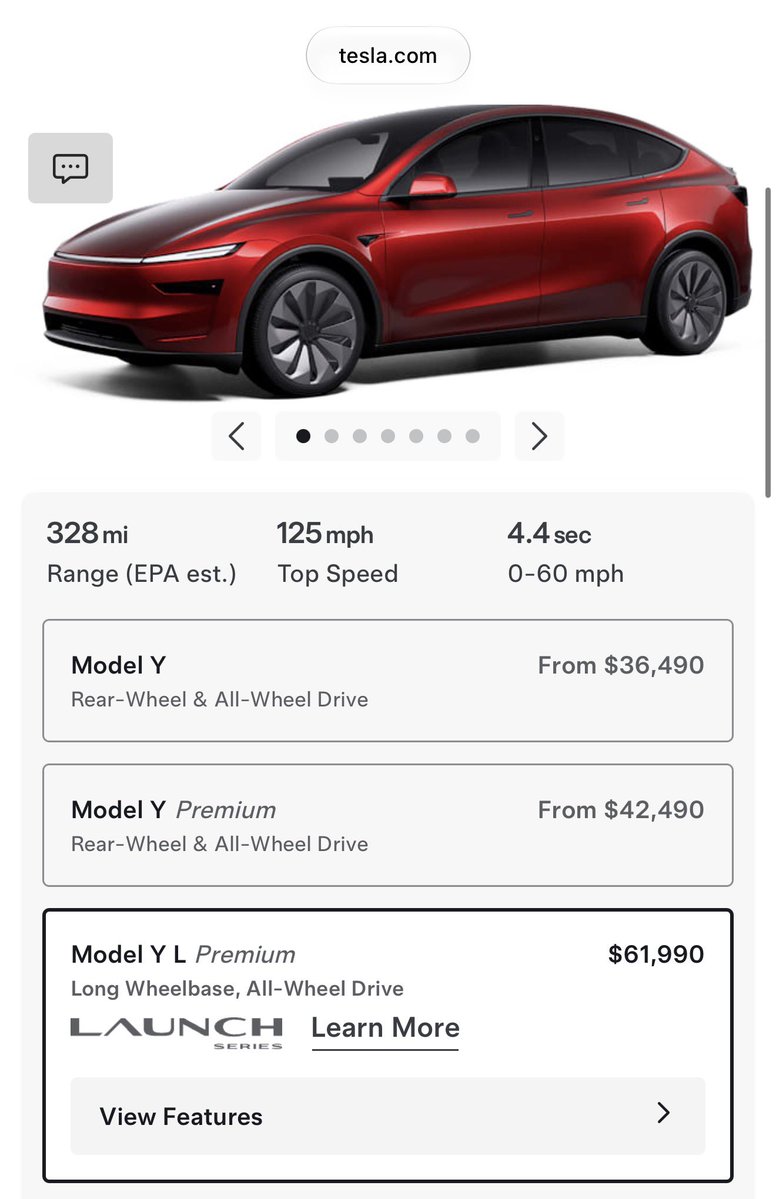
If you placed a new Model Y L Launch Series order in the U.S. this week, your estimated delivery window just got longer. Across all configurations, Tesla is now quoting January–March 2027 — a slip from the previous January–February range — and some customers are seeing dates pushed all the way to February–April 2027. For a vehicle that only began reaching U.S. showrooms in July 2026, that's a meaningful signal about where demand stands heading into the end of the year.

How the Delivery Windows Have Shifted
To understand the magnitude of the slip, it helps to look at how estimates have moved over the past few months. Back in August 2026, a fresh Launch Series order was quoting December 2026 delivery — roughly a four-month wait. By late September, the Model Y L Premium AWD had moved to January–February 2027. Now, in mid-October, the baseline window for all configurations is January–March, with a growing number of buyers seeing February–April.
That's a two-to-three month extension in roughly six weeks. The direction of travel is clear.
The standard Model Y lineup is also showing extended waits, though less dramatically. According to data from late September, base Model Y RWD and AWD orders were quoting December 2026–January 2027, while Performance and standard Premium trims were landing in the October–November 2026 window. The long-wheelbase Launch Series is at the back of the queue by a considerable margin.
What's Behind the Extended Wait
Tesla hasn't issued an official explanation for the longer windows, and the company rarely comments on delivery estimate mechanics. But a few factors are worth considering.
The Model Y L is a fundamentally new vehicle — a longer-wheelbase, six-seat configuration that launched in China in August 2025 before making its U.S. debut in mid-2026. Launch Series trims are typically the first allocation of a new model, carrying unique badging and early-production positioning. Once that initial batch clears, production ramp and logistics determine how quickly the next wave ships.
There's also a regulatory angle worth watching. Some customers in California have reported receiving communications from Tesla citing a "CARB certification for 2027 models" hold as a reason for delays on their orders. That detail comes from user-reported communications rather than any official Tesla statement, so it should be treated cautiously — but it's consistent with the pattern of California buyers seeing some of the longest waits.
The broader picture is that demand for the Model Y L appears to be running ahead of what Fremont can currently fulfill. That's a different problem than the demand concerns that periodically surface for Tesla's more mature models.
What This Means If You're Waiting — or Considering an Order
For customers already holding a Launch Series order, the shift in estimated dates doesn't necessarily mean your specific delivery has moved — Tesla's estimates are ranges, and individual orders can still land earlier within the window. That said, if your order previously showed January–February and now shows February–April, the system is telling you something real about your position in the queue.
For buyers still deciding, the calculus is straightforward: ordering today means accepting a roughly four-to-six month wait for the Launch Series. If the December quarter is important to you for tax purposes or personal timing, the standard Model Y lineup — with its shorter October–January windows — may be the more practical path. The Launch Series trim carries early-adopter appeal, but that comes with early-adopter wait times.
Delivery windows will continue to compress as Fremont's production rhythm normalizes on the new platform. Whether that happens in Q1 or Q2 2027 depends on factors — parts supply, logistics throughput, regulatory clearances — that aren't yet visible from the outside. The next meaningful data point will be Tesla's Q4 2026 delivery report.
Related Gear
Gear up your Model Y with tested, custom-fit BASENOR accessories — shop Model Y accessories →
Sources & reporting notes
The links below identify the material source records used for this report.
- @SawyerMerritt on X (2026-10-18T18:21:23.000Z) — Direct source
Source links are preserved as published or accessed. See our editorial standards and corrections policy.
The BASENOR Editorial Desk covers Tesla, SpaceX, and related technology, curating reporting from primary sources — official accounts, regulatory filings, and software release data. Every article passes source-record and fact-checking review before publication. About the newsroom.
This report was curated by the BASENOR Editorial Desk from the sources listed above. Read our editorial standards or email editorial@basenor.com to report an error.