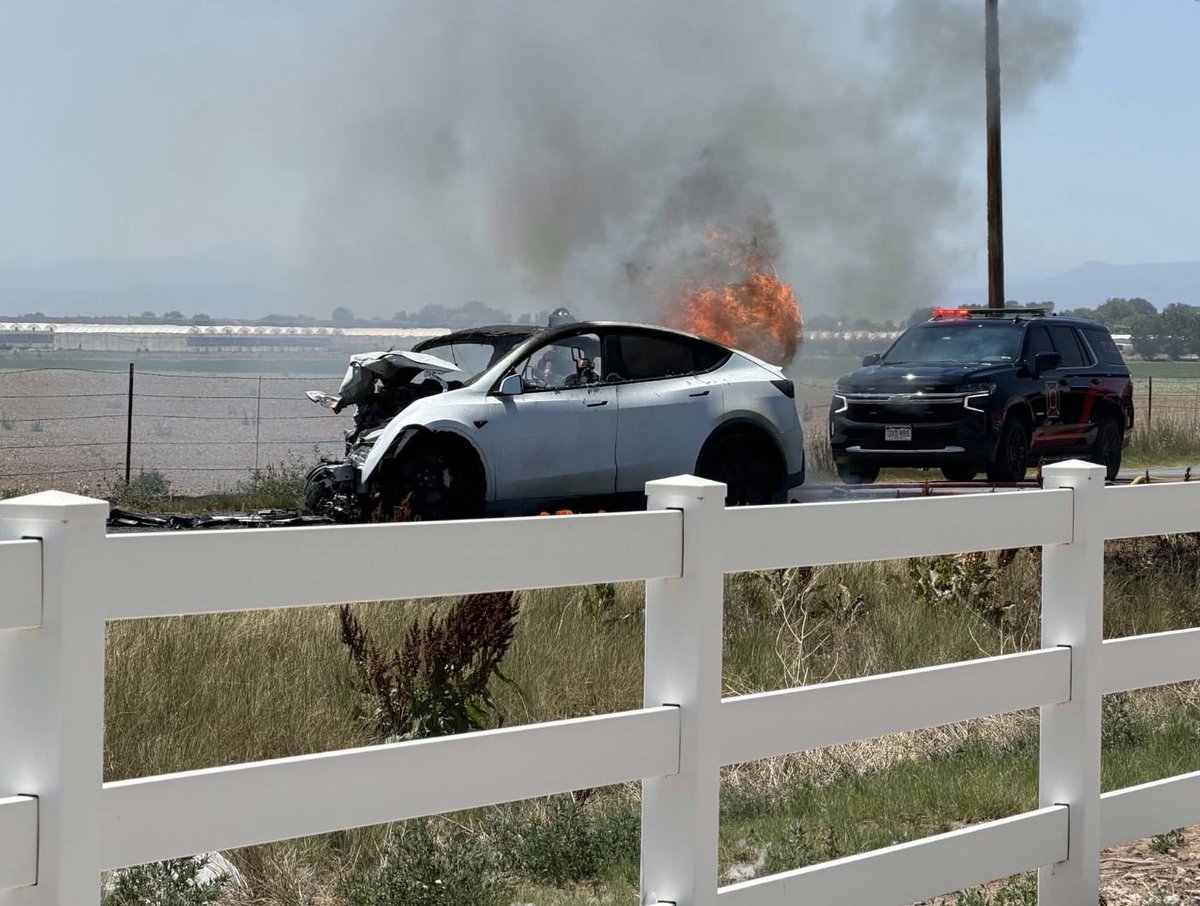
A Tesla Model Y owner survived a violent head-on collision with a Dodge Charger traveling at approximately 84 mph (135 km/h) and was able to exit the vehicle under her own power, sustaining only a few fractures. The Charger, which was reportedly attempting an illegal pass at the time of impact, suffered far worse — one fatality and two additional injuries among its occupants. The stark contrast in outcomes is a real-world demonstration of what modern EV safety engineering looks like when it's tested at its limits.


Why the Model Y Held Up
A head-on collision at combined closing speeds this high is among the most severe crash scenarios a passenger vehicle can face. The Model Y's survival outcome here isn't luck — it reflects several structural and engineering decisions Tesla has baked into the platform.
The Model Y uses a rigid occupant cell reinforced with ultra-high-strength steel, designed to absorb and redirect crash energy away from the passenger compartment. The front and rear crumple zones are engineered to deform progressively, converting kinetic energy into controlled structural collapse rather than transferring it directly to the cabin. According to Euro NCAP testing, the Model Y provides good-to-adequate protection across all critical body regions in full-width frontal impacts, and scored maximum points in side barrier tests. The IIHS has also rated the Model Y's structure and safety cage as performing well across multiple frontal and side crash scenarios for 2020–2025 model years.
Beyond the structure itself, the Model Y's low center of gravity — a byproduct of the floor-mounted battery pack — reduces rollover risk in high-speed impacts, and the absence of a traditional engine block means there's less rigid mass to intrude into the footwell during a frontal collision.

What Every Model Y Owner Should Check and Know
This incident is a reminder that passive safety — the engineering already built into your car — only works as intended when the vehicle is properly maintained and configured. Here's what owners should verify:
1. Confirm your airbag and restraint system has no open recalls
Go to Controls → Software → Additional Vehicle Information on your touchscreen, or check NHTSA's VIN lookup tool directly. Any open safety recall should be addressed at a Tesla Service Center before it becomes relevant in an emergency.
2. Keep your seat belt pre-tensioners in working order
After any significant collision — even a minor fender-bender — have Tesla inspect the seat belt pre-tensioners and load limiters. These are single-use pyrotechnic devices that fire during a crash. If they've deployed, they must be replaced. A used pre-tensioner provides zero protection in a subsequent impact.
3. Check that your airbag indicator light is off
A persistent airbag warning light on your instrument cluster means the supplemental restraint system has a fault. In a crash, a faulted SRS may not deploy correctly. If the light is on, schedule service — don't defer it.
4. Ensure your emergency contacts are set in the Tesla app
The Model Y can automatically notify emergency services after a severe collision via its built-in eCall system. Make sure your emergency contact information is current in the Tesla app under Profile → Emergency Contacts, so responders and family can be reached immediately if you're incapacitated.
5. Understand what post-crash behavior to expect
After a significant impact, the Model Y is designed to automatically unlock the doors, activate the hazard lights, and cut high-voltage power to reduce fire risk. If you're conscious after a crash, the car should already be doing these things. Don't attempt to manually force doors open before the system has had a moment to cycle — the auto-unlock typically triggers within seconds of airbag deployment.

The Bigger Picture
Incidents like this one don't prove any vehicle is invincible — crash outcomes depend on angle, speed, road conditions, and dozens of other variables. What they do illustrate is that the Model Y's safety architecture performs at a high level when it's pushed to extremes. The driver in this case walked out of a wreck that killed someone in the other vehicle. That outcome is not accidental.
The most important takeaway for owners isn't to feel invulnerable behind the wheel — it's to keep the safety systems that protected this driver in the same ready state they were in when they did their job. A car this well-engineered deserves to be maintained to match.
Related Gear
Gear up your Model Y with tested, custom-fit BASENOR accessories — shop Model Y accessories →
Sources & reporting notes
The links below identify the material source records used for this report.
- @TeslaNewswire on X (2026-09-16T05:25:03.000Z) — Direct source
Source links are preserved as published or accessed. See our editorial standards and corrections policy.
The BASENOR Editorial Desk covers Tesla, SpaceX, and related technology, curating reporting from primary sources — official accounts, regulatory filings, and software release data. Every article passes source-record and fact-checking review before publication. About the newsroom.
This report was curated by the BASENOR Editorial Desk from the sources listed above. Read our editorial standards or email editorial@basenor.com to report an error.