⚡ 30-Second Brief
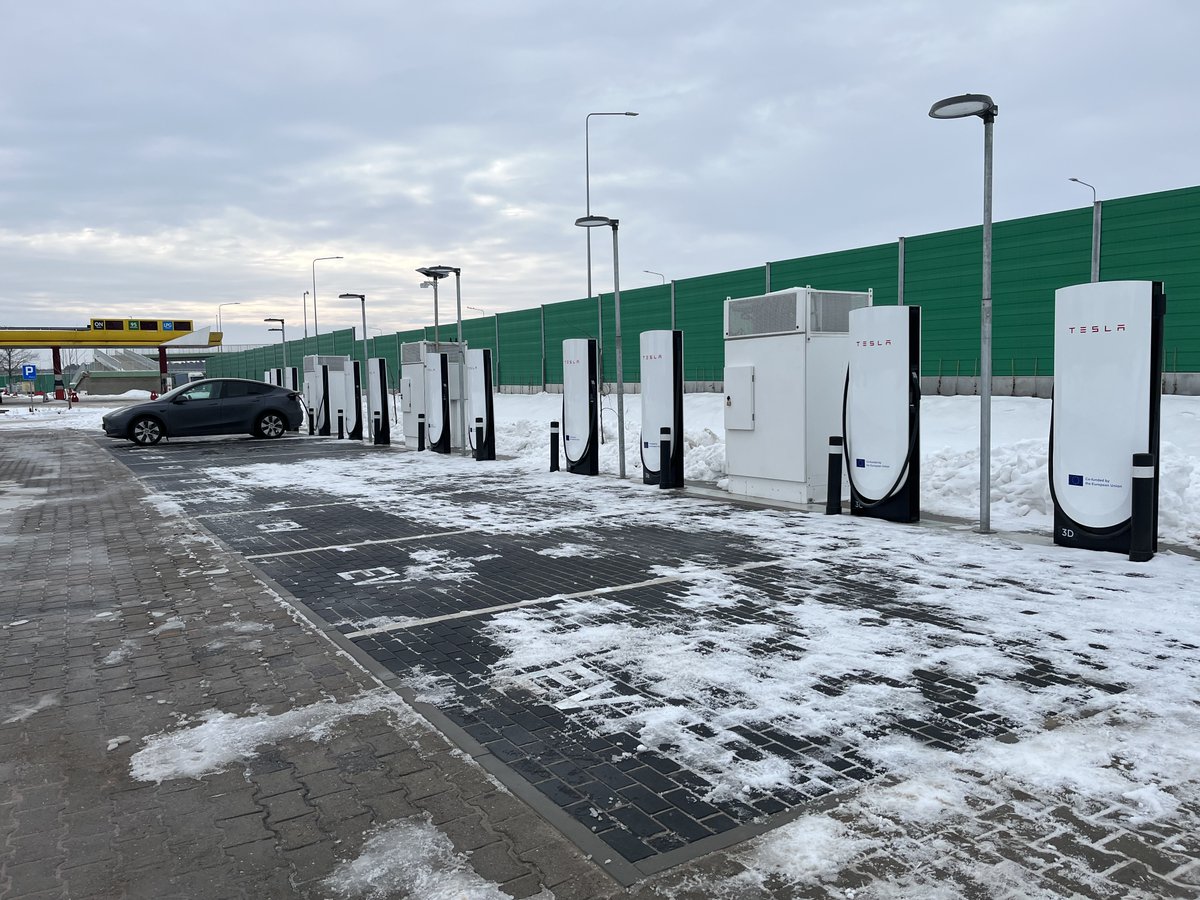
The News: Tesla has officially opened a new 12-stall Supercharger station in Załuski, Poland, marking another milestone in the company's Eastern European infrastructure expansion.
Why It Matters: This station strengthens the charging corridor along the S7 expressway in central Poland, improving range confidence for owners traveling between Warsaw and northern regions while supporting Tesla's growing delivery volumes in Eastern Europe.
Source: @TeslaCharging on X
📊 Key Figures
| Metric | Value | Context |
|---|---|---|
| Stall Count | 12 stalls | Standard mid-size station format for highway corridors |
| Location | Załuski, Poland | Strategic position on S7 expressway, ~80km north of Warsaw |
| Construction Timeline | Oct 2025 → Feb 2026 | Approximately 4 months from documented construction to activation |

🗺️ Strategic Positioning
The Załuski Supercharger occupies a critical position along Poland's S7 expressway, one of the country's primary north-south transport arteries. Located at Stacja Paliw on Gminna 22, the station sits approximately 80 kilometers north of Warsaw, serving as a convenient charging stop for owners traveling between the capital and coastal destinations like Gdańsk.
This location addresses a previously identified gap in Tesla's Polish network. Prior to this opening, owners traveling from Warsaw northward faced longer stretches between charging options, particularly during peak travel periods. The 12-stall configuration suggests Tesla anticipates moderate to high utilization, balancing capacity needs with the regional delivery footprint.
According to PlugShare listings, the station is positioned at a fuel station complex, following Tesla's established strategy of co-locating Superchargers with existing amenities. This approach provides owners with restroom access, food options, and other conveniences during charging sessions—typically 15-30 minutes for highway travel scenarios.
📈 Poland's Network Evolution
The Załuski opening follows Tesla's accelerated expansion timeline in Poland. The company grew its Polish Supercharger network by 10% in July 2024 with a 12-stall, 250 kW station in Szczecin, and announced plans for six additional locations across Gdynia, Poznań, Koszalin, Gliwice, Wrocław, and Rzeszów.
Tesla Poland received a portion of nearly $150 million in European Union funding through the Alternative Fuels Infrastructure Facility in September 2023. According to reports, these funds support the installation or replacement of 740 chargers across six countries: Croatia, Czechia, Greece, Hungary, Poland, and Slovenia. The Załuski station likely represents part of this EU-backed infrastructure push.
In November 2025, Tesla began opening its Polish Supercharger network to non-Tesla owners, with Rumia serving as the first permanently open location, followed by Poznań. This policy shift expands potential utilization but also raises questions about stall availability during peak periods—an important consideration for owners planning routes through newly opened stations like Załuski.
🔭 The BASENOR Take
Timeline: Operational — Station is live and accepting charging sessions as of Feb 12, 2026
Impact Level: ⭐⭐⭐ Medium — Improves regional coverage and highway confidence for Polish owners
Confidence: 95% — Official announcement from @TeslaCharging with photo confirmation
This station represents more than just 12 additional charging stalls—it signals Tesla's commitment to building out infrastructure ahead of demand in emerging European markets. Poland's EV adoption is accelerating, and Tesla's proactive approach mirrors the strategy that made range anxiety virtually obsolete in mature markets like the US and Western Europe.
The ~4-month timeline from construction documentation (October 2025 YouTube video) to activation demonstrates Tesla's execution efficiency in the region. For context, permitting and construction timelines in Poland are typically faster than Western European equivalents, allowing Tesla to deploy capital more efficiently.
The choice of 12 stalls—rather than 8 or 16—is deliberate. Tesla's station sizing typically reflects projected 2-3 year demand based on delivery forecasts and route modeling. A 12-stall configuration suggests moderate growth expectations for the S7 corridor, balancing initial investment against future capacity needs.
Looking ahead, the Załuski station fills a critical gap in Tesla's Polish network topology. With planned expansions in Gdynia to the north and existing coverage in Warsaw to the south, owners now have consistent charging options along the entire S7 corridor. This network density is particularly important as Tesla scales Model Y and Model 3 deliveries across Eastern Europe.
📰 Deep Dive
The broader strategic context makes this opening particularly noteworthy. Tesla's European infrastructure investments have historically lagged delivery growth in Eastern markets compared to the company's build-ahead strategy in the US. The Załuski station, funded partially through EU infrastructure grants, demonstrates how regulatory support can accelerate network deployment in regions where Tesla might otherwise prioritize Western European density.
Poland's position as a manufacturing hub—with proximity to Gigafactory Berlin—creates unique logistics advantages. The country serves as a distribution point for vehicles destined for Baltic and Eastern European markets, meaning improved charging infrastructure supports both customer delivery experiences and Tesla's own logistics operations. Owners taking delivery in Poland can now confidently drive to neighboring countries without range concerns.
The non-Tesla access policy introduced in November 2025 adds complexity to capacity planning. While opening the network generates additional revenue, it also means Tesla owners may encounter occupied stalls during peak travel periods. Tesla's app-based monitoring typically provides real-time stall availability, allowing owners to adjust routes if Załuski shows high utilization—a critical feature as network sharing expands.
Finally, this activation underscores Tesla's advantage in vertical integration. While competitors announce charging partnerships and joint ventures, Tesla continues deploying proprietary infrastructure at scale. Each new station like Załuski compounds the ownership experience advantage that drives purchase decisions in markets where charging anxiety remains a primary EV adoption barrier. For Polish owners, the message is clear: Tesla's network coverage now rivals traditional fuel station density on major corridors.
Related Gear
Gear up your Tesla with tested, custom-fit BASENOR accessories — shop Tesla accessories →
Sources & reporting notes
The links below identify the material source records used for this report.
- @TeslaCharging on X (2026-02-12T07:44:45.000Z) — Direct source
Source links are preserved as published or accessed. See our editorial standards and corrections policy.
The BASENOR Editorial Desk covers Tesla, SpaceX, and related technology, curating reporting from primary sources — official accounts, regulatory filings, and software release data. Every article passes source-record and fact-checking review before publication. About the newsroom.
This report was curated by the BASENOR Editorial Desk from the sources listed above. Read our editorial standards or email editorial@basenor.com to report an error.