Germany pays some of the highest household electricity rates on the planet — around 37 cents per kWh as of 2026, with average annual bills of roughly €1,300 — and approaching €3,100 for high-consumption households with an EV and heat pump. Tesla Europe is making the case that a Powerwall paired with solar panels fundamentally changes that math. Here's what German homeowners actually need to know.

Why does Germany's electricity price make solar storage more compelling than elsewhere?
According to Eurostat data, German household electricity prices hit €0.3869 per kWh in the second half of 2025, placing Germany among the most expensive markets globally. The average household (around 3,500 kWh per year) spends roughly €1,150–€1,300 per year on electricity, per BDEW figures — while a high-consumption household with an EV and heat pump (around 8,000 kWh per year, the scenario Tesla's example is built on) can see annual costs approach €3,100. That baseline cost is what makes the economics of battery storage work so decisively — every kilowatt-hour you avoid buying from the grid saves significantly more money than it would in, say, France or Spain. The higher the grid rate, the faster a storage system pays for itself.
What's the actual problem with solar panels alone — without a battery?
A solar array without storage creates a timing mismatch. Panels generate the most power midday, when most households are at work and consumption is low. That surplus energy either gets exported back to the grid at a low feed-in tariff, or simply goes unused. Then in the evening — when families are home, cooking, running appliances, and electricity demand peaks — the panels are idle and the household falls back on expensive grid power. You're selling cheap and buying expensive. A battery flips that equation.
How does the Powerwall 3P specifically address the German market?
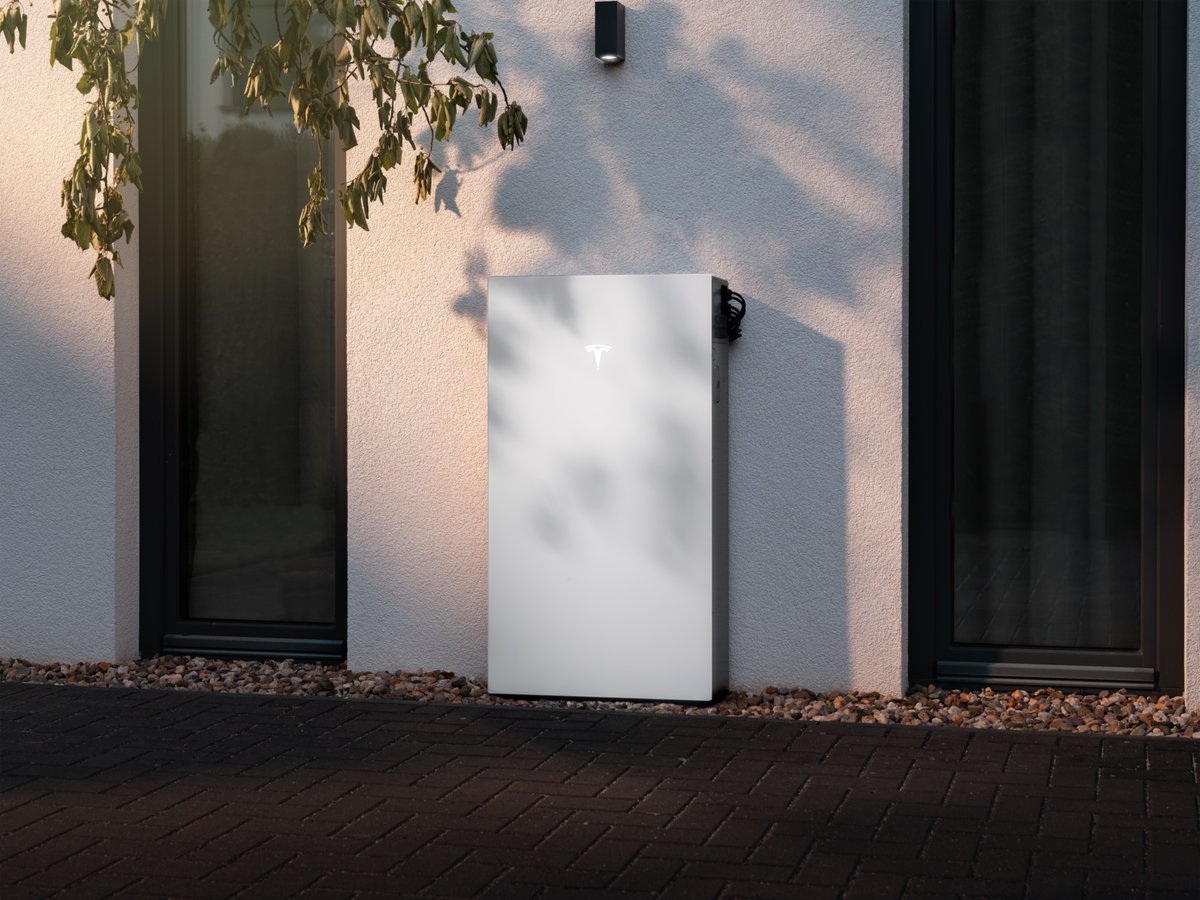
Tesla launched the Powerwall 3P (three-phase) in Germany in April 2026, with installations beginning in June. The 3P designation matters: German residential homes use three-phase electrical grids as standard, and earlier Powerwall models weren't optimized for this. A single Powerwall 3P unit is engineered to handle the energy demands of 95% of German homes. It includes an integrated hybrid inverter — meaning homeowners don't need to purchase a separate third-party inverter — and supports up to four MPPT solar inputs, accommodating solar arrays up to 20.3 kW. It also works with both new DC-coupled installations and existing AC-coupled solar systems, so it's not just for new builds.
How much can a German household realistically save?
According to verified data, combining Tesla Solar with the Powerwall 3P can reduce a German household's annual electricity bill by up to 77%. In Tesla's high-usage example scenario — a household with an EV and heat pump paying close to €3,100 per year — that translates to roughly €2,400 in savings, bringing the effective electricity cost down to around €700 annually; for an average household paying around €1,300, the absolute savings would be proportionally smaller, on the order of €1,000 per year. These figures assume a properly sized solar array and typical household consumption patterns. Individual results will vary based on roof orientation, shading, household size, and consumption habits, but the directional case is strong given Germany's rate environment.
What is Opticaster and does it require a subscription?
The Powerwall 3P includes Tesla's Opticaster AI software, which runs locally on the unit itself — no cloud subscription required. Opticaster continuously optimizes when the battery charges and discharges based on four inputs: real-time household consumption, current solar output, weather forecasts, and dynamic electricity tariff pricing. In practice, this means the system can learn to charge the battery when grid rates are lowest (or when solar is abundant) and discharge during peak-price evening hours automatically, without the homeowner needing to manually configure schedules.
Is this relevant for homeowners who already have solar panels installed?
Yes. The Powerwall 3P's compatibility with existing AC-coupled solar systems means it isn't limited to new installations. If you already have panels on your roof but no storage, adding a Powerwall 3P is a viable retrofit. The integrated inverter handles the AC coupling without requiring a full system replacement. Given that Germany has one of the highest rates of residential solar adoption in Europe, this retrofit path is likely the most relevant entry point for a large share of potential customers.
With German electricity prices showing no structural signs of declining, the case for pairing solar with storage only strengthens over time. The Powerwall 3P's local AI optimization and three-phase compatibility remove two of the main friction points that previously made battery storage complicated for German homeowners — the question now is largely whether the upfront investment timeline works for individual households.
Related Gear
Gear up your Tesla with tested, custom-fit BASENOR accessories — shop Tesla accessories →
Sources & reporting notes
The links below identify the material source records used for this report.
- @teslaeurope on X (2026-07-07T16:18:29.000Z) — Direct source
Source links are preserved as published or accessed. See our editorial standards and corrections policy.
The BASENOR Editorial Desk covers Tesla, SpaceX, and related technology, curating reporting from primary sources — official accounts, regulatory filings, and software release data. Every article passes source-record and fact-checking review before publication. About the newsroom.
This report was curated by the BASENOR Editorial Desk from the sources listed above. Read our editorial standards or email editorial@basenor.com to report an error.