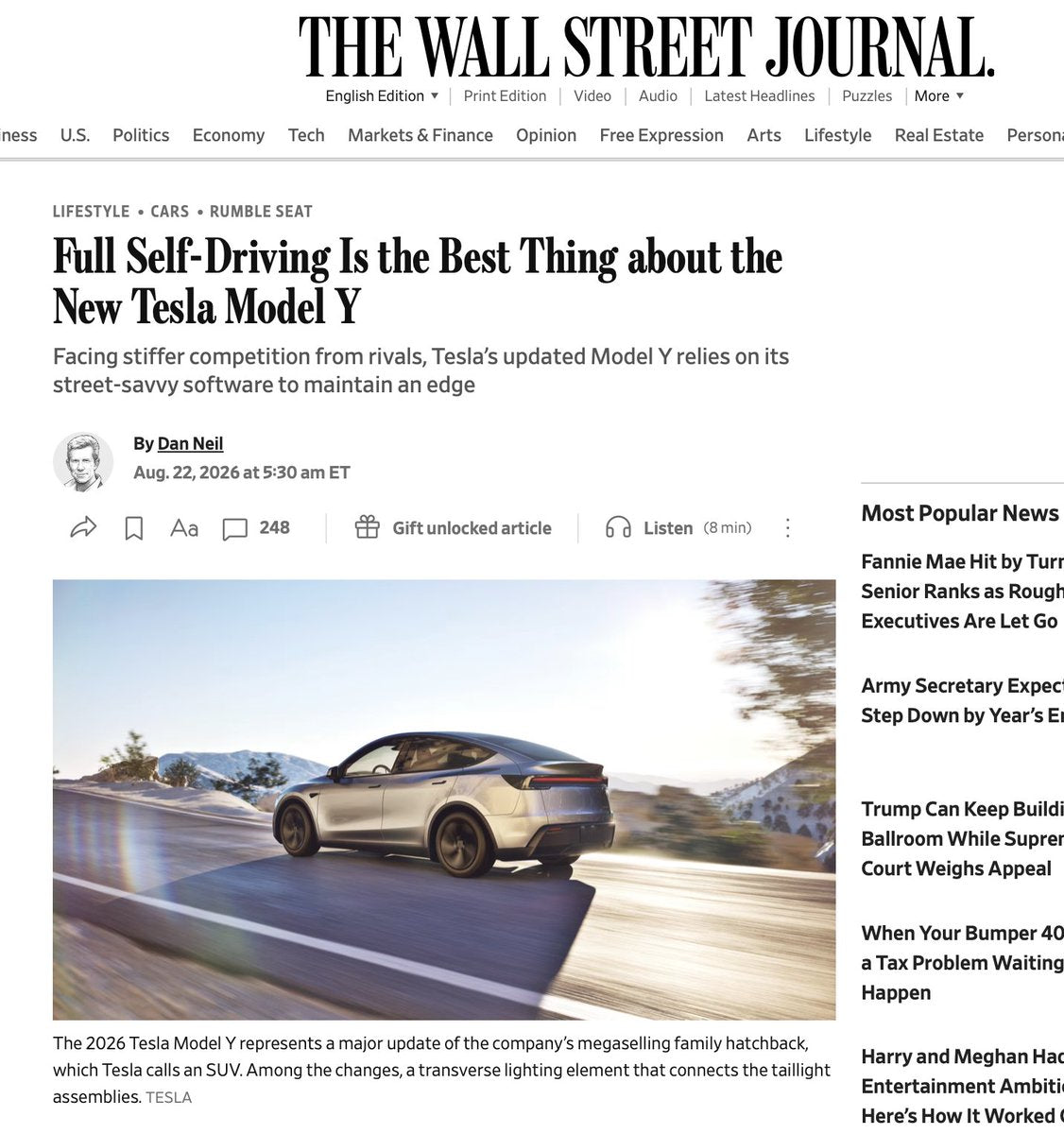
Tesla's Full Self-Driving (Supervised) system picked up an unlikely endorsement on August 22 — Wall Street Journal automotive critic Dan Neil, one of the more skeptical voices in mainstream car journalism, reported being genuinely won over after spending time behind the wheel with FSD active. Elon Musk amplified the moment with a characteristically brief nudge to anyone who hasn't tried it yet.

Neil's verdict, shared by Tesla watcher Sawyer Merritt: "By the end of the second hour — I was bewitched. FSD is amazing. I acknowledge I am a sample group of one, with only the scantest evidence to work with. Still, I know good driving when I see it. Mile by mile, the FSD started to earn my [trust]." Coming from a Pulitzer Prize-winning automotive journalist who has spent decades evaluating cars for a living, that's not a throwaway compliment.
Why This Moment Matters
Tesla has spent years accumulating owner testimonials about FSD, but mainstream automotive press coverage has historically been more cautious — often focusing on edge-case failures rather than sustained real-world competence. A positive, extended-use review from a WSJ critic carries a different kind of weight than a social media post, precisely because Neil's audience is the skeptical mainstream car buyer, not the Tesla enthusiast community.
Musk's response — "Try Tesla self-driving. Feels like magic" — is a deliberate echo of the company's long-standing belief that FSD is a product best understood by experiencing it rather than reading about it. The two-tweet sequence (Neil's review amplified by Merritt, then Musk's direct call to action) landed within about 30 minutes of each other on Saturday afternoon, giving the story unusual momentum on X.
Where FSD Actually Stands Right Now
The timing of Neil's review coincides with what is arguably the most capable version of FSD to date. According to tesla-info.com, the current release is FSD (Supervised) v14.3.7, shipping as part of software version 2026.21.6 (rolled out around August 18–22, 2026). The headline improvements in this build include a rewritten AI compiler and runtime using MLIR — delivering a reported 20% faster reaction time — alongside an upgraded reinforcement learning stage and an enhanced neural network vision encoder that improves performance in rare and low-visibility conditions.
Behaviorally, v14.3.7 addresses some of the friction points that have historically frustrated users: unnecessary lane biasing, minor tailgating tendencies, and hesitancy in parking scenarios. The system also shows improved responses to emergency vehicles, school buses, and right-of-way violations — the kinds of infrequent but high-stakes situations where earlier FSD versions could feel uncertain.
The cumulative data picture is also striking. According to verified sources, Tesla's FSD fleet crossed 13.6 billion real-world miles driven as of August 21, 2026 — up from 13 billion just three weeks earlier on August 3. That pace of accumulation matters because FSD's neural networks improve with exposure to edge cases, and the rate of new miles is accelerating as the subscriber base grows.
The Subscription Landscape
For owners considering trying FSD for the first time, the access model has changed significantly in 2026. The one-time purchase option officially ended on February 14, 2026 — the final price was $8,000. FSD is now subscription-only: $99 per month for most owners, or $49 per month for those who previously purchased Enhanced Autopilot. The lower tier makes a trial genuinely low-stakes for a segment of the existing owner base.
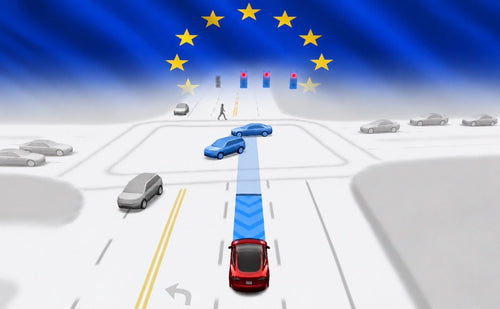
Geographic availability has also expanded. FSD (Supervised) is currently active in 12 countries and regions, including the United States, Canada, Mexico, Australia, New Zealand, South Korea, and several European markets (the Netherlands, Lithuania, Estonia, Denmark, and Belgium). China is no longer on the supported list as of this writing.
Looking further out, Tesla has indicated that FSD v15 — described internally as a "step-change" in capability and featuring a 10-billion parameter model running natively on Hardware 4 — is planned for late 2026 or early 2027. That context makes Neil's reaction to the current system more interesting, not less: if v14.3.7 is already earning the word "bewitched" from a skeptical mainstream critic, the bar for v15 is now set very publicly.
The question for undecided owners is a practical one: at $49–$99 per month with no long-term commitment, the cost of finding out for yourself has never been lower. Neil's two-hour verdict suggests the experience may do more persuading than any spec sheet.
Related Gear
Gear up your Tesla with tested, custom-fit BASENOR accessories — shop Tesla accessories →
Sources & reporting notes
The links below identify the material source records used for this report.
- @SawyerMerritt on X (2026-08-22T15:24:30.000Z) — Direct source
- @elonmusk on X (2026-08-22T15:56:28.000Z) — Direct source
Source links are preserved as published or accessed. See our editorial standards and corrections policy.
The BASENOR Editorial Desk covers Tesla, SpaceX, and related technology, curating reporting from primary sources — official accounts, regulatory filings, and software release data. Every article passes source-record and fact-checking review before publication. About the newsroom.
This report was curated by the BASENOR Editorial Desk from the sources listed above. Read our editorial standards or email editorial@basenor.com to report an error.