📌 UPDATE — October 21, 2026
During the Q3 2026 earnings call, Tesla's CFO revealed the company is sitting on its highest-ever vehicle order backlog, with demand "outpacing production by a significant margin," and confirmed factories across all sites are ramping in response. The CFO also revised Tesla's full-year capital expenditure guidance down to $20 billion, citing disciplined capital deployment, with the entire amount expected to be funded through cash flow from operations — signaling strong confidence in near-term cash generation. Elon Musk added an optimistic note, saying: "After a few years of things being flat, we're now headed for a lot of fun and significant growth." Together, these disclosures suggest Tesla's demand inflection is accelerating faster than its current production capacity, a dynamic that could pressure delivery timelines but support pricing power heading into Q4 2026.
📌 UPDATE — October 21, 2026
Tesla's Q3 2026 earnings call is now underway, and several key details have emerged beyond the headline numbers. Auto gross margins came in at 18.1%, comfortably beating the 16.7% analyst estimate, and Tesla returned to positive free cash flow in the quarter. North American FSD attach rate surged to 75% — up sharply from 55% in Q2 2026 — adding further momentum to the 67% subscriber growth figure already reported.
On the call, Elon Musk stated directly: "Demand is growing rapidly for our vehicles, and exceeding our production." That supply-constrained framing is a notable shift in tone and signals potential upside for delivery volumes heading into Q4 2026, assuming production ramp continues.
Despite the beats, $TSLA shares were trading lower in after-hours, which analyst Gary Black flagged as surprising given the margin outperformance and FCF recovery. Investor focus may be drifting toward board-level governance developments mentioned on the call.
📌 UPDATE — October 21, 2026
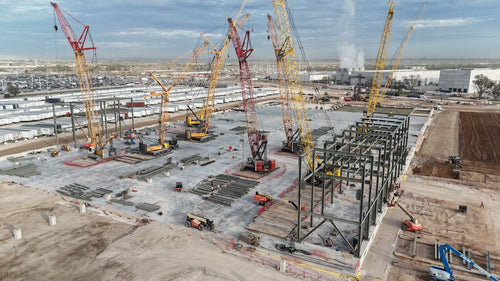
Tesla's Q3 2026 earnings report revealed significant manufacturing capacity expansions across multiple product lines. Model Y production at Gigafactory Texas jumped 50%, now exceeding 375,000 units annually. Most notably, both the Tesla Semi facility and the Texas Megapack factory have officially transitioned from "Commissioning" to full "Production" status — Semi at 25,000 units/year and Megapack at 50 GWh/year — signaling Tesla's energy and commercial trucking businesses are scaling in earnest alongside its core EV output.

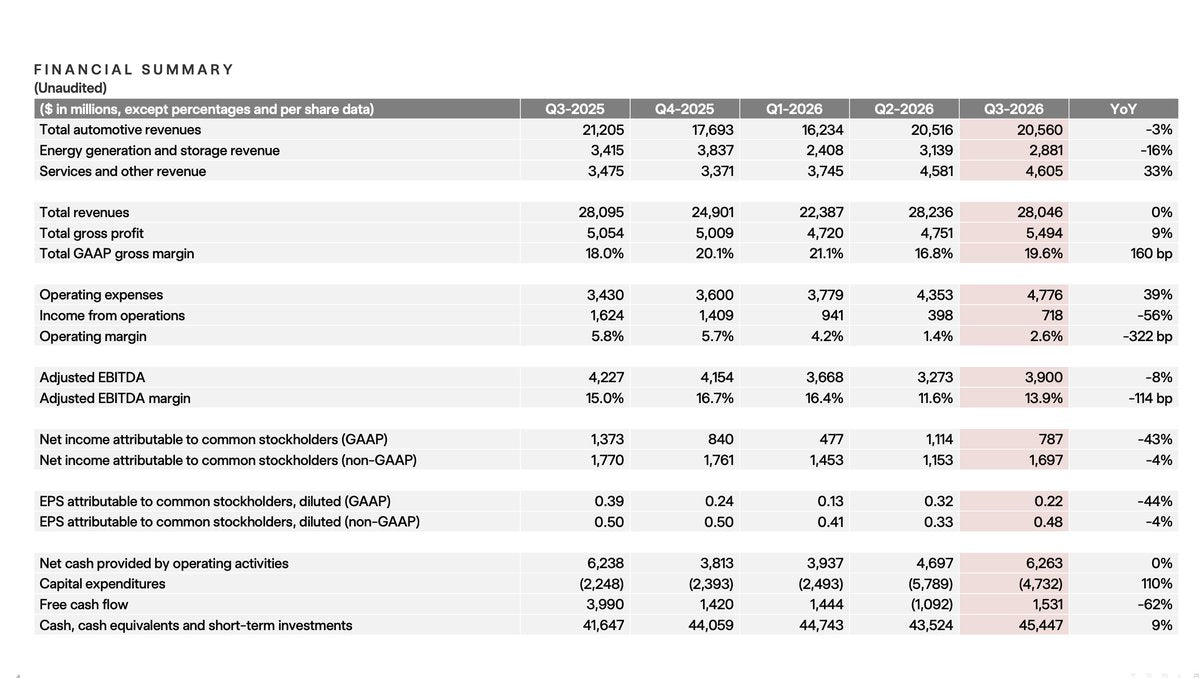
Tesla reported its third-quarter 2026 financial results on Wednesday afternoon, delivering a mixed but revealing snapshot of the company at a pivotal moment. Revenue of $28.05 billion came in just below Wall Street's $28.3 billion consensus, while non-GAAP earnings per share of $0.48 edged past the $0.45 estimate. The quarter was defined by record-pace FSD subscription growth, a sharp jump in capital spending, and gross margins that held up better than many analysts feared.
The numbers paint a company spending aggressively on its AI, robotaxi, and energy ambitions while its core automotive business settles into a new normal of flat-to-modest growth. For Tesla owners and prospective buyers, the operational signals buried in the release matter more than the headline beats and misses.

The Headline Numbers
Here's where Q3 2026 landed on the metrics that matter most:
| Metric | Q3 2026 | YoY Change |
|---|---|---|
| Revenue | $28.05B | Flat |
| Non-GAAP EPS | $0.48 | — |
| GAAP Net Income | $787M | — |
| Adjusted EBITDA | $3.90B | — |
| Gross Margin | 19.6% | +160 bps |
| Free Cash Flow | $1.53B | Down from $3.99B |
| Cash & Investments | $45.4B | — |
| Vehicle Production | 464,391 | +4% |
| Vehicle Deliveries | 486,532 | — |
The headline that will dominate the earnings call is the gross margin resilience. Despite a quarter that included significant price adjustments across the lineup and the ongoing Model Y L launch costs, Tesla expanded gross margin by 160 basis points year-over-year to 19.6%. That's the kind of operational discipline that suggests the automotive business is finding its footing after a bruising 2025.
FSD Subscriptions: The Breakout Number
The single most consequential data point in this release isn't a dollar figure — it's the FSD subscriber count. According to @SawyerMerritt's breakdown, active Full Self-Driving subscriptions have reached 1.74 million, up 67% year-over-year from 1.04 million.
That growth rate matters for three reasons. First, FSD revenue carries structurally higher margins than vehicle sales, which helps explain the gross margin expansion. Second, 1.74 million active subscribers is now a large enough base that Tesla's AI business is becoming materially visible in the income statement. Third, it validates the strategic bet that the robotaxi and autonomy roadmap can be funded in part by consumer subscription revenue rather than external capital.
For context, that's roughly 400,000 net new FSD subscribers added over the trailing twelve months — a pace that, if it continues, puts Tesla on track to cross 2 million subscribers before the end of Q1 2027.
Capital Spending Doubled — Here's Why
The free cash flow line tells the real story of this quarter. FCF came in at $1.53 billion, down sharply from $3.99 billion in Q3 2025. The culprit, as Fred Lambert noted, is capital spending that more than doubled year-over-year to $4.73 billion, up from $2.25 billion a year ago.
Tesla isn't disclosing a line-item breakdown in the summary release, but the areas absorbing that capital are well-known from prior guidance: Cybercab tooling at Gigafactory Texas, Optimus production line conversion at Fremont (the former Model S/X line), expanded AI training infrastructure, and continued buildout of the Lithium Refinery in Corpus Christi.
The important takeaway for investors: Tesla ended the quarter with $45.4 billion in cash and investments. Even at this elevated spending pace, the balance sheet can absorb the AI and robotics capex without requiring external financing. That's a competitive moat that few — if any — automakers can match.

Production and Deliveries: A Measured Quarter
Tesla built 464,391 vehicles in Q3 and delivered 486,532 — meaning deliveries exceeded production by roughly 22,000 units, drawing down inventory. That's a healthy sign in a quarter where many analysts had worried about demand softness heading into the end of the US federal EV tax credit window.
Production grew 4% year-over-year, a modest figure that reflects two realities: the Fremont Model S/X line is no longer producing vehicles (that line is being converted to Optimus manufacturing), and the ramp of Model Y L in US markets is still in its early innings after July 2026 showroom arrivals. The Shanghai, Berlin, and Austin Gigafactories are now carrying essentially all of Tesla's volume.
Energy Business Continues to Scale
Tesla deployed 13.7 GWh of energy storage products in Q3, according to the company's release. The energy business — Megapack and Powerwall — has quietly become one of Tesla's highest-growth segments, and at current deployment rates it's on pace to be a meaningful contributor to total company revenue in 2027.
The energy segment also tends to carry stronger gross margins than vehicles, which further explains the margin expansion story. Watch for commentary on the earnings call about Megapack factory expansion plans in Shanghai and the next phase of Lathrop capacity.
What Tesla Owners Should Take From This
For current Tesla owners, the earnings report reinforces several practical realities. The massive FSD subscriber growth suggests Tesla has strong incentive to keep improving the product — the subscription business only works if churn stays low, which means feature velocity on FSD updates should remain high. The 19.6% automotive gross margin means Tesla has pricing flexibility if demand softens, but less urgency to cut prices than it did a year ago. And the $45.4 billion cash position essentially guarantees that software support, Supercharger expansion, and parts availability for existing vehicles are not resource-constrained.
For prospective buyers, the signal is mixed: Tesla has the balance sheet to invest aggressively in the next generation of products (Cybercab, affordable model, Model Y L global rollout), but near-term volume growth looks modest. The company that emerges from 2026 will look meaningfully different from the one that entered it — more AI, more robotics, more energy, and proportionally less dependent on a single automotive line.
What to Watch Next
- Earnings call commentary (5:30 p.m. ET today): Specifically, management guidance on Cybercab production timing, Optimus volume targets, and 2027 delivery expectations.
- FSD subscription trajectory: Can the 67% YoY growth rate hold as the base gets larger? The next data point comes with Q4 2026 earnings in late January.
- Capex guidance for 2027: Will the $4.73B quarterly pace continue, or does it moderate as Cybercab tooling completes?
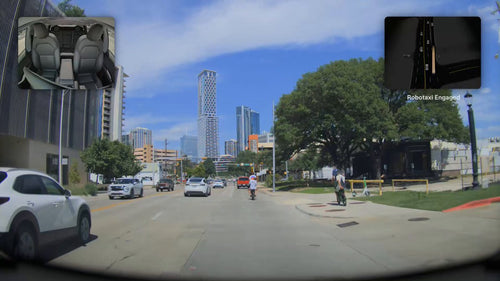
- Robotaxi expansion metrics: Austin and Bay Area ride counts, geographic expansion, and any disclosed utilization data.
- Energy storage backlog: Any update on multi-year Megapack order commitments from utility customers.
The Q3 2026 report confirms Tesla is a company in deliberate transition — one that is spending heavily today to be a very different business in 2028. Whether that bet pays off will depend less on quarterly delivery figures and more on execution against the AI, autonomy, and robotics roadmap. The earnings call later today should offer the clearest look yet at how management is sequencing those priorities.
🚕 Following the Robotaxi rollout? See every operating city, launch date and announced market in our Tesla Robotaxi Tracker.
🤖 Tracking Tesla's humanoid robot? See every Optimus production milestone and appearance in our Tesla Optimus Tracker.
Related Gear
Gear up your Tesla with tested, custom-fit BASENOR accessories — shop Tesla accessories →
Sources & reporting notes
The links below identify the material source records used for this report.
- @SawyerMerritt on X (2026-10-21T20:04:44.000Z) — Direct source
- @FredLambert on X (2026-10-21T20:18:45.000Z) — Direct source
- @TeslaNewswire on X (2026-10-21T20:57:11.000Z) — Direct source
Source links are preserved as published or accessed. See our editorial standards and corrections policy.
The BASENOR Editorial Desk covers Tesla, SpaceX, and related technology, curating reporting from primary sources — official accounts, regulatory filings, and software release data. Every article passes source-record and fact-checking review before publication. About the newsroom.
This report was curated by the BASENOR Editorial Desk from the sources listed above. Read our editorial standards or email editorial@basenor.com to report an error.