Days before the next-generation Tesla Roadster's scheduled October 1 reveal, a newly published USPTO patent has handed us a detailed technical preview of one of its most ambitious engineering features: a deployable active rear wing that can generate up to 700 kg of downforce, eliminate drag on demand, and retract automatically if the car senses an impending collision.

What the Patent Actually Describes
The filing — US 2026/0285418 A1, titled "Deployable and Active Rear Wing Assembly with Safety Features" — was published by the USPTO on September 24, 2026. Tesla originally filed it in August 2025 as a continuation of a March 2025 application. The named inventors are David Lemire and James Michael Arthur Crook.
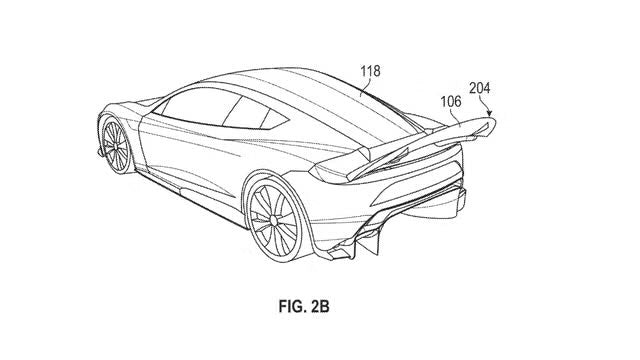
The system is a two-piece design: a main wing element and a smaller leading-edge slat. In what the patent calls "road mode," both pieces sit flush with the deck lid — the slat hides underneath, the main element lies flat — making the wing effectively invisible at a glance. The patent drawings show a two-door coupe profile consistent with every Roadster rendering Tesla has released.
Once deployed, the wing operates across a range of aerodynamic states. At speeds above 100 mph in high-downforce mode, it can generate up to 700 kg of downforce — a figure that puts it in the same conversation as purpose-built track cars. At the other extreme, rotating the wing flat into DRS (Drag Reduction System) position brings the car to 0 kg of downforce and removes 250 drag counts (0.025 Cd) compared to the deployed position. The full aerodynamic delta when deploying from stowed is 350 drag counts (0.035 Cd) added and 1,000 counts of downforce gained.

The Numbers That Stand Out
| Specification | Value |
|---|---|
| Max downforce (high downforce mode, 100+ mph) | 700 kg |
| Downforce in DRS mode | 0 kg |
| Drag added when deployed | 350 counts (0.035 Cd) |
| Drag removed in DRS vs. deployed | 250 counts (0.025 Cd) |
| Stowed → fully deployed time | < 3 seconds |
| Angle adjustment time | < 0.25 seconds |
| Patent number | US 2026/0285418 A1 |
| Original filing date | March 2025 |
The Safety Integration Is the Interesting Part
Active aero on performance cars is not new — Porsche, Ferrari, and McLaren have used deployable wings for years. What makes this patent worth reading carefully is the collision-retraction logic.
According to the filing, the wing is integrated directly into the vehicle's automated driver-assist software. If the system detects an impending collision, the wing retracts automatically. The stated purpose is twofold: protect the mechanism itself from damage, and reduce the wing's contribution to harm in an impact. The sub-quarter-second angle adjustment speed means the system can respond in real time — not just as a pre-crash preparation but potentially as a continuous aerodynamic management loop tied to the same sensor stack that runs FSD.

That integration is a meaningful engineering choice. Most active aero systems operate on speed and driver-mode inputs alone. Tying wing position to the same real-time perception pipeline that handles emergency braking and lane avoidance is a different design philosophy — one that treats the aerodynamic surface as a safety system rather than purely a performance accessory.

Context: Five Days Before the Reveal
The timing of the USPTO publication — September 24, just one week before the October 1 Roadster reveal — is almost certainly not accidental. Patent applications are published on a fixed schedule set by the USPTO, but Tesla's engineers filed the continuation in August 2025, knowing full well when the car would be shown. The patent gives the public a technical frame of reference before the reveal event, and it sets a performance benchmark that will be hard to walk back: 700 kg of downforce is a claim that demands proof on a test track.
Whether every detail in a patent filing makes it into production hardware is always an open question. But the specificity here — named inventors, precise drag counts, sub-second actuation times, a defined road-mode stow position — reads less like a defensive IP filing and more like documentation of something that already works. The October 1 reveal will tell us how much of this made the cut.
Related Gear
Gear up your Tesla with tested, custom-fit BASENOR accessories — shop Tesla accessories →
Sources & reporting notes
The links below identify the material source records used for this report.
- @TeslaNewswire on X (2026-09-26T06:27:42.000Z) — Direct source
Source links are preserved as published or accessed. See our editorial standards and corrections policy.
The BASENOR Editorial Desk covers Tesla, SpaceX, and related technology, curating reporting from primary sources — official accounts, regulatory filings, and software release data. Every article passes source-record and fact-checking review before publication. About the newsroom.
This report was curated by the BASENOR Editorial Desk from the sources listed above. Read our editorial standards or email editorial@basenor.com to report an error.