📌 UPDATE — August 6, 2026
Tesla's Robotaxi program appears to be crossing a meaningful threshold: it's no longer just an impressive proof of concept, but is beginning to function as a genuine rideshare service. Whole Mars Catalog — a closely followed Tesla observer — noted the shift on August 6, suggesting the commercial deployment is maturing in a tangible way. This aligns with the fleet expansion data covered below, and points to Tesla moving from "demo mode" toward a scalable, revenue-generating rideshare operation. No specific city expansion or pricing details were disclosed alongside the observation.
"Tesla Robotaxi is starting to become a real rideshare service, not just a cool proof of concept" — @wholemars, Aug 6 2026
📌 UPDATE — August 6, 2026
Tesla's unsupervised Model Y Robotaxis have expanded into nighttime operations in Austin, Texas, with footage captured around 9 PM local time confirming the milestone. Night driving introduces more complex lighting conditions, sensor challenges, and edge cases — making this a meaningful step beyond daytime-only service. Sawyer Merritt shared video evidence on X, noting the program continues its methodical, step-by-step capability expansion. This adds a sixth data point to the fleet's growth story: it's not just more cars on the road, but more hours of the day covered.
@SawyerMerritt · Aug 6, 2026
"Looks like @Tesla's Unsupervised Model Y Robotaxis are now operating at night in Austin. About 9 PM local time in the video below. Step by step!"
View on X →
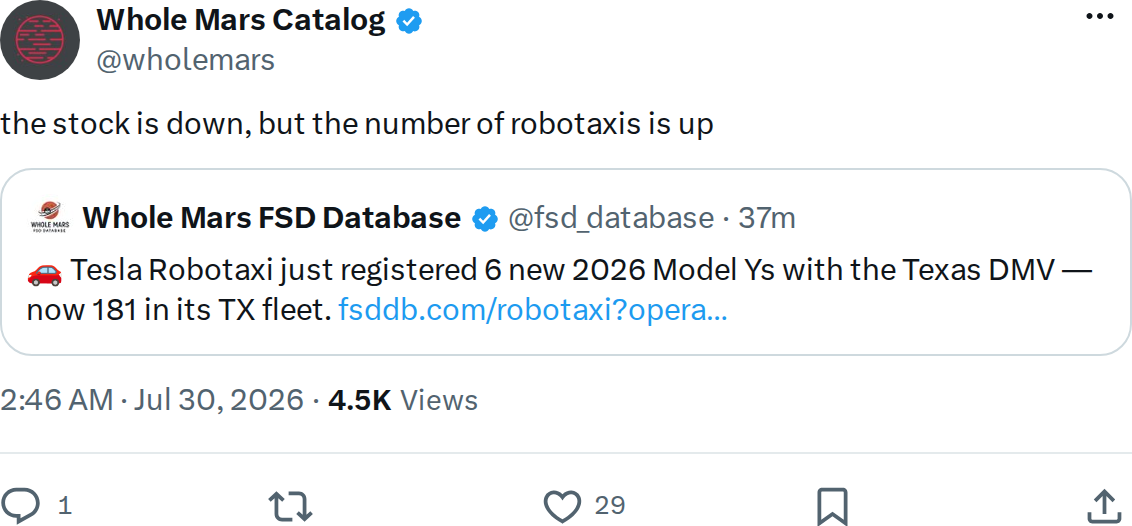
Tesla's stock may be under pressure, but the Robotaxi program is moving in the opposite direction. A note from Whole Mars Catalog captured the disconnect neatly — and the underlying data backs it up. Here's what the numbers actually show about where Tesla's autonomous ride-hailing service stands right now.

1. Over 380,000 Unsupervised Miles Logged
Tesla's Robotaxi platform has now accumulated more than 380,000 unsupervised miles — meaning trips completed without a safety driver in the vehicle. That figure spans six cities across two states, and it's the clearest single metric for how much real-world autonomous operation has actually happened. Every mile logged is training data, safety validation, and operational proof rolled into one.
2. Double-Digit Weekly Mileage Growth Since January
The program hasn't just grown — it's been compounding. According to available data, unsupervised miles driven per week have increased at a rate exceeding 10% week-over-week since the start of 2026. That kind of sustained growth rate, if maintained, means the gap between where the fleet is today and where it needs to be closes faster than linear projections suggest. Tesla has set a target of 450,000 unsupervised miles per week by the end of 2026.
3. Nearly 2.5 Million Cumulative Paid Miles by End of Q2
By the close of Q2 2026, Tesla's Robotaxi service had recorded nearly 2.5 million cumulative paid miles. This figure includes trips where a safety monitor was present, making it a broader measure of the commercial operation's total activity. It's the number that matters for the business case: real passengers, real trips, real revenue miles — not just test laps.
4. Seven US Metro Regions Now Active — Florida Leads
The geographic footprint has expanded to seven US metropolitan regions. Most recently, Tesla launched unsupervised Model Y vehicles in Tampa and Orlando as of July 23, 2026, which makes Florida the state with the most active Robotaxi markets — Miami was already on the map. Expanding into multiple Florida cities simultaneously signals that Tesla is moving from a single-market proof-of-concept to a multi-city operational model.
5. FSD v15 Is Powering the Fleet — v14 Is What Owners Have
There's a meaningful software gap between what Robotaxi vehicles are running and what's currently rolling out to the broader fleet. The Robotaxi fleet operates on FSD version 15, while consumer vehicles are receiving FSD v14.3.6 (for HW4 vehicles) and FSD v14 Lite (for HW3 vehicles) via software update 2026.20.6.11. Key improvements in the v14 rollout include a 20% faster reaction time thanks to a rewritten AI compiler using MLIR, an upgraded reinforcement learning training stage, and a unified model across Smart Summon, FSD, and Robotaxi. The version gap is intentional — the fleet serves as the proving ground before capabilities trickle down to owner vehicles. For more context on the FSD rollout, see our FSD coverage.
The stock-versus-fleet divergence that Whole Mars Catalog flagged is a real tension, but the operational metrics suggest the program is executing. The more relevant question for Tesla owners is how quickly FSD v15 capabilities — currently reserved for the commercial fleet — make their way into the software updates landing on vehicles in driveways.
🚕 Following the Robotaxi rollout? See every operating city, launch date and announced market in our Tesla Robotaxi Tracker.
Related Gear
Gear up your Tesla with tested, custom-fit BASENOR accessories — shop Tesla accessories →
Sources & reporting notes
The links below identify the material source records used for this report.
- @wholemars on X (2026-07-30T02:46:26.000Z) — Direct source
Source links are preserved as published or accessed. See our editorial standards and corrections policy.
The BASENOR Editorial Desk covers Tesla, SpaceX, and related technology, curating reporting from primary sources — official accounts, regulatory filings, and software release data. Every article passes source-record and fact-checking review before publication. About the newsroom.
This report was curated by the BASENOR Editorial Desk from the sources listed above. Read our editorial standards or email editorial@basenor.com to report an error.