📌 UPDATE — July 12, 2026
A new claim is circulating about the scale of the AI5 chip's process jump: according to a post from Whole Mars Catalog, AI5's transistors are 3.5× smaller than those in the current AI4 chip. Tesla has not confirmed that figure — it mirrors the ratio of the 7nm and 2nm node names, which are marketing labels rather than measured transistor dimensions — but the move to Samsung's 2nm process does point to a substantial uplift in both raw compute density and power efficiency compared to the HW4 silicon it will replace. The figure underscores why the move to Samsung's Taylor fab and the 2nm node is such a pivotal milestone for Tesla's in-house AI hardware roadmap.

📣 @wholemars via X — July 12, 2026
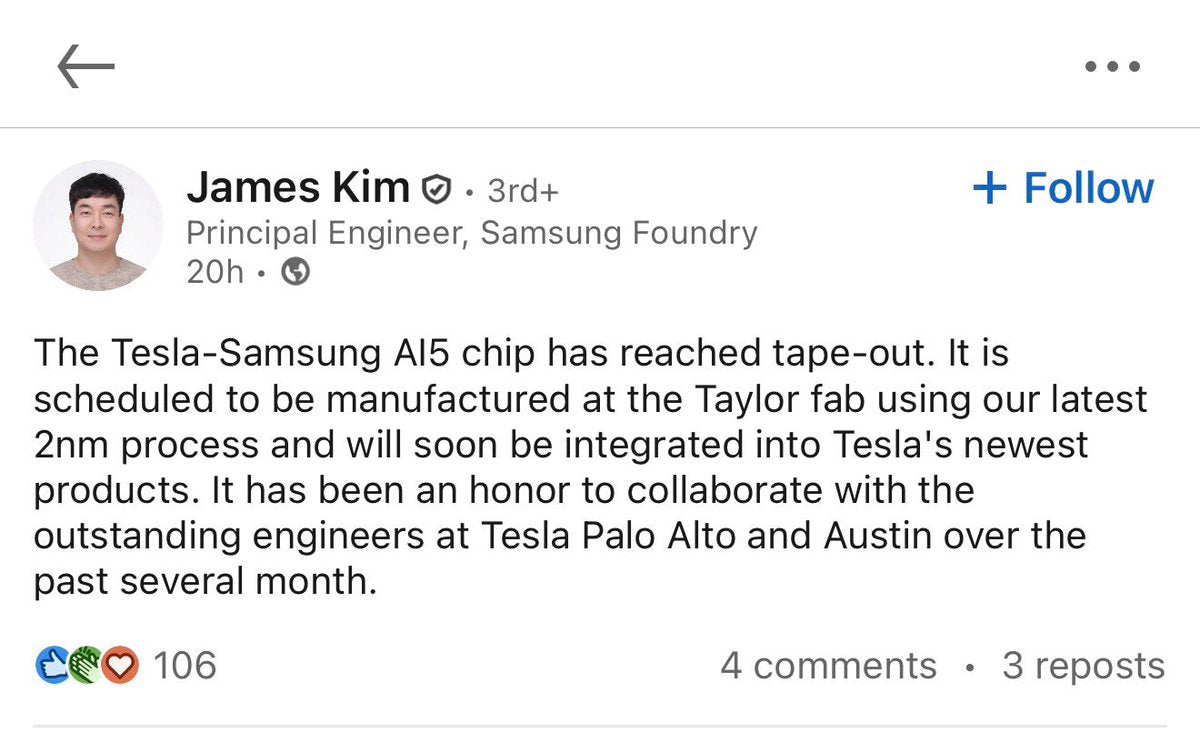
A Samsung Foundry engineer has publicly corroborated that the Tesla-Samsung AI5 chip has reached tape-out, marking the completion of its design phase and clearing the runway for manufacturing at Samsung's Taylor, Texas plant on a 2nm process. The comment came from an individual Samsung Foundry Principal Engineer's post, surfaced by Sawyer Merritt on X — the first public remark from the Samsung side since Elon Musk publicly confirmed the tape-out in April. It is not a formal company announcement.
The disclosure sharpens the picture around what Tesla has been calling AI5, also referred to as Hardware 5 (HW5) — the successor to the HW4 compute platform currently shipping in Model 3, Model Y, Model S, Model X and Cybertruck. It also fuels fresh speculation, echoed by content creator Dirty Tesla, about whether a refreshed Model Y ("Model YL") could be the first vehicle to carry HW5 as early as next year.

What Tape-Out Actually Means
Tape-out is the point at which a chip's design is finalized and handed off to the fab for physical manufacturing. It doesn't mean chips are rolling off the line — engineering samples typically follow months later, with volume production behind that. According to previous reporting on the AI5 program, engineering samples are expected in late 2026, with high-volume production following in 2027 — TrendForce puts vehicle-bound volume production at mid-to-late 2027.
The Samsung engineer's phrasing — that AI5 "will soon be integrated into Tesla's newest products" — is notable but should be read carefully. "Soon" in semiconductor terms is measured in quarters, not weeks. Merritt also noted in his post that volume production won't start immediately.
Key Figures
| Spec | AI5 / HW5 | AI4 / HW4 (reference) |
|---|---|---|
| Process node | 2nm (Samsung Taylor + TSMC Arizona) | 7nm class |
| Compute (full computer) | ~2,000–2,500 TOPS | Baseline |
| Compute vs AI4 | ~8x | 1x |
| Memory per SoC | Up to 192GB LPDDR5X (SK Hynix) | ~9x less |
| Peak power draw | 700–800W | ~300W |
| Target volume production | Late 2026 / early 2027 | Currently shipping |
Performance figures are drawn from statements by Elon Musk and reporting across TrendForce, TweakTown, and TechPowerUp. Musk has claimed a single AI5 SoC matches NVIDIA Hopper-class performance, with a dual AI5 configuration approaching Blackwell — at roughly three times the power efficiency and under 10% of the cost, per his own comments.
How We Got Here
Samsung landed the AI5 and AI6 contract in July 2025, a deal widely reported as a critical anchor tenant for Samsung's Taylor, Texas fab. Musk publicly confirmed the AI5 design tape-out on April 15, 2026. Today's post from the Samsung side corroborates the manufacturing plan — and notably names 2nm as the target node, which had been reported but never formally announced by Samsung Foundry. An engineer's personal post is still short of an official company confirmation.
Production will be split between Samsung's Taylor plant and TSMC's Arizona facility, giving Tesla dual-sourcing on what is arguably its most strategically important piece of silicon. AI5 is designed to power next-generation Full Self-Driving, Optimus humanoid robots, and Tesla's supercomputer clusters.

What This Means for Tesla Owners
Here is where the enthusiasm needs a reality check. Despite the excitement around a possible HW5 debut in a refreshed Model Y next year, Musk himself has publicly stated that AI5 is currently "overengineered for cars," and that AI4 is sufficient to achieve "much better than human safety for FSD." According to reporting from Electrek and TweakTown citing Musk's own comments, the near-term priority for AI5 is Optimus and supercomputer clusters — not vehicles.
High-volume AI5 production destined for vehicles is targeted for mid-to-late 2027, per TrendForce reporting. The Cybercab, often assumed to be an AI5 debut platform, is expected to launch with current AI4 hardware. That timing makes HW5-equipped Model Y or Model 3 refreshes a 2027-at-the-earliest story; any earlier appearance would be a limited rollout rather than a fleet-wide transition.
There's also the power consumption question. HW5 is expected to draw 700–800 watts at peak load — more than double HW4's ~300W. Tesla has said the platform is designed to be very energy-efficient most of the time, but the thermal and range implications for a passenger vehicle carrying that hardware are non-trivial and will shape which models get it first.
What to Watch Next
Three signals will tell us how close AI5 is to a vehicle debut:
- Engineering sample announcements — expected in late 2026. Musk or Tesla's AI team typically flag these on X.
- Samsung Taylor fab yield milestones — 2nm is a bleeding-edge node, and any yield issues at Taylor would push AI5 volume timelines right.
- Model Y refresh specs — if Tesla announces a mid-cycle Model Y refresh in 2027 with a materially different compute stack, HW5 is the likely explanation.
For now, this tape-out confirmation is best understood as an infrastructure milestone rather than a product signal. The chip is real, the fab is booked, the node is set. Whether the first HW5 vehicle arrives in late 2026, 2027, or later depends on Tesla's own judgment about when the software actually needs the horsepower — and by Musk's own admission, that need is more urgent for Optimus than for the car in your driveway.
Related Gear
Gear up your Tesla with tested, custom-fit BASENOR accessories — shop Tesla accessories →
🤖 Tracking Tesla's humanoid robot? See every Optimus production milestone and appearance in our Tesla Optimus Tracker.
Sources & reporting notes
The links below identify the material source records used for this report.
- @SawyerMerritt on X (2026-07-11T18:06:54.000Z) — Direct source
- @DirtyTesLa on X (2026-07-11T18:17:19.000Z) — Direct source
- @SawyerMerritt on X (2026-07-11T18:09:21.000Z) — Direct source
- @wholemars on X (2026-07-12T08:05:40.000Z) — Direct source
Source links are preserved as published or accessed. See our editorial standards and corrections policy.
The BASENOR Editorial Desk covers Tesla, SpaceX, and related technology, curating reporting from primary sources — official accounts, regulatory filings, and software release data. Every article passes source-record and fact-checking review before publication. About the newsroom.
This report was curated by the BASENOR Editorial Desk from the sources listed above. Read our editorial standards or email editorial@basenor.com to report an error.