📌 UPDATE — August 5, 2026
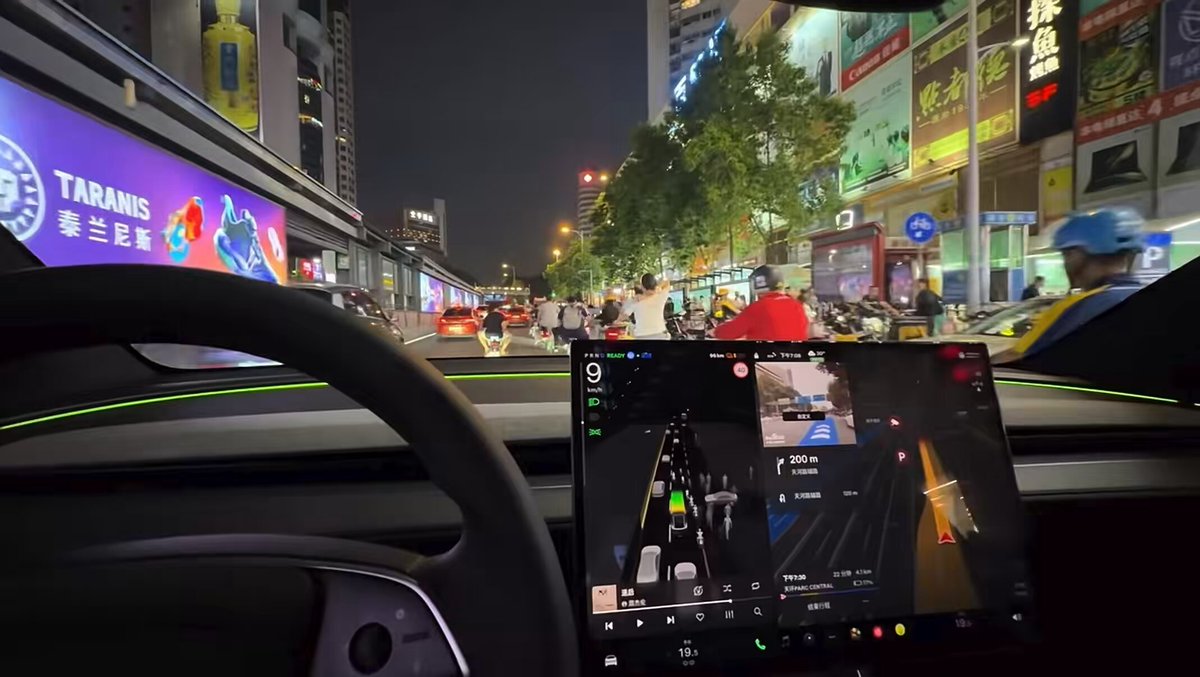
New footage out of Guangzhou shows Tesla FSD (Supervised) — known in China as TAD — confidently navigating dense downtown city streets, offering a real-world look at how the system handles complex urban environments. The clip also reveals two notable UI upgrades: 3D navigation maps and a live intersection preview that displays an overhead view of the upcoming junction before you reach it. These enhancements suggest Tesla is actively refining the in-car experience for Chinese drivers beyond just the core autonomy stack. Neither the 3D maps nor the intersection preview feature has been officially announced by Tesla China, so treat their rollout status as unconfirmed for now. 🔍

Tesla's self-driving push in China is real, it's moving, and it's more complicated than a single tweet suggests. A video shared by Whole Mars Catalog on August 5 shows Tesla's assisted driving system operating on Chinese roads — a snapshot of where one of the world's most important automotive markets currently stands with the technology.

What's Actually Available — and What Isn't
Tesla officially confirmed "Full Self-Driving (Supervised)" availability in China on May 21, 2026, placing the country alongside the US, Canada, Australia, South Korea, and the Netherlands. But the story has a few layers worth unpacking.
Chinese buyers have technically been able to purchase FSD since early 2025, though that earlier version was a limited, localized variant. The May confirmation formalized the supervised system's broader availability. Then, in late May, Tesla China quietly rebranded the feature entirely — dropping "Full Self-Driving" in favor of "Tesla Assisted Driving" (TAD) on its Chinese website. The reason is regulatory: Chinese authorities prohibit using terms like "fully automatic" or "autonomous driving" for Level 2 driver-assistance systems, which require constant driver supervision and hands-on control.
So what owners in China are actually using today is a Level 2 system, legally and functionally. The video circulating online shows that system working — but full unsupervised autonomy remains a future target, not a present reality.
The Regulatory Finish Line
Full regulatory approval to deploy FSD across all eligible vehicles in China is still outstanding. During Tesla's Q1 2026 earnings call in April, CFO Vaibhav Taneja stated the company is targeting full regulatory approval by Q3 2026 — meaning the window closes at the end of September.
That timeline has already slipped once. Elon Musk had projected approval around February or March 2026; that didn't materialize. Whether Q3 holds is now the central question for Tesla's China autonomous driving strategy. The company has done the groundwork: a Shanghai data center established in 2021 keeps vehicle data within Chinese borders, and Tesla satisfied four mandatory data security requirements confirmed in April 2024. The regulatory infrastructure is largely in place. What remains is the final approval decision from Chinese authorities.
Pricing and How China Differs From Other Markets
| Detail | China | US / Other Markets |
|---|---|---|
| Branding | Tesla Assisted Driving (TAD) | FSD (Supervised) |
| Purchase option | One-time: 64,000 CNY (~$9,420 USD) | Subscription only (one-time purchase ended Feb 2026) |
| Monthly subscription | Not yet available | Available |
| Classification | Level 2 (driver supervision required) | Level 2 (driver supervision required) |
| Full autonomy approval | Pending — Q3 2026 target | Varies by jurisdiction |
One notable divergence: while Tesla ended the one-time FSD purchase option in the US and other markets in February 2026, China still offers outright purchase at 64,000 CNY. A monthly subscription model has not been introduced for Chinese customers. That's a meaningful structural difference — and likely a deliberate one, given that the Chinese market's regulatory and competitive dynamics don't map cleanly onto the Western subscription playbook.
Why China Matters for FSD's Global Story
China isn't just Tesla's second-largest market by volume — it's a proving ground for autonomous driving in a genuinely different regulatory and infrastructure environment. Getting full approval there would validate the system's adaptability beyond North American road conditions and unlock a massive addressable market for a feature that carries significant per-vehicle revenue.
The Q3 2026 deadline is close. If approval comes through before September 30, expect Tesla to move quickly on both the commercial rollout and the inevitable announcement. If it slips again, the gap between Musk's timelines and regulatory reality in China will become a harder story to dismiss. Either way, the footage circulating this week is a reminder that the system is already on Chinese roads — the question is how much further it's allowed to go.
Related Gear
Gear up your Tesla with tested, custom-fit BASENOR accessories — shop Tesla accessories →
Sources & reporting notes
The links below identify the material source records used for this report.
- @wholemars on X (2026-08-05T12:56:11.000Z) — Direct source
Source links are preserved as published or accessed. See our editorial standards and corrections policy.
The BASENOR Editorial Desk covers Tesla, SpaceX, and related technology, curating reporting from primary sources — official accounts, regulatory filings, and software release data. Every article passes source-record and fact-checking review before publication. About the newsroom.
This report was curated by the BASENOR Editorial Desk from the sources listed above. Read our editorial standards or email editorial@basenor.com to report an error.