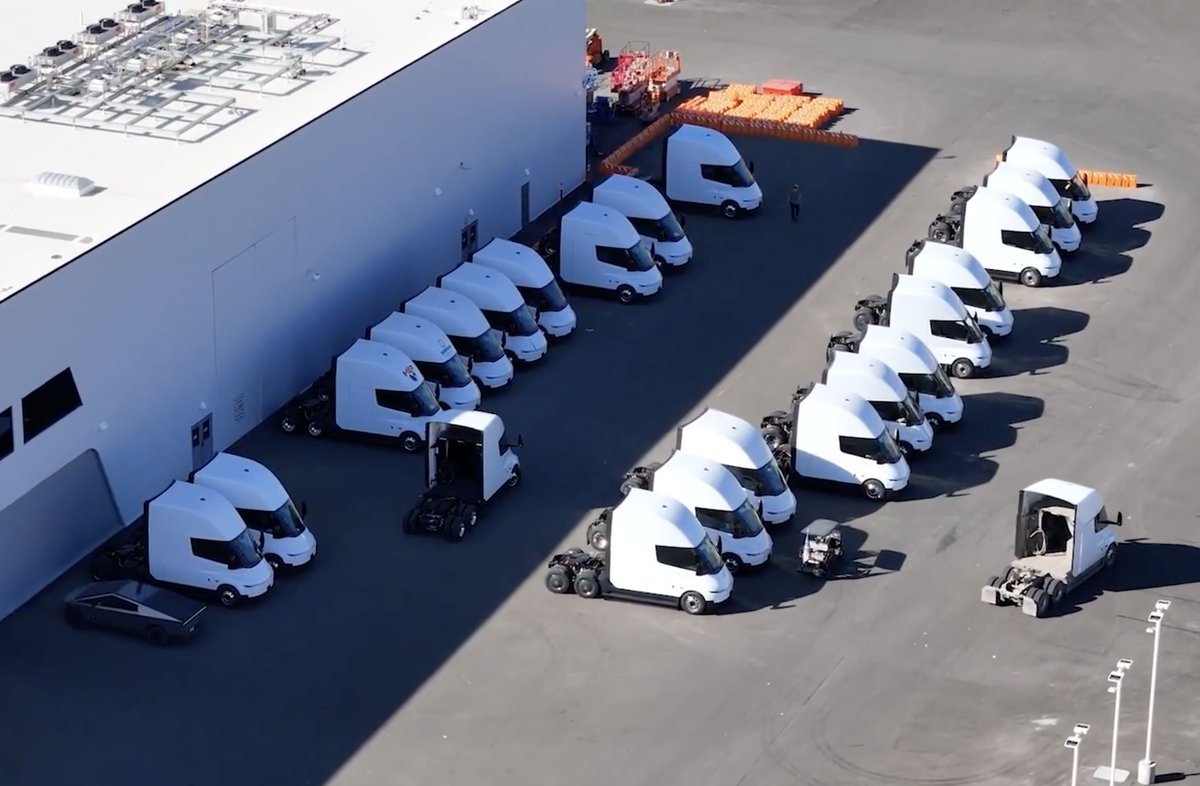
Over 40 Tesla Semis were spotted on the lot at Tesla's dedicated Nevada factory on October 10, 2026 — a sighting that has the trucking and EV world buzzing. After years of delays, the electric Class 8 truck appears to be rolling off the line in genuine volume. Here's what the sighting actually tells us, and what's still uncertain.

What does seeing 40+ Semis on the lot actually confirm?
It confirms that Tesla's Nevada Semi factory is producing trucks at a pace meaningful enough to accumulate a visible staging inventory. A single lot with 40+ units suggests the line is running consistently, not just building one-offs for testing or press events. That said, a parking lot sighting doesn't tell us the exact daily build rate — it could reflect several days of output being staged before delivery dispatch, or a short-term inventory build ahead of a customer delivery wave.
Where exactly is this factory, and how big is it?
Tesla built a dedicated 1.8 million-square-foot Semi manufacturing facility adjacent to Gigafactory Nevada in Sparks. It's purpose-built for the Semi — not a converted section of an existing plant. According to previous reports, the facility is designed with an annual capacity target of up to 50,000 Semis per year, which works out to roughly 960 trucks per week at full utilization.
Has Tesla actually started delivering Semis to customers yet?
Yes. First customer deliveries began around late September 2026, according to Tesla's own announcement on X. The October 10 sighting comes roughly two weeks into that delivery phase, which aligns with a ramp-up pattern: build inventory, begin deliveries, then scale both simultaneously. The trucks spotted on the lot are likely a mix of units awaiting transport to customers and freshly completed production.
Tesla said it would hit 'volume production' in 2026 — did it?
Technically, not quite — at least not by Tesla's own earlier definition. In July 2026, Tesla stated it expects to build 'many thousands' of Semis before year-end but acknowledged it would fall short of the full 'volume production' milestone it had originally targeted for 2026. The primary constraint cited was battery cell capacity, not manufacturing capability at the truck plant itself. So what we're seeing now is a genuine high-volume ramp, but the ceiling is being set by cell supply, not assembly throughput.
Why did the Semi take so long to reach this point?
The Semi was first unveiled in November 2017 with an original delivery target of 2019. The program was repeatedly pushed back — first by production prioritization (Model 3, Model Y, Cybertruck all took precedence), then by the challenge of sourcing enough 4680 battery cells to power a Class 8 truck at competitive range and cost. The Semi requires a substantially larger battery pack than Tesla's passenger vehicles, making it acutely sensitive to cell supply constraints. The Nevada factory itself only came online for initial production in late 2022 for a small pilot batch delivered to PepsiCo.
What does this mean for fleet operators who placed reservations?
If you or your company holds a reservation, the October sighting is a positive signal that the delivery queue is moving. Tesla has not published a public reservation backlog number, so it's difficult to estimate wait times precisely. The most actionable step is to ensure your reservation account details and delivery address are current in Tesla's fleet portal — Tesla typically contacts reservation holders directly when their delivery window approaches. Given the battery cell constraint acknowledged in July, delivery timelines for later-queue reservations may still stretch into 2027.
The Semi program has been a long time coming. Seeing 40+ trucks staged in Nevada — not as a press stunt, but as routine production output — is the clearest sign yet that Tesla's heavy-duty bet is finally paying off. The next number worth watching: how many units Tesla actually reports delivered when Q4 2026 earnings roll around.
Related Gear
Gear up your Tesla with tested, custom-fit BASENOR accessories — shop Tesla accessories →
Sources & reporting notes
The links below identify the material source records used for this report.
- @SawyerMerritt on X (2026-10-10T03:33:08.000Z) — Direct source
Source links are preserved as published or accessed. See our editorial standards and corrections policy.
The BASENOR Editorial Desk covers Tesla, SpaceX, and related technology, curating reporting from primary sources — official accounts, regulatory filings, and software release data. Every article passes source-record and fact-checking review before publication. About the newsroom.
This report was curated by the BASENOR Editorial Desk from the sources listed above. Read our editorial standards or email editorial@basenor.com to report an error.