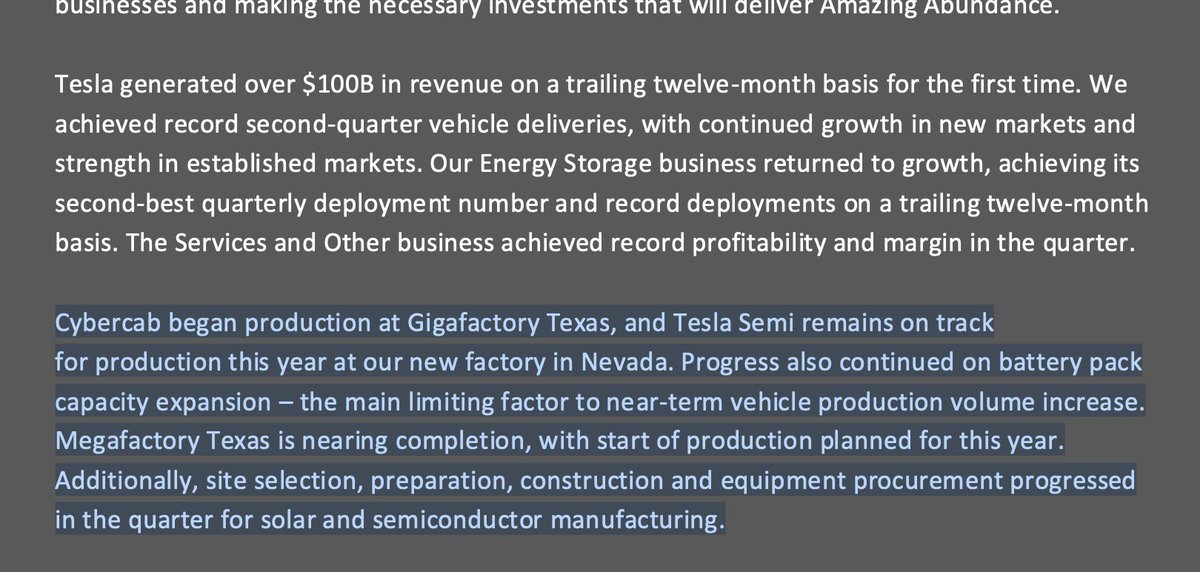
Tesla reaffirmed Tuesday that its Semi truck program remains on schedule for production this year at the company's dedicated Nevada factory, while making clear that battery pack capacity — not factory floor space or demand — is the primary brake on how fast it can scale vehicle production globally. The update came as part of Tesla's latest manufacturing capacity disclosure, which also confirmed Cybercab production has begun at Gigafactory Texas.

Where the Semi Program Stands
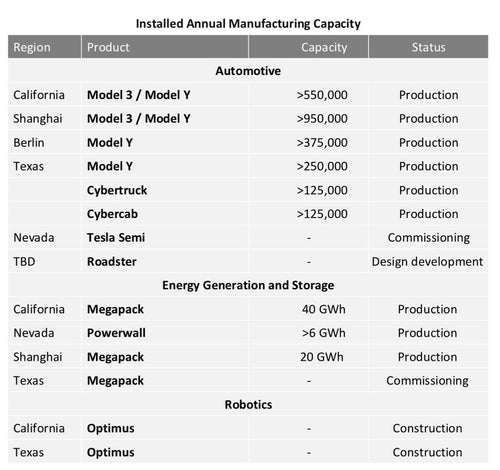
Tesla's Nevada Semi factory — a 1.7-million-square-foot facility in Sparks, adjacent to Gigafactory Nevada — officially began high-volume production on April 29, 2026, according to previous company disclosures. The plant targets an annual run rate of 50,000 units. In its updated manufacturing capacity chart released Tuesday, Tesla listed the Semi line as "Commissioning," a status that signals the production system is being validated and optimized rather than running at full rate.
Tesla has said it expects to build "many thousands" of Semis before the end of 2026. Industry analysts have projected 2026 deliveries in the range of 5,000 to 15,000 units — a wide band that reflects genuine uncertainty about how quickly the ramp will accelerate. The commissioning label on the capacity chart is consistent with that picture: the factory exists and is producing, but the line hasn't been signed off at full throughput yet.

One structural advantage the Nevada factory has over earlier Semi pilot production: it sits next door to Tesla's 4680 cell manufacturing operation. The Semi Long Range variant requires 822 kWh of usable battery capacity — roughly ten times what a Model Y carries. Getting those cells down the road rather than across the country was always going to matter for cost and logistics, and the co-location was a deliberate design choice when Tesla selected the site.
Battery Pack Capacity: The Honest Constraint
Tesla was unusually direct in its language around the supply chain picture. The company stated that battery pack capacity "remains the limiting factor on ramping our vehicle production globally" — not demand, not labor, not factory capacity. That framing matters because it tells you where Tesla is spending its capital and engineering attention right now.

The company noted progress on "new battery and material factories," specifically calling out vehicle pack capacity expansion in Berlin. Gigafactory Berlin has been scaling its own cell and pack production, and adding pack capacity there reduces the load on Nevada and Fremont to supply European-market vehicles — freeing up cells for the Semi ramp and for Cybercab volume at Gigafactory Texas.
The capacity chart released alongside Tuesday's update listed Cybercab at greater than 125,000 units of installed annual capacity. That's a meaningful number: Cybercab uses a much smaller battery pack than the Semi, so each incremental cell produced can go further in Cybercab volume terms. The tension Tesla is managing is allocating a constrained cell supply across three very different vehicle programs — Cybercab, the broader consumer lineup, and Semi — each with its own pack size and margin profile.
What This Means for the Semi Program's Credibility
Tesla has a long history of optimistic production timelines on the Semi specifically. The truck was first unveiled in 2017, with initial deliveries originally promised for 2019. The first customer deliveries didn't happen until December 2022, and volume production has been a slow build since. Against that backdrop, the "commissioning" status and the reiterated 2026 production commitment deserve some scrutiny.
That said, the Nevada factory is a real, purpose-built asset — not a tent or a converted warehouse. The co-location with 4680 cell production addresses the single biggest bottleneck that plagued earlier Semi production. And Tesla's language Tuesday was measured rather than promotional: "remains on track" and "commissioning" are not the kind of phrases a company uses when it's trying to hype a program. They're the language of an operation that's running but hasn't hit its stride.
The battery constraint acknowledgment is the more strategically significant disclosure. It confirms that Tesla's near-term production ceiling is set in the cell and pack factories, not on the vehicle assembly lines. Progress in Berlin and Nevada on pack capacity will determine how fast the Semi ramp accelerates — and how quickly Cybercab can scale beyond its current installed capacity figure. Both timelines are running on the same resource.
🚕 Following the Robotaxi rollout? See every operating city, launch date and announced market in our Tesla Robotaxi Tracker.
Related Gear
Gear up your Tesla with tested, custom-fit BASENOR accessories — shop Tesla accessories →
Sources & reporting notes
The links below identify the material source records used for this report.
- @SawyerMerritt on X (2026-07-22T20:08:21.000Z) — Direct source
- @SawyerMerritt on X (2026-07-22T20:10:28.000Z) — Direct source
- @SawyerMerritt on X (2026-07-22T20:13:35.000Z) — Direct source
Source links are preserved as published or accessed. See our editorial standards and corrections policy.
The BASENOR Editorial Desk covers Tesla, SpaceX, and related technology, curating reporting from primary sources — official accounts, regulatory filings, and software release data. Every article passes source-record and fact-checking review before publication. About the newsroom.
This report was curated by the BASENOR Editorial Desk from the sources listed above. Read our editorial standards or email editorial@basenor.com to report an error.