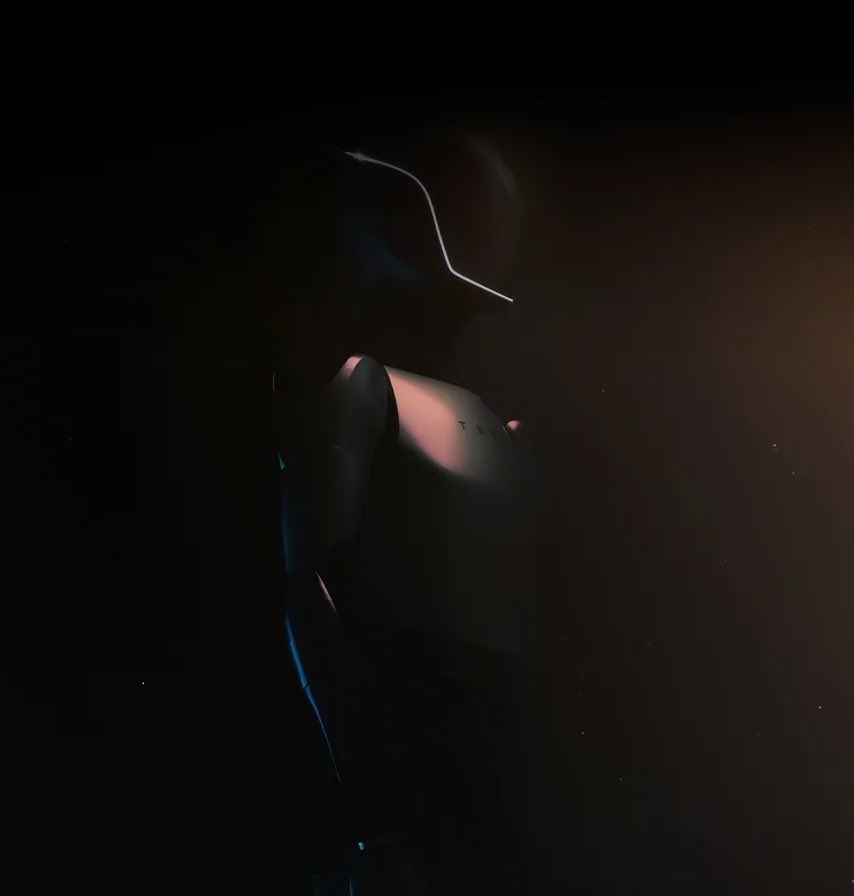
Tesla has started producing its Optimus humanoid robot on high-volume manufacturing lines at Gigafactory Texas, with the company confirming that the first units coming off the line are production-quality hardware. The milestone shifts Optimus from a hand-built prototype program into a repeatable factory process — the single hardest transition for any new hardware product, and one Tesla has publicly committed billions of dollars to over the next three years.
The announcement, surfaced via @TeslaNewswire on October 21, cites Tesla's own language: “The bots coming off this line are the first production-quality bots that we have manufactured. While we will continue to iterate on the hardware and manufacturing process, we have proven that” — a statement that frames this as the start of a sustained manufacturing ramp rather than a one-off demonstration build.

Why This Is a Bigger Deal Than It Sounds
Humanoid robots have existed in research labs for decades. What has not existed is a humanoid robot built on an automotive-style production line, using automotive-grade suppliers, tolerances, and takt times. According to Tesla's prior public communications on the Optimus program, that was always the explicit goal: move the robot off a bench where engineers hand-assemble each actuator and onto a line where the same assembly steps repeat reliably, hour after hour.
The distinction between “prototype” and “production-quality” is the entire ballgame here. Prototype units can achieve impressive demos because they are tuned, hand-calibrated, and often repaired between appearances. Production-quality units have to come off a line consistent enough that two randomly selected robots behave the same way, with the same degrees of freedom, the same battery performance, and the same compute stack. That is the bar Tesla is claiming to have cleared.
Independent reporting indicates that what is running at Giga Texas today should be understood as pilot high-volume production — a line configured for scale, now proving it can produce at scale, but not yet running at the hundreds-of-thousands-per-year rates Tesla has previously targeted. That ramp is still ahead, and the next 12-24 months will determine whether the line can scale without the yield problems that typically plague first-generation hardware.
How We Got Here
Tesla first revealed the Optimus concept at AI Day in 2021 with a human in a bodysuit on stage. The first functional prototype walked, slowly, in 2022. Gen 2 followed in late 2023 with faster movement and more dexterous hands. Through 2024 and 2025, Tesla showed Optimus units performing increasingly complex factory tasks — sorting objects, folding laundry, walking across uneven terrain — and began deploying small numbers inside its own facilities for internal work.
The pivot that made this week's milestone possible happened earlier in 2026, when Tesla confirmed it was converting portions of the Fremont Model S and Model X production footprint to Optimus manufacturing after ending S/X vehicle production in May 2026. Giga Texas was always planned as the primary volume site, with Fremont handling additional capacity and more specialized builds. The Texas line coming online this fall is the first time any automaker has committed real factory floor space, at a real vehicle plant, to building humanoid robots at volume.
What Tesla Owners Should Actually Take From This
For Tesla vehicle owners, the direct impact is zero in the short term. Optimus is not going to show up in your garage, your service center, or your Supercharger stop next quarter. But the second-order effects are worth paying attention to.
First, Optimus and FSD share the same AI foundation. The neural networks that teach Optimus to perceive its environment, plan actions, and execute them in the real world are architecturally related to the networks that drive Tesla vehicles. Every mile of data Optimus generates in a factory feeds back into the same training pipeline. Owners should expect this cross-pollination to accelerate as Optimus moves from dozens of units to thousands.
Second, Tesla's capital allocation is now visibly tilted toward Optimus. The company has repeatedly told investors that Optimus could eventually be a larger business than vehicles — a claim that was easy to dismiss when the robot was a prototype. With a production line now running, that forecast gets tested in public, and quarterly updates will start including Optimus unit counts, cost-per-robot data, and deployment destinations.
Third, the manufacturing muscle Tesla is building for Optimus — precision actuators, lightweight structures, high-density batteries, embedded compute — overlaps substantially with next-generation vehicle platforms. Any yield or supply-chain progress on the Optimus line is relevant to future Tesla hardware, including the Cybercab robotaxi platform.
Key Figures
| Metric | Current Status |
|---|---|
| Production Site | Gigafactory Texas (primary) |
| Production Phase | High-volume pilot — first production-quality units |
| Program Start (public reveal) | AI Day, August 2021 |
| First Walking Prototype | 2022 |
| Secondary Site | Fremont (converted from Model S/X) |
What to Watch Next
- Weekly production rate — Tesla has not disclosed a target cadence from the Texas line. Watch for teardown videos, drone flyovers, and investor-day updates for signals on whether the line is building units per day, per week, or still per month.
- External deployments — So far Optimus has been shown doing work inside Tesla facilities. The next real test is units deployed at a customer site or partner factory, operating in a less controlled environment.
- Pricing and ordering — Tesla has previously suggested a $20,000–$30,000 target price range for Optimus. No commercial order window is open as of this writing. Any announcement of a reservation program would be a major event.
- Q4 2026 earnings call — Expect this milestone to be a centerpiece. Pay attention to any specific Optimus revenue, unit, or margin disclosures.
FAQ
Is Optimus actually being sold to customers yet?
No. The units currently coming off the Giga Texas line are production-quality but are being used internally by Tesla or deployed in controlled settings. There is no public order process, no price list, and no delivery timeline for external customers at this stage.
How is this different from the Optimus demos we've seen for years?
Previous public demonstrations featured hand-built or small-batch prototype units, often tuned individually for specific tasks. “Production-quality” means units built on a repeatable assembly line that could, in principle, scale to tens of thousands of identical robots without re-engineering each one.
Does this affect Tesla's vehicle production?
Not directly. Giga Texas continues to build Cybertruck and Model Y. The Optimus line occupies dedicated floor space. Separately, the Fremont lines that previously built Model S and Model X ended vehicle production in May 2026 and are being converted to additional Optimus capacity.
Will Optimus run the same software as my Tesla's FSD?
Not literally the same software, but they share AI architecture, training infrastructure, and some perception components. Advances on one program typically feed the other. Vehicle owners should expect ongoing FSD improvements to benefit indirectly from the data and model work driven by Optimus development.
When will Optimus be available to buy?
Tesla has not announced a consumer availability date. Elon Musk has previously suggested external sales could begin in 2026 or 2027, but no reservation system or firm commercial launch has been confirmed. For now, Optimus remains in an industrial-first deployment path, with Tesla itself as the initial customer.
Today's milestone does not change what any Tesla owner can do with their car tomorrow morning. But it does change the trajectory of the company owning that car. For the first time, Optimus has stopped being a slide in a keynote and started being a product coming off a line — and the next few quarters will reveal whether Tesla's bet on humanoid robotics as a trillion-dollar business is substance or spectacle.
🤖 Tracking Tesla's humanoid robot? See every Optimus production milestone and appearance in our Tesla Optimus Tracker.
Related Gear
Gear up your Tesla with tested, custom-fit BASENOR accessories — shop Tesla accessories →
Sources & reporting notes
The links below identify the material source records used for this report.
- @TeslaNewswire on X (2026-10-21T21:04:28.000Z) — Direct source
Source links are preserved as published or accessed. See our editorial standards and corrections policy.
The BASENOR Editorial Desk covers Tesla, SpaceX, and related technology, curating reporting from primary sources — official accounts, regulatory filings, and software release data. Every article passes source-record and fact-checking review before publication. About the newsroom.
This report was curated by the BASENOR Editorial Desk from the sources listed above. Read our editorial standards or email editorial@basenor.com to report an error.