30-Second Brief
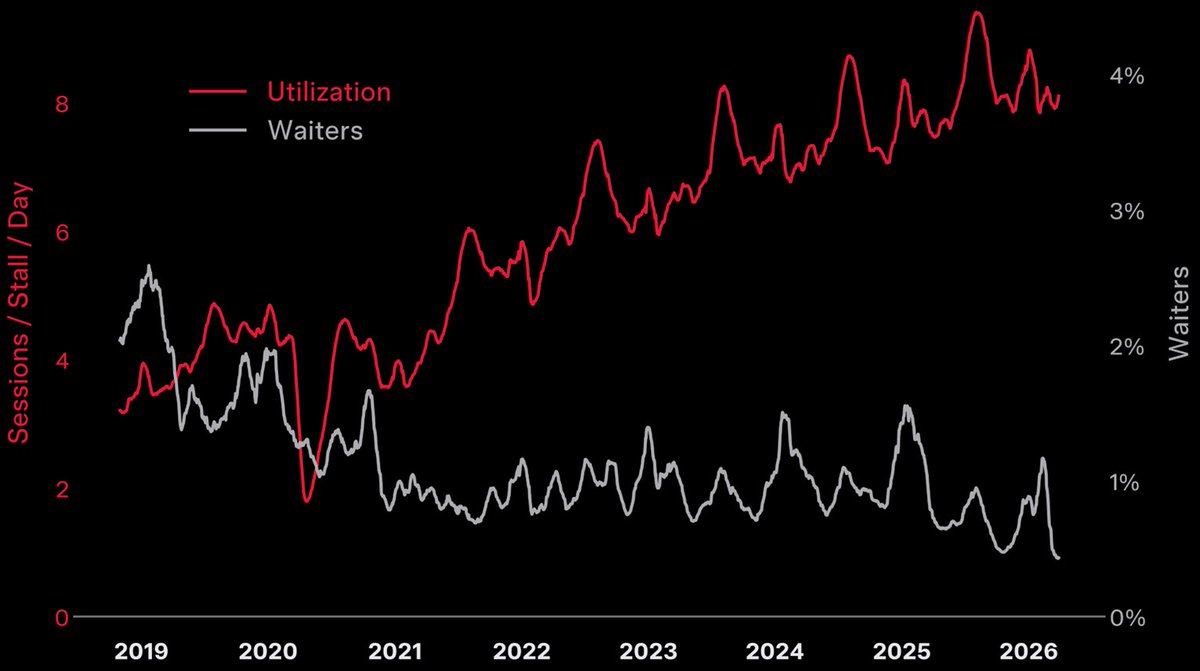
The News: Tesla's Supercharger network has reached an average of 8 charging sessions per stall per day, while fewer than 1% of users experience any wait time for a stall.
Why It Matters: This combination — high utilization with near-zero congestion — is a direct result of Tesla's software-driven demand management, and it sets a benchmark no other public charging network has matched.
Source: @wholemars on X
Tesla's Supercharger Network Hits 8 Sessions Per Stall Daily — With Less Than 1% of Drivers Waiting
Two numbers. That's all it takes to understand why Tesla's Supercharger network is in a class of its own right now.
Whole Mars Catalog shared data today showing the Supercharger network is averaging 8 charging sessions per stall per day — while fewer than 1% of users are waiting for a stall to open up. If you've spent any time thinking about charging infrastructure, you know those two figures shouldn't coexist. High utilization almost always means congestion. Here, it doesn't. That's the story.

📊 Key Figures
| Metric | Value | Context |
|---|---|---|
| Sessions per Stall per Day (global avg) | 8 | ~2× the rate in mid-2021 |
| Users waiting for a stall | <1% | Near-zero congestion rate |
| Global Supercharger stalls (end of 2025) | ~77,682 | +17–19% YoY growth |
| Energy delivered in 2025 | 6.7 TWh | Record; exceeds all other fast chargers outside China combined |
| North America sessions per stall per day | 10 | Highest regional figure (June 2025) |
| Average session energy | 35.5 kWh | Q2 2025 average per session |
| Q4 2025 global charging sessions | ~52 million | Single quarter record |
Why High Utilization + Low Wait Times Is So Hard to Achieve
In any physical queuing system — airports, gas stations, parking garages — utilization and congestion move together. Pack more throughput into fixed capacity and wait times climb. That's basic operations math. The fact that Tesla has decoupled these two variables is genuinely unusual, and it's not an accident.
The global average of 8 sessions per stall per day has roughly doubled since mid-2021, according to Tesla's own data. North America is running even hotter at 10 sessions per stall per day. Europe sits at 7. APAC (excluding China) is at 5.3. The network is busier than it has ever been — and yet the overwhelming majority of drivers pull up, find an open stall, and plug in without waiting.
The mechanism behind this is Tesla's integrated software stack. The navigation system routes drivers to Superchargers based on real-time stall availability, not just proximity. It pre-conditions the battery en route to maximize charging speed and minimize time on the charger. It staggers arrivals across nearby sites when one location is approaching capacity. The result is demand that gets distributed across the network rather than piling up at any single point.
The Virtual Queue Pilot: Solving the 1% Problem
Tesla isn't ignoring that sub-1% of sessions where waits do occur. In Q2 2025, Tesla piloted a virtual queuing system at select high-traffic Supercharger sites — essentially a digital line that lets drivers wait nearby rather than circling the lot. It's a targeted fix for peak-hour congestion at the busiest locations, and it signals that Tesla is actively working to push that wait rate even lower rather than accepting it as a floor.
The hardware side is keeping pace too. V4 Supercharger cabinets, which began rolling out in Q3 2025, deliver up to 500 kW per stall for passenger vehicles and support three times the power density of V3 hardware. More power per square foot means faster sessions, faster turnover, and more capacity headroom before congestion becomes a real issue.
🔭 The BASENOR Take
Timeline: Utilization has been climbing steadily since mid-2021. The current 8 SSD global average represents a sustained, multi-year trend — not a one-quarter spike.
Impact Level: High — for both current Tesla owners and the broader EV charging conversation.
Confidence: High — figures are consistent with Tesla's published quarterly data and corroborated by third-party tracking.
The charging anxiety narrative that dominated EV discourse for years was never really about charger count — it was about reliability and availability. Tesla has been quietly dismantling that narrative with data. When you can run 8 sessions per stall per day and still have 99%+ of drivers arrive to an open stall, you've effectively solved the availability problem at scale.
What makes this sustainable is that the software advantage compounds. Every new Tesla added to the fleet feeds more routing data back into the system. Every new Supercharger site is placed using demand modeling that accounts for existing traffic patterns. The network gets smarter as it grows, which is why utilization can climb without congestion following it upward.
For owners, the practical takeaway is straightforward: the Supercharger network is more reliable today than it has ever been, and the trajectory is pointing in the right direction. The virtual queue pilot and V4 hardware rollout both suggest Tesla is focused on maintaining that reliability even as the fleet — and the demand — continues to grow.
Related Gear
Gear up your Tesla with tested, custom-fit BASENOR accessories — shop Tesla accessories →
Sources & reporting notes
The links below identify the material source records used for this report.
- @wholemars on X (2026-04-01T14:43:59.000Z) — Direct source
Source links are preserved as published or accessed. See our editorial standards and corrections policy.
The BASENOR Editorial Desk covers Tesla, SpaceX, and related technology, curating reporting from primary sources — official accounts, regulatory filings, and software release data. Every article passes source-record and fact-checking review before publication. About the newsroom.
This report was curated by the BASENOR Editorial Desk from the sources listed above. Read our editorial standards or email editorial@basenor.com to report an error.