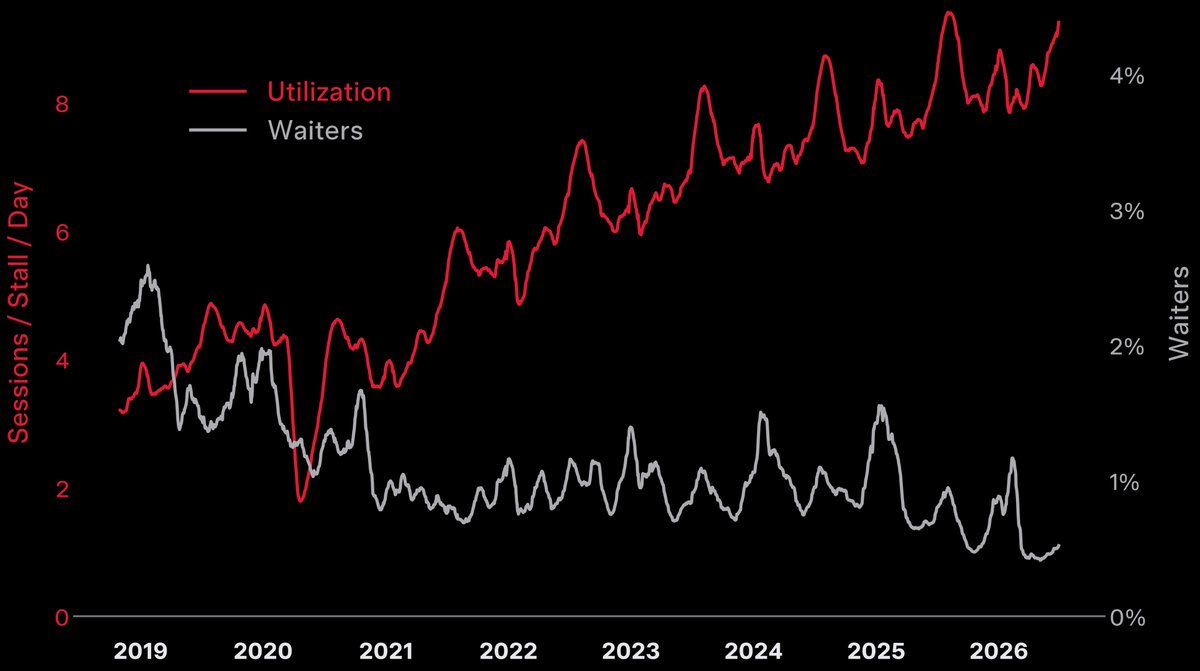
Tesla's Charging team has released fresh utilization data for the Supercharger network, and the numbers tell a compelling story: more charging than ever, with almost nobody waiting. The global average has reached approximately 9 sessions per stall per day — an all-time high — while the share of drivers who experience a wait has fallen to just 0.4–0.5%, near a record low.

What the Numbers Actually Mean
Nine sessions per stall per day is a meaningful benchmark. Assuming an average charge of roughly 30–45 minutes, that translates to stalls running at productive utilization for 4.5–6.75 hours out of every 24 — high throughput for public charging infrastructure without creating the congestion that typically follows. The 0.4–0.5% wait rate is the more striking figure: it means that out of every 200 charging sessions globally, fewer than one ends with the driver circling for an open stall.
For context, Q2 2026 data shows the network delivered a record 2.0 terawatt-hours of energy — a 30% increase versus Q2 2025 — across approximately 60 million total charging sessions, up 32% year-over-year, according to verified reporting. That volume is being absorbed by a network that added roughly 2,700 new stalls during the quarter alone, a 17% year-over-year expansion.
| Metric | Q2 2026 | Change YoY |
|---|---|---|
| Energy Delivered | 2.0 TWh | +30% |
| Total Charging Sessions | 60 million | +32% |
| New Stalls Added (Q2) | ~2,700 | +17% total network YoY |
| Avg. Sessions per Stall/Day | ~9 (global) | All-time high |
| Wait Rate | ~0.4–0.5% | Near record low |
How Tesla Is Staying Ahead of Demand
The low wait rate despite record utilization is not accidental — it reflects a deliberate expansion strategy. As of mid-May 2026, the global Supercharger network had crossed 80,000 stalls. Gigafactory New York concluded production of V3 Supercharger cabinets in March 2026, with V4 now the standard. V4 hardware supports up to 500 kW for passenger vehicles and up to 1.2 MW per stall for the Tesla Semi, with each cabinet capable of supporting up to eight stalls — a significant density improvement over previous generations.
Tesla has also been stress-testing high-demand locations with infrastructure rather than just software. A waitlist pilot program launched on May 11, 2026, at five high-traffic US stations — including Los Gatos Boulevard in California and East Gun Hill Road in the Bronx, New York — allowing drivers to join an automatic queue rather than physically wait at a station. The low network-wide wait rate suggests this kind of targeted intervention is working where it matters most.
The Non-Tesla Factor
One variable that makes these utilization figures more impressive: the network is no longer Tesla-only. Over 27,500 Supercharger stalls globally are now accessible to non-Tesla electric vehicles as of early 2026. That means the 9-sessions-per-stall figure and the sub-0.5% wait rate are being achieved on a network absorbing meaningful third-party traffic — not just Tesla fleet growth. For the broader EV industry, that's a significant data point about what a well-managed public charging network can look like at scale.
The open question going into Q3 is whether expansion can keep pace as Tesla's own fleet continues to grow alongside rising non-Tesla adoption. With North America already running above 10 sessions per stall per day in prior quarters, the pressure points are regional — and the next utilization report will show whether the V4 buildout is staying ahead of them. For now, the data suggests Tesla's charging infrastructure is in its healthiest state yet. For more on the network's growth, see our charging news coverage.
Related Gear
Gear up your Tesla with tested, custom-fit BASENOR accessories — shop Tesla accessories →
Sources & reporting notes
The links below identify the material source records used for this report.
- @TeslaNewswire on X (2026-07-01T19:42:08.000Z) — Direct source
Source links are preserved as published or accessed. See our editorial standards and corrections policy.
The BASENOR Editorial Desk covers Tesla, SpaceX, and related technology, curating reporting from primary sources — official accounts, regulatory filings, and software release data. Every article passes source-record and fact-checking review before publication. About the newsroom.
This report was curated by the BASENOR Editorial Desk from the sources listed above. Read our editorial standards or email editorial@basenor.com to report an error.