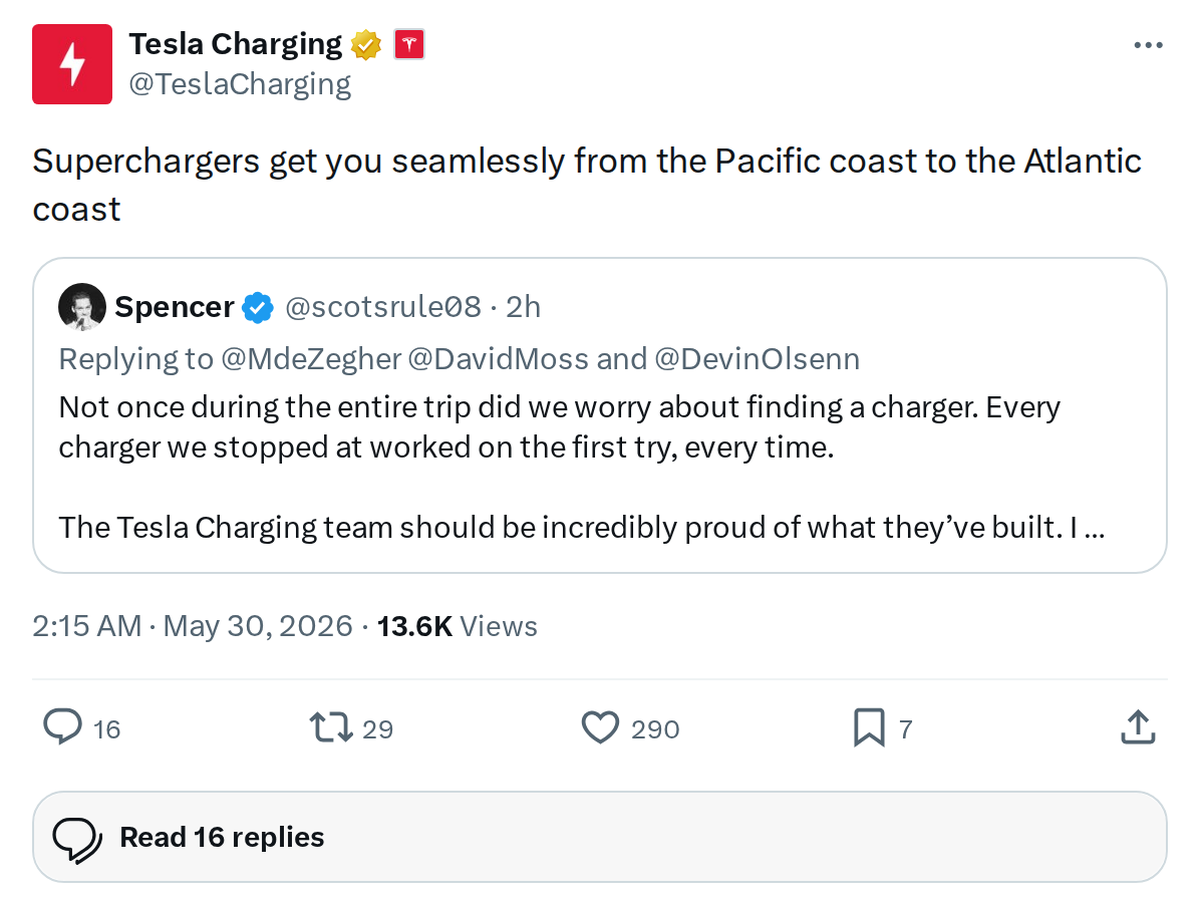
Tesla Charging made it simple in one line: Superchargers get you seamlessly from the Pacific coast to the Atlantic coast. Behind that confidence is a network that has quietly become the backbone of long-distance EV travel in North America — and the data backing that claim is more substantial than most owners realize.

The Scale Behind the Claim
As of mid-May 2026, Tesla operates 3,088 Supercharger stations across the United States housing 37,428 individual charging ports. That single figure represents 52% of all DC fast EV charging ports in the country — meaning if you pull up to a fast charger anywhere in America, there's better than a coin-flip chance it's a Tesla Supercharger.
Globally, the network has crossed 80,000 Superchargers. Growth in the US alone was aggressive through 2025: stations and ports increased 24% and 29% respectively over the course of the year, with nearly 6,800 new ports added. Public fast-charging capacity across the entire US grew roughly 30% in 2025 — and Tesla drove a disproportionate share of that expansion.
US Supercharger Network Snapshot — May 2026
| US Stations | 3,088 |
| US Charging Ports | 37,428 |
| Share of US DC Fast Charging | 52% |
| Global Superchargers | 80,000+ |
| Network Uptime | >99.9% |
| Max Charge Speed (V4) | 500 kW per stall |
Why Coast-to-Coast Actually Works Now
The practical reality of a cross-country EV trip has shifted considerably. On most major US interstates, fast charging stations are now spaced roughly every 50-70 miles in populated corridors. Superchargers can add up to 200 miles of range in approximately 15 minutes — meaning a coast-to-coast drive involves charging stops that are closer in duration to a gas station break than the multi-hour waits that defined early EV road trips.
Reliability has matched the coverage. According to a J.D. Power study released in August 2025, Tesla Superchargers posted the highest reliability rating among charging networks, with only a 4% reported failure rate during charging visits. The network's self-reported uptime exceeds 99.9% — figures that matter enormously when you're 300 miles from home and depending on a specific station.
Hardware Is Evolving Too
The network isn't just growing — it's getting faster. Gigafactory New York wrapped up production of V3 Supercharger cabinets in March 2026 and has since shifted to scaling the V4 line. V4 hardware supports up to 500 kW per stall for compatible vehicles, and the first operational 500 kW V4 Supercharger on the East Coast opened in Kissimmee, Florida, earlier this year. As V4 hardware rolls out along major travel corridors, charge times will continue to shrink for vehicles that can take advantage of the higher power.
Not Just for Tesla Owners Anymore
The coast-to-coast story now extends beyond Tesla drivers. More than 27,500 Supercharger stalls globally are accessible to non-Tesla EVs as of March 2026, with Ford, GM, Rivian, Hyundai, and Stellantis vehicles among those that can plug in. In Canada — where the network exceeds 3,000 DC fast-charging ports across 300+ locations — over 90% of Superchargers are already open to all EVs, with every new site planned for universal access.
The North American Charging Standard (NACS) adoption has accelerated this shift. By early 2026, nearly every significant automaker selling EVs in North America had either adopted NACS natively or committed to adapter access, effectively making the Supercharger network the default long-distance charging infrastructure for the continent.
For Tesla owners, the practical implication is straightforward: the network that made long-distance EV travel viable is now denser, faster, and more reliable than at any point in its history. The Pacific-to-Atlantic claim isn't marketing — it's infrastructure.
Related Gear
Gear up your Tesla with tested, custom-fit BASENOR accessories — shop Tesla accessories →
Sources & reporting notes
The links below identify the material source records used for this report.
- @TeslaCharging on X (2026-05-29T18:15:59.000Z) — Direct source
Source links are preserved as published or accessed. See our editorial standards and corrections policy.
The BASENOR Editorial Desk covers Tesla, SpaceX, and related technology, curating reporting from primary sources — official accounts, regulatory filings, and software release data. Every article passes source-record and fact-checking review before publication. About the newsroom.
This report was curated by the BASENOR Editorial Desk from the sources listed above. Read our editorial standards or email editorial@basenor.com to report an error.