30-Second Brief
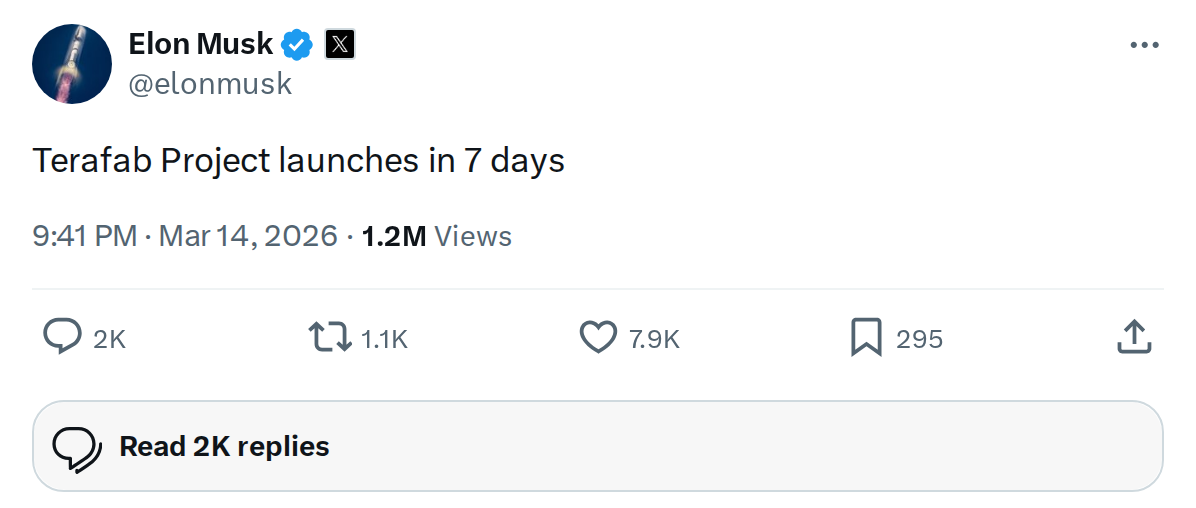
The News: Elon Musk announced on X that the 'Terafab Project' will officially launch in seven days.
Why It Matters: Terafab is Tesla's planned in-house semiconductor fabrication facility — a move that could fundamentally reduce the company's dependence on external chip suppliers and accelerate AI hardware for autonomous vehicles and Optimus robots.
Source: @elonmusk on X
Seven words. That's all it took for Elon Musk to set the semiconductor world on notice. Posted on March 14, 2026, the tweet — 'Terafab Project launches in 7 days' — has already racked up over 866,000 views, and for good reason. The Terafab Project isn't a minor internal initiative. If it delivers on what's been discussed, it represents one of the most ambitious vertical integration moves in Tesla's history.

What Is the Terafab Project?
Based on verified reporting and prior discussions, Tesla's Terafab is envisioned as a massive in-house semiconductor fabrication facility — a chip foundry built specifically to produce the advanced AI processors that power Tesla's autonomous systems and Optimus robots.
The scale of the ambition is staggering. According to prior reporting, the facility targets the 2nm process node — the same cutting-edge manufacturing tier used by the most advanced chips in the world. Initial capacity is planned at 100,000 wafer starts per month, with long-term ambitions to scale to 1 million wafer starts per month.
The strategic logic is straightforward: Tesla's AI roadmap — Cybercab robotaxis, Optimus humanoid robots, next-generation FSD — requires enormous quantities of specialized chips. Relying on external foundries creates supply chain risk, long lead times, and cost structures that aren't optimized for Tesla's specific neural network architectures. Terafab is Tesla's answer to all three problems at once.
📊 Terafab: Key Facts at a Glance
| Target Process Node | 2nm |
| Initial Capacity | 100,000 wafer starts/month |
| Long-Term Capacity Target | 1,000,000 wafer starts/month |
| Primary Chip Target | Tesla AI5 (volume production 2027) |
| Estimated Construction Cost | Several billion USD |
| Location | Undisclosed |
What 'Launch' Actually Means — And What It Doesn't
It's worth being precise here. A Terafab 'launch' in seven days almost certainly does not mean a fully operational chip fabrication facility opens its doors on March 21. Semiconductor fabs of this scale take years to construct and commission.
What 'launch' more likely signals is one of the following: a formal project announcement with location and timeline details, a groundbreaking ceremony, a public reveal of the facility's design and specifications, or the start of construction on the first phase. Musk has previously indicated openness to discussions with Intel as a potential collaboration partner for the project — a formal announcement event could also clarify whether any such partnership is moving forward.
Importantly, Tesla's fifth-generation AI chip, AI5, is expected to begin small-quantity production in 2026, with volume production projected for 2027. A Terafab launch announcement now aligns with that timeline — the facility would need to begin construction and commissioning well ahead of volume production targets.
🔭 The BASENOR Take
Timeline: Announcement March 14, 2026 → Launch event expected ~March 21, 2026 → AI5 small-batch production 2026 → Volume production 2027
Impact Level: 🔴 High — This is a foundational move for Tesla's entire AI hardware stack
Confidence: Medium — The 'launch' framing is confirmed; the specific nature of the event is not yet detailed
Analysis: If Tesla successfully builds a 2nm chip fab at scale, it becomes one of only a handful of entities on earth capable of producing frontier AI silicon in-house. The competitive implications extend far beyond Tesla's own vehicles — it potentially positions Tesla as a chip supplier or licensor to other industries. For Tesla owners, the near-term impact is on FSD capability progression and Cybercab availability. Chip supply has been a quiet bottleneck for Tesla's autonomous ambitions; Terafab is the long-game solution. The cleanroom innovation angle — reportedly dispensing with conventional cleanroom requirements by isolating wafers from contaminants — is also worth watching. If proven at scale, it could dramatically reduce the cost and complexity of building future fab capacity.
📰 Deep Dive
Tesla's push into semiconductor manufacturing follows a pattern the company has executed before: identify a critical external dependency, internalize it, and use vertical integration as a competitive moat. The company did it with battery cells (4680), with vehicle software, and with charging infrastructure. Chips are the next frontier — and arguably the most consequential one, given how central AI silicon is to every major product Tesla is building over the next decade.
The 2nm process node target is not marketing language. It represents the current leading edge of semiconductor manufacturing — the same tier being pursued by TSMC and Samsung for their most advanced customers. For Tesla to target this node in-house speaks to the seriousness of the investment and the long-term horizon of the project. This isn't a stopgap measure; it's a decade-long infrastructure bet.
For Tesla owners watching the Cybercab robotaxi program and FSD development, Terafab's progress directly determines how fast Tesla can scale autonomous capability. The current generation of Tesla AI hardware relies on chips sourced from external partners. Every quarter that supply is constrained is a quarter where FSD fleet expansion and Cybercab deployment timelines are exposed to risk. Terafab eliminates that exposure — eventually. The seven-day countdown Musk has now started means we'll have significantly more clarity on scope, location, and timeline very soon. Watch this space.
🚕 Following the Robotaxi rollout? See every operating city, launch date and announced market in our Tesla Robotaxi Tracker.
🤖 Tracking Tesla's humanoid robot? See every Optimus production milestone and appearance in our Tesla Optimus Tracker.
Related Gear
Gear up your Tesla with tested, custom-fit BASENOR accessories — shop Tesla accessories →
Sources & reporting notes
The links below identify the material source records used for this report.
- @elonmusk on X (2026-03-14T13:41:35.000Z) — Direct source
Source links are preserved as published or accessed. See our editorial standards and corrections policy.
The BASENOR Editorial Desk covers Tesla, SpaceX, and related technology, curating reporting from primary sources — official accounts, regulatory filings, and software release data. Every article passes source-record and fact-checking review before publication. About the newsroom.
This report was curated by the BASENOR Editorial Desk from the sources listed above. Read our editorial standards or email editorial@basenor.com to report an error.