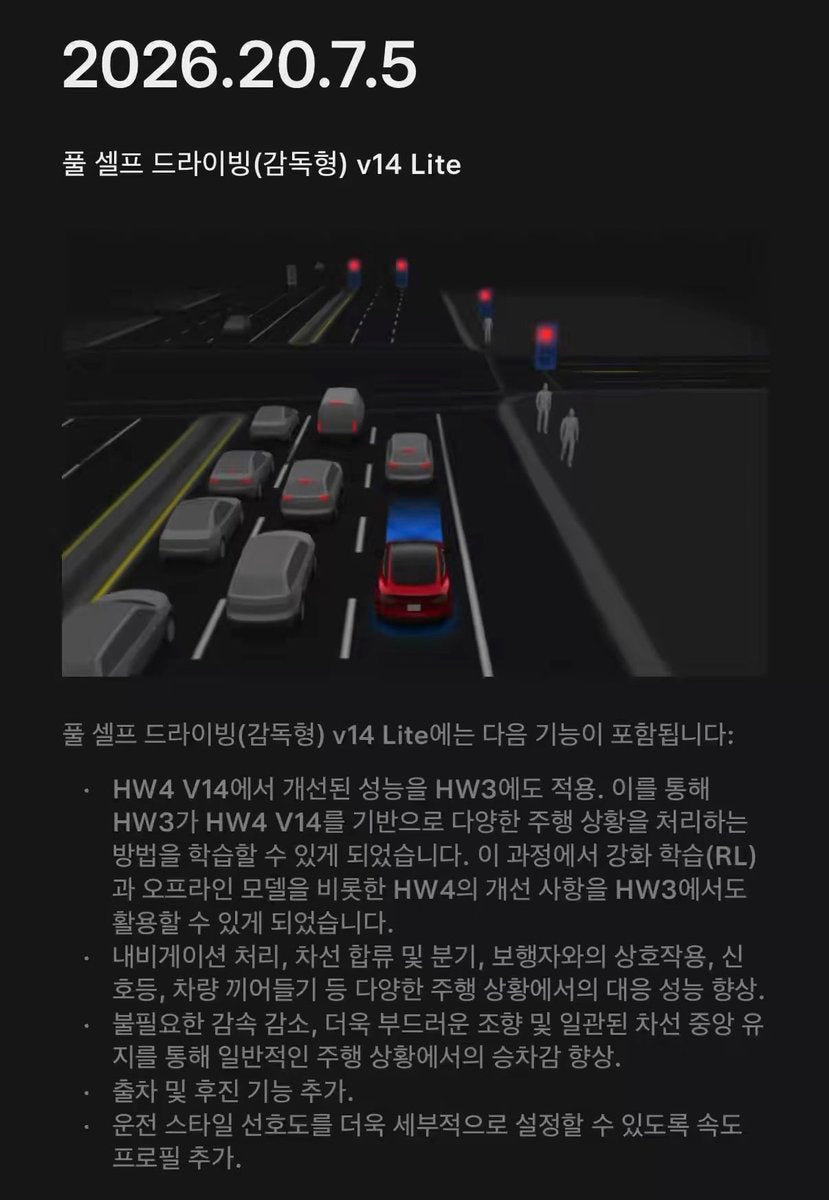
Tesla is pushing FSD (Supervised) v14 Lite to a second wave of Hardware 3 owners in South Korea via software update 2026.20.7.5. The build mirrors the 2026.20.6.10 release that went out to U.S. owners, bringing a meaningful set of driving improvements — but eligibility rules mean the vast majority of South Korean Tesla owners won't see it yet.

Who Actually Gets This Update
Before checking your car, confirm you meet every condition. According to background research, the eligibility criteria are narrow:
- Vehicle origin: US-manufactured Model 3 or Model Y only. China-built vehicles — which account for roughly 97.6% of registered Teslas in South Korea as of late April — are excluded pending a separate regulatory approval process.
- Hardware: Hardware 3 (HW3/AI3). HW4 vehicles are not part of this rollout.
- FSD status: Active FSD (Supervised) subscription or purchased FSD package.
- Vehicle age: Up to five years old.
If you're unsure of your car's manufacturing origin, check the VIN — US-built Teslas start with 5YJ. A VIN beginning with LRW indicates Chinese manufacture and is not eligible for this rollout.
What Changed in This Build
| Change | Type | Models |
|---|---|---|
| FSD (Supervised) v14 Lite — HW4 intelligence distilled into HW3, unlocking Reinforcement Learning and offline models | Official | Model 3, Model Y |
| Speed Profiles (SLOTH / CHILL / STANDARD / HURRY) — adjustable from the Self-Driving visualization | Official | Model 3, Model Y |
| Brake Confirm toggle — disable to allow FSD engagement directly via the self-driving button without a separate brake press | Official | Model 3, Model Y |
| Start Self-Driving from Park | Official | Model 3, Model Y |
| Unparking and reversing via FSD | Official | Model 3, Model Y |
| Improved proactive/reactive responsiveness — merges, pedestrian interactions, traffic lights, cut-in scenarios | Official | Model 3, Model Y |
| Smoother steering, fewer false slowdowns, consistent lane centering | Official | Model 3, Model Y |

Action Plan: What to Do Right Now
If you're an eligible HW3 owner in South Korea, work through these steps in order.
Step 1 — Check for the update
Go to Controls → Software on your touchscreen. If 2026.20.7.5 isn't showing yet, tap Check for Updates. This is a staged rollout — if it's not available today, check again in 24–48 hours.
Step 2 — Install when prompted
Schedule the install for a time your car will be parked and plugged in. The update requires the vehicle to be stationary. Keep it on Wi-Fi; downloading over cellular is slower and may fail mid-install.
Step 3 — Set your Speed Profile
After the update installs, open the Self-Driving visualization while FSD is active. You'll see the new Speed Profile selector. Start with CHILL or STANDARD to get a feel for v14 Lite's behavior before pushing to HURRY.
Step 4 — Review the Brake Confirm setting
Navigate to Controls → Autopilot → FSD (Supervised) and look for the Brake Confirm toggle. By default it's enabled, meaning you must press the brake before FSD engages. If you prefer the faster single-button engagement, you can disable it here — but understand the tradeoff before changing it.
Step 5 — Try Start Self-Driving from Park
With the car in Park, press the right scroll wheel (or the FSD button, depending on your steering wheel config). The system should now initiate FSD without requiring you to first pull away manually. This is particularly useful in tight parking scenarios alongside the new unparking capability.
The Eligibility Gap Worth Knowing
The practical reach of this rollout is limited. According to background research, approximately 97.6% of registered Teslas in South Korea are China-built — and those vehicles are excluded from this update entirely. Tesla Korea launched FSD (Supervised) v14 Lite on July 10, 2026, but regulatory approval for China-manufactured vehicles follows a separate track. There's no confirmed timeline for when that approval will come through, so owners of LRW-VIN cars should not expect this update imminently.
For the small pool of US-built HW3 owners who do qualify, this is a substantive upgrade. The core promise of v14 Lite — distilling HW4's neural network training into HW3 hardware — means these vehicles are now running a fundamentally different inference stack than they were on v13. The Speed Profiles and Brake Confirm toggle are quality-of-life additions, but the underlying driving model improvement is the headline. South Korean owners in the eligible cohort should prioritize getting this installed and spending time with it on familiar routes first before using it in complex urban environments.
📋 Tracking Tesla software? See every firmware, FSD and app version in one place in our Tesla Software Update Tracker.
Related Gear
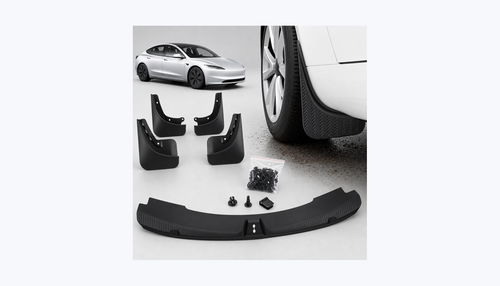
Gear up your Model 3 with tested, custom-fit BASENOR accessories — shop Model 3 accessories →
Sources & reporting notes
The links below identify the material source records used for this report.
- @TeslaNewswire on X (2026-08-08T06:53:22.000Z) — Direct source
Source links are preserved as published or accessed. See our editorial standards and corrections policy.
The BASENOR Editorial Desk covers Tesla, SpaceX, and related technology, curating reporting from primary sources — official accounts, regulatory filings, and software release data. Every article passes source-record and fact-checking review before publication. About the newsroom.
This report was curated by the BASENOR Editorial Desk from the sources listed above. Read our editorial standards or email editorial@basenor.com to report an error.