30-Second Brief
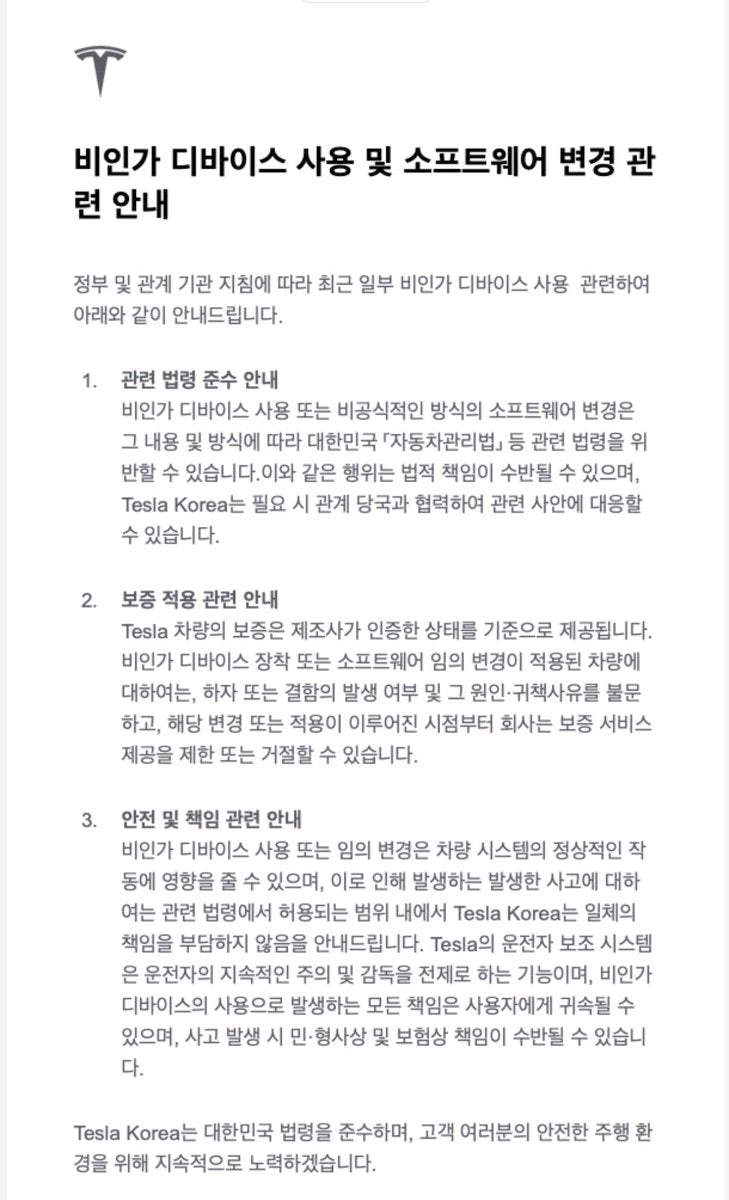
The News: Tesla has issued an official statement to South Korean vehicle owners warning against unauthorized devices that enable Full Self-Driving, with South Korea's Ministry of Land, Infrastructure and Transport (MOLIT) simultaneously issuing its own government-level warning.
Why It Matters: Using these devices exposes owners to full legal liability for any incident — and under South Korean law, it's a criminal offense carrying up to two years in prison or fines of up to 20 million won (~$14,800 USD).
Source: @teslascope on X
Tesla Warns Korean Owners: Unauthorized FSD Devices Carry Full Liability — and Criminal Charges
Tesla has fired a direct warning at vehicle owners in South Korea: if you're using an unauthorized device to enable Full Self-Driving, you are entirely on your own if something goes wrong. The statement, issued today, comes as South Korea's Ministry of Land, Infrastructure and Transport (MOLIT) separately announced its own government-level crackdown — making this a pincer movement from both the manufacturer and the regulator at the same time.

📊 What's Behind the Warning
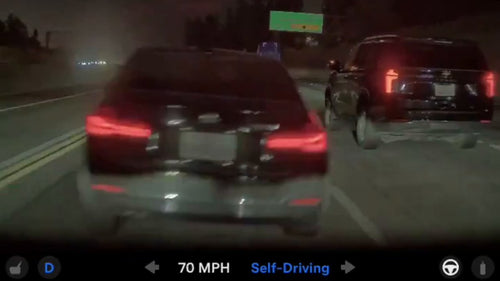
The trigger is a USB-like device — priced at around 500 euros — that has emerged in the market claiming to unlock FSD in regions where it isn't officially supported. The device reportedly works by bypassing Tesla's geofencing and software restrictions, and requires an existing FSD package plus Autopilot Hardware 3 (HW3) or HW4 to function.
Here's the core of the problem in South Korea: FSD (Supervised) was officially rolled out to select owners starting around November 2025, but it's currently only certified for U.S.-made Model S, Model X, and Cybertruck vehicles. That exemption exists because of the Korea-U.S. Free Trade Agreement, which allows those vehicles to bypass certain Korean safety standards. China-made Model 3 and Model Y vehicles — which follow European safety standards — have not received local certification for FSD and are explicitly excluded.
Tesla Korea also identified a software vulnerability linked to the unauthorized activation method and flagged it as a cybersecurity threat, which escalated the situation to the government level.
⚠️ Legal Exposure at a Glance
Maximum Penalty: Up to 2 years in prison or fines up to 20 million won (~$14,800 USD)
| Factor | Official FSD (Certified) | Unauthorized Device |
|---|---|---|
| Legal Status | ✓ Compliant | ✗ Criminal offense |
| Incident Liability | Shared / standard | 100% on the owner |
| Insurance Coverage | Maintained | Almost certainly void |
| Available Models (Korea) | Model S, Model X, Cybertruck (U.S.-made) | Any HW3/HW4 vehicle (uncertified) |
| Cybersecurity Risk | None (official software) | Active vulnerability flagged by Tesla Korea |
🚦 Owner's Action Plan
Verdict: ESSENTIAL — If you are in South Korea, read this before your next drive.
- Check your vehicle configuration immediately. If you own a China-made Model 3 or Model Y in South Korea, FSD is not certified for your vehicle. Any FSD activation you're experiencing is unauthorized by definition.
- Remove any third-party USB or external device connected to your vehicle's ports. If you purchased or received a device claiming to unlock FSD, disconnect and remove it now. The 500-euro device circulating in the market is the specific type flagged by both Tesla and MOLIT.
- Do not use FSD on uncertified models, even if it appears to work. The system functioning is not the same as it being legal. MOLIT has explicitly stated enforcement is active.
- Contact Tesla Korea if you're unsure about your vehicle's FSD eligibility. U.S.-made Model S, Model X, and Cybertruck owners may be eligible for official FSD — verify through official Tesla channels, not third-party sellers.
- Check your insurance policy. If you have been using an unauthorized activation method, contact your insurer. Operating a vehicle with unauthorized software modifications will almost certainly void coverage for incidents involving that system.
- If you purchased an FSD option for a non-supported model (Model 3 or Model Y in Korea), be aware that the Korea Fair Trade Commission has been scrutinizing Tesla's practice of selling FSD for models where it isn't yet certified. Monitor official Tesla Korea communications for updates on your eligibility timeline.
📰 Deep Dive
What makes this situation particularly sharp is the dual-front nature of the warning. Tesla issuing a liability statement is standard corporate risk management — the company is drawing a clear line between supported and unsupported use. But MOLIT stepping in on the same day signals that South Korean regulators are treating this as an active enforcement matter, not a hypothetical future concern. The government doesn't issue warnings with criminal penalty language unless it expects to use them.
The underlying tension here is real: Tesla began selling the FSD option in South Korea for vehicles it hasn't yet certified locally. Owners who paid approximately 9,043,000 won (~$6,200 USD) for FSD on a Model 3 or Model Y are sitting on a feature they legally cannot use — and that frustration creates a market for exactly the kind of unauthorized workaround now being cracked down on. The Korea Fair Trade Commission's scrutiny of this practice suggests the regulatory pressure on Tesla isn't one-directional.
On the technical side, the cybersecurity angle is worth noting. Tesla Korea specifically flagged a software vulnerability associated with the unauthorized activation method. That's not just a legal or liability issue — it means these devices may be creating exploitable attack surfaces in the vehicle's software stack. The fact that FSD Version 14 was tested on Korean highways as recently as January 2026 (with generally positive results from the Korea Expressway Corporation) shows official FSD deployment is progressing — but the certification process for China-made models hasn't caught up yet, and that gap is exactly what these unauthorized devices are exploiting.
For owners waiting on official FSD access: Tesla Korea extended the FSD (Supervised) transfer delivery deadline to June 30, 2026, for new vehicle orders placed by March 31, 2026. That's the legitimate path forward — not a 500-euro USB device that puts you on the wrong side of the Automobile Management Act.
Related Gear
Gear up your Tesla with tested, custom-fit BASENOR accessories — shop Tesla accessories →
Sources & reporting notes
The links below identify the material source records used for this report.
- @teslascope on X (2026-03-31T09:31:03.000Z) — Direct source
Source links are preserved as published or accessed. See our editorial standards and corrections policy.
The BASENOR Editorial Desk covers Tesla, SpaceX, and related technology, curating reporting from primary sources — official accounts, regulatory filings, and software release data. Every article passes source-record and fact-checking review before publication. About the newsroom.
This report was curated by the BASENOR Editorial Desk from the sources listed above. Read our editorial standards or email editorial@basenor.com to report an error.