
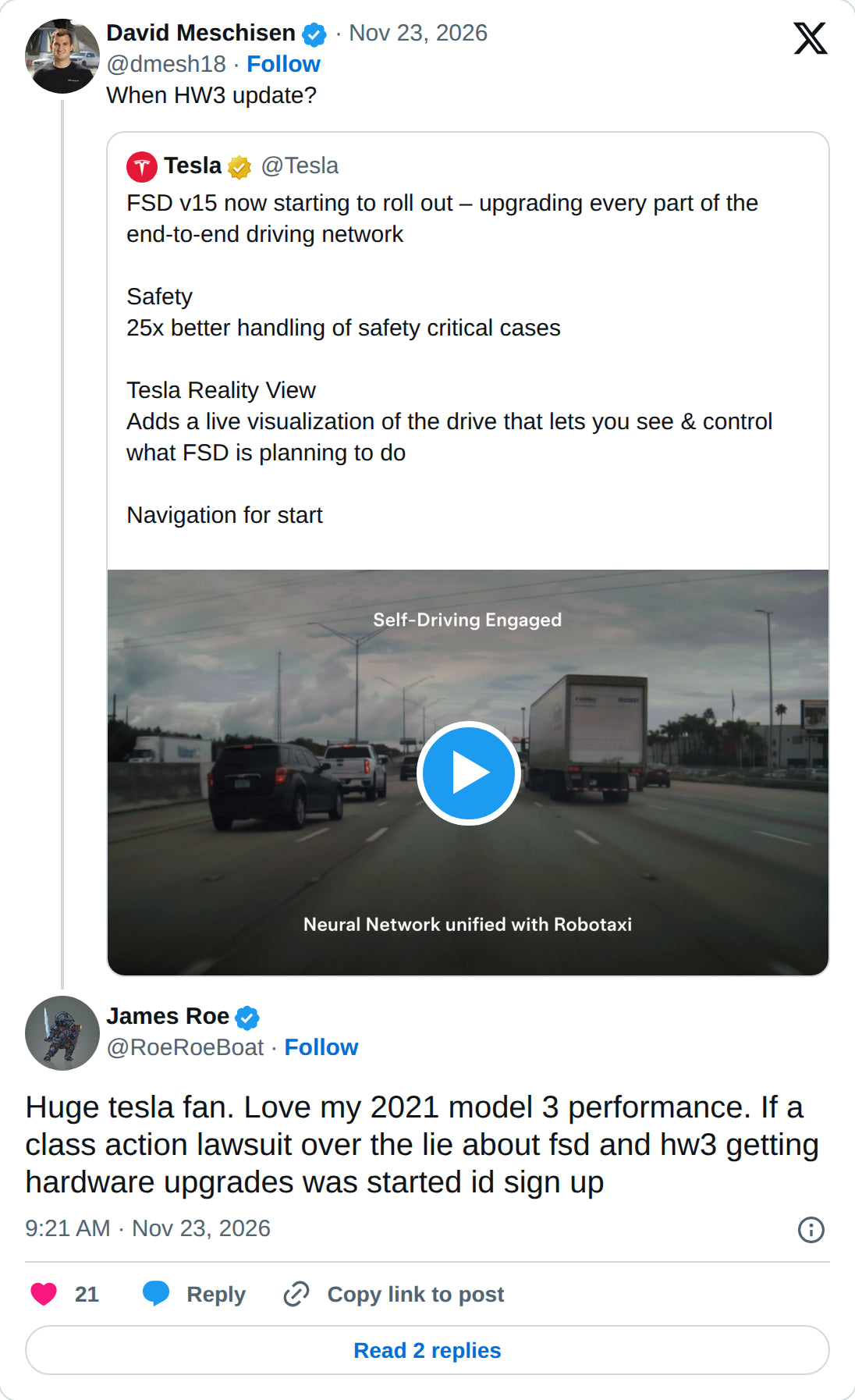
Tesla owners who paid up to $15,000 for Full Self-Driving on Hardware 3 vehicles are increasingly looking at the courts for relief — and they now have something they didn't have a year ago: the CEO's own words on record. On X, owners are openly discussing class-action lawsuits, and the legal landscape has moved well beyond talk. Multiple suits are already filed across three continents, with the US picture shifting significantly as recently as October 2026.

The Admission That Changed Everything
The legal calculus for HW3 owners shifted materially on April 22, 2026, when Elon Musk confirmed during Tesla's Q1 2026 earnings call that Hardware 3 "simply does not have the capability to achieve unsupervised FSD." He cited a specific technical bottleneck: HW3 carries only one-eighth the memory bandwidth of Hardware 4. Achieving unsupervised autonomy on an HW3 vehicle would require replacing not just the compute unit but also the camera hardware — a full-system overhaul.
That statement matters legally because Tesla sold FSD as a capability that would be delivered via over-the-air software updates to existing hardware. Owners who paid between $7,000 and $15,000 for the package in the US — or up to €7,500 in Europe — now have a public, on-record acknowledgment from the company's CEO that the hardware they own cannot fulfill that promise.

Where the Lawsuits Actually Stand
The legal picture is more developed — and more complicated — than the social media discussion suggests. Here is the current status across jurisdictions.
United States — Waller v. Tesla: A proposed nationwide class action was filed on June 4, 2026, in federal court in the Northern District of California. The suit covers owners of HW1, HW2, HW2.5, and HW3 vehicles who paid for FSD in states outside California and opted out of Tesla's arbitration agreement. This case is active and proceeding.
United States — LoSavio v. Tesla (California): The older California-focused class action had won class certification in August 2025 — a significant legal milestone. However, the Ninth Circuit Court of Appeals vacated that class certification on October 16, 2026. California FSD buyers cannot currently pursue the case as a group, though individual claims remain possible. This is a meaningful setback for the California cohort specifically.
Netherlands: A Dutch-led collective claim at hw3claim.nl had nearly 7,000 verified participants by June 2026, backed by law firm Kennedy Van der Laan. The claim seeks a portion of the vehicle's pre-HW4 catalog value plus FSD refunds of up to €6,400. The Dutch road authority (RDW) approved FSD Supervised exclusively for HW4 hardware on April 10, 2026, and confirmed that HW3 was never even submitted for regulatory assessment — a detail that significantly strengthens the European case.
Australia: Law firm JGA Saddler filed a class action in the Federal Court in 2025 covering Model 3 and Model Y owners who purchased or leased between May 2021 and February 2025. The suit covers FSD promises alongside phantom braking and range claims.
Individual small claims: Tesla has quietly refunded the full $6,000 FSD purchase price to certain HW3 owners who filed individual small claims suits for breach of contract. That pattern of settling rather than litigating individual cases is itself informative about Tesla's internal assessment of litigation risk.
What Tesla Is Offering HW3 Owners
Tesla has not simply walked away from HW3 owners. The company is offering a discounted trade-in program for HW3 owners to upgrade to newer vehicles equipped with HW4. Tesla's head of Autopilot, Ashok Elluswamy, confirmed that a "V14-lite" software update would arrive for HW3 vehicles in late June 2026, bringing some V14 features to cars that had been frozen at FSD version 12.6 since January 2025. Tesla has also indicated plans for "micro-factories" in major metropolitan areas to handle hardware replacement volume, rather than routing everything through standard service centers.
Unsupervised FSD deployment is currently targeted for Q4 2026 at the earliest — and that rollout is explicitly limited to HW4-equipped vehicles.
The settlement terms being discussed publicly by owners — a vehicle discount proportional to the original FSD purchase price, continued FSD access on the new vehicle, and no reduction in loyalty credits — mirror what Tesla has informally offered in some individual cases. Whether those terms become the basis of a formal class settlement is the open question.
The Core Legal Argument
As one owner framed it plainly on X: "This is not about how long it takes to achieve full self-driving. It's about whether the hardware is capable of achieving it at all." That distinction is legally significant. Delays can be defended; a categorical hardware ceiling is harder to argue around, particularly when the CEO has confirmed it on an earnings call.
The arbitration clause in Tesla's purchase agreement has historically been the biggest obstacle to class actions in the US. The Waller v. Tesla suit specifically targets owners who opted out of that clause — a smaller but legally cleaner plaintiff pool. The LoSavio setback in California illustrates how difficult class certification remains even with strong underlying facts.
For HW3 owners weighing their options: the small-claims route has produced full FSD refunds in documented cases and bypasses the arbitration question entirely for claims under state thresholds. The class-action path offers potentially broader relief but carries more procedural uncertainty, as the California experience demonstrates. Either way, Musk's April 2026 earnings call statement is now part of the public record — and that changes the conversation in every courtroom where this is being argued.
Related coverage
Related Gear
Gear up your Tesla with tested, custom-fit BASENOR accessories — shop Tesla accessories →
Sources & reporting notes
The links below identify the material source records used for this report.
- @RoeRoeBoat on X (2026-11-23T01:21:43.000Z) — Direct source
- @carolelucky on X (2026-11-23T14:20:45.000Z) — Direct source
Source links are preserved as published or accessed. See our editorial standards and corrections policy.
The BASENOR Editorial Desk covers Tesla, SpaceX, and related technology, curating reporting from primary sources — official accounts, regulatory filings, and software release data. Every article passes source-record and fact-checking review before publication. About the newsroom.
This report was curated by the BASENOR Editorial Desk from the sources listed above. Read our editorial standards or email editorial@basenor.com to report an error.