📌 UPDATE — August 18, 2026
The end of the 1,021-day IF Metall strike is already delivering tangible results for EV drivers: Tesla Sweden announced that more than 250 Supercharger stalls across 20 locations throughout the country are set to come online on August 19th. Tesla Sweden's press release called it "a big day for all electric car drivers throughout Sweden and tourists traveling" in the country — infrastructure that had been held back during the prolonged labor dispute. The expansion represents one of the most immediate and concrete outcomes of the strike's resolution, significantly boosting Sweden's fast-charging network ahead of peak late-summer travel season.
@SawyerMerritt · Aug 18, 2026
"More than 250 Tesla Supercharger stalls across 20 locations in Sweden are about to come online now that the 1,021 day long IF Metall strike is over."
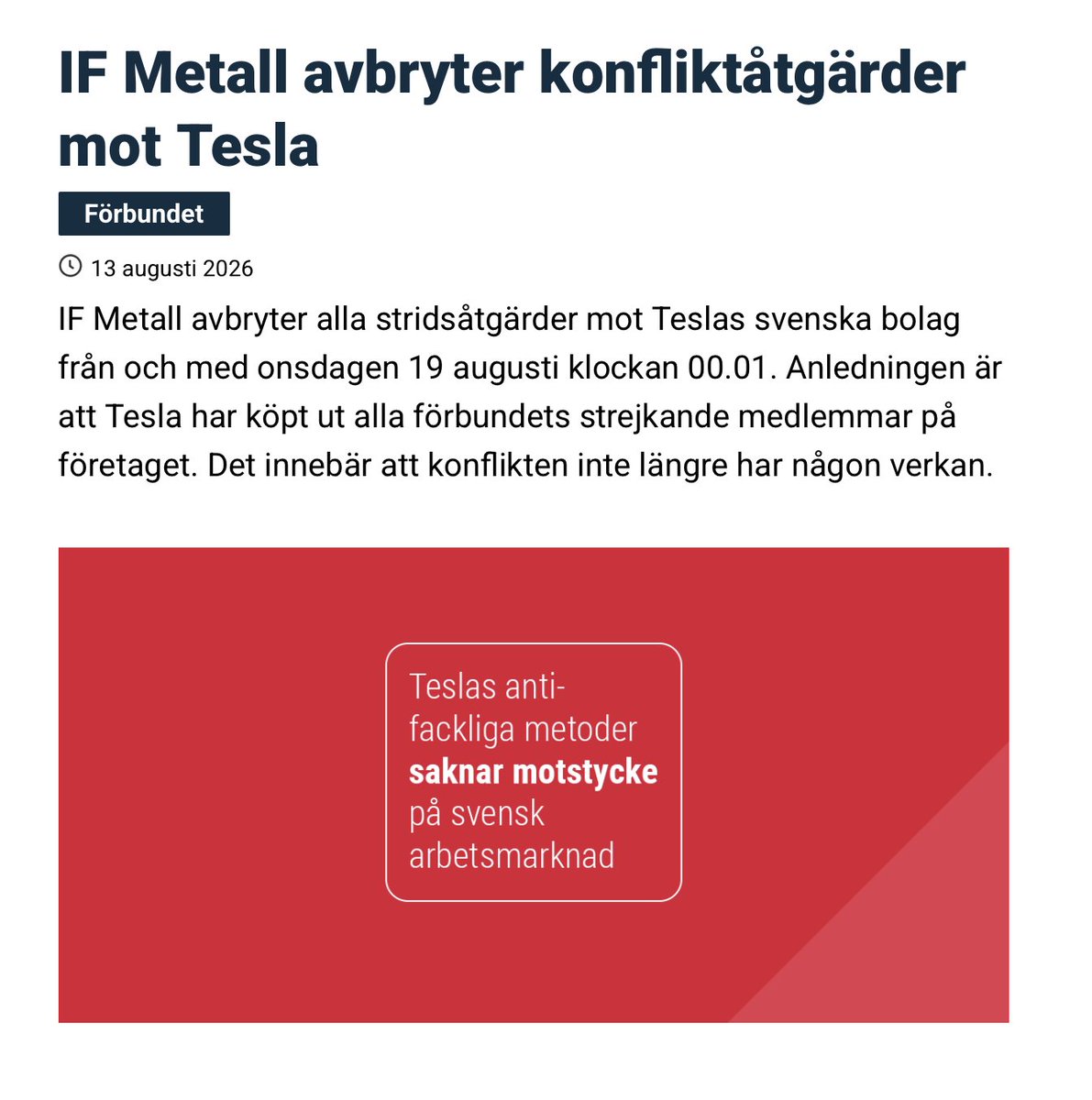
Sweden's longest-running labor conflict has ended — and Tesla did not blink. IF Metall, the powerful Swedish metalworkers' union that took on Tesla in October 2023, announced it is suspending all industrial action against the automaker effective August 19, 2026, closing out a nearly three-year standoff over collective bargaining. The union's stated reason for calling off the strike is striking in itself: there are no strikers left to represent.
The outcome marks a rare defeat for organized labor in a country where more than 90% of workers are covered by collective agreements, and it validates Tesla's global stance of refusing to sign union contracts — a position CEO Elon Musk has defended for years.

How the Standoff Ended
According to IF Metall's own statement, the strike is being called off because Tesla systematically bought out its striking members at the company. With no remaining union employees participating in the industrial action, the union concluded that the conflict "no longer has any effect." IF Metall described Tesla's approach of buying out striking employees as "unprecedented in the Swedish labour market," according to reporting compiled from Reuters wire coverage.
That framing is important. IF Metall is not declaring victory, nor is it announcing a negotiated settlement. It is acknowledging that the mechanism it relied on — withholding labor to pressure an employer into signing a collective agreement — stopped functioning when the workforce it was mobilizing chose severance over solidarity.
The Numbers Behind the Dispute
| Metric | Detail |
|---|---|
| Strike start | October 2023 |
| Official end date | August 19, 2026 |
| Total duration | ~34 months (longest strike in Swedish history) |
| Workers involved | Tesla service technicians (no Swedish manufacturing) |
| Outcome | No collective bargaining agreement signed |
How We Got Here
The dispute began in late October 2023 when roughly 130 Tesla mechanics walked off the job at Tesla's Swedish service centers, demanding the company sign a collective bargaining agreement — the standard framework under which nearly all industrial labor in Sweden operates. IF Metall's position was straightforward: Tesla should follow the Swedish model like every other employer in the country.
Tesla's position was equally clear. The company argued, and continues to argue, that its Swedish employees already receive terms comparable to or better than what IF Metall was demanding, and that it does not sign collective agreements anywhere in the world. That has been Tesla's policy from Fremont to Berlin to Shanghai, and Sweden was not going to be the exception.
What made the Swedish conflict genuinely dangerous for Tesla was the wave of sympathy strikes that followed. Dockworkers refused to unload Tesla vehicles at Swedish ports. The postal union PostNord stopped delivering license plates to Tesla, forcing the company into a legal battle it eventually won. Electricians refused service work. Cleaners walked out of Tesla facilities. At its peak, the sympathy action extended to Denmark, Norway, and Finland, threatening to turn a service-technician dispute into a Nordic-wide blockade.
Yet through all of it, Tesla kept selling cars and kept servicing them. The company brought in workers from abroad, restructured service logistics, and — critically — offered buyouts to striking employees. Over 34 months, that combination hollowed out the union's presence inside Tesla's Swedish operations until, as of this week, IF Metall confirmed there was no one left to strike.
Why Tesla Held the Line
Signing a collective agreement in Sweden would have been more than a local concession. It would have created a template for IG Metall in Germany (where Giga Berlin is a persistent flashpoint), for the UAW in the United States (which has explicitly targeted Tesla), and for unions in every jurisdiction where Tesla operates. Musk and Tesla leadership have consistently framed direct employee relationships — including equity compensation — as superior to intermediated union contracts, and they were unwilling to accept a precedent that would undercut that argument globally.
The financial math also favored Tesla. Sweden is a meaningful but not critical market. Tesla does not manufacture there. The cost of buying out striking service technicians, importing labor, and absorbing operational friction for nearly three years was, evidently, less than the perceived long-term cost of signing.
What It Means for the Broader Labor Landscape
For Tesla, the resolution removes a persistent PR headache and hardens the company's stance in every other jurisdiction. Any union approaching Tesla now has to reckon with the Swedish precedent: even a coordinated, multi-year, Nordic-wide sympathy campaign backed by one of the most union-friendly labor systems on Earth did not force a signature.
For IF Metall and the broader Swedish labor movement, the outcome is a genuine strategic problem. The Swedish model depends on the credible threat that any employer refusing to bargain will face insurmountable pressure. Tesla has now demonstrated that a well-capitalized global company can absorb that pressure indefinitely if it chooses to. Expect Swedish labor law reform proposals to accelerate — several political parties have already floated legislation that would make collective agreements effectively mandatory for large employers.
For Tesla owners in Sweden, the practical impact is minimal. Service continued throughout the dispute, and the end of the strike simply normalizes what has already been the operational reality for the past year.
What to Watch Next
- Legislative response: Whether the Swedish Riksdag takes up proposals to strengthen collective bargaining requirements in response to the Tesla precedent.
- Nordic union coordination: IF Metall's sister unions in Denmark, Norway, and Finland may attempt a coordinated regional framework — though the same buyout dynamic could apply.
- Giga Berlin: IG Metall has been organizing at Tesla's German plant. The Swedish outcome will inform both sides' strategy there.
- Tesla's formal statement: As of the union's announcement, Tesla had not publicly commented. Any response — or the decision not to respond — will signal how the company wants to frame the win.
Nearly three years, four Nordic countries, sympathy strikes across a dozen professions, and a legal fight over license plates. In the end, Tesla's answer was the same one it gave on day one: no collective agreement. This time, the answer stuck.
Related Gear
Gear up your Tesla with tested, custom-fit BASENOR accessories — shop Tesla accessories →
Sources & reporting notes
The links below identify the material source records used for this report.
- @SawyerMerritt on X (2026-08-13T15:49:41.000Z) — Direct source
- @SawyerMerritt on X (2026-08-13T15:49:41.000Z) — Direct source
Source links are preserved as published or accessed. See our editorial standards and corrections policy.
The BASENOR Editorial Desk covers Tesla, SpaceX, and related technology, curating reporting from primary sources — official accounts, regulatory filings, and software release data. Every article passes source-record and fact-checking review before publication. About the newsroom.
This report was curated by the BASENOR Editorial Desk from the sources listed above. Read our editorial standards or email editorial@basenor.com to report an error.