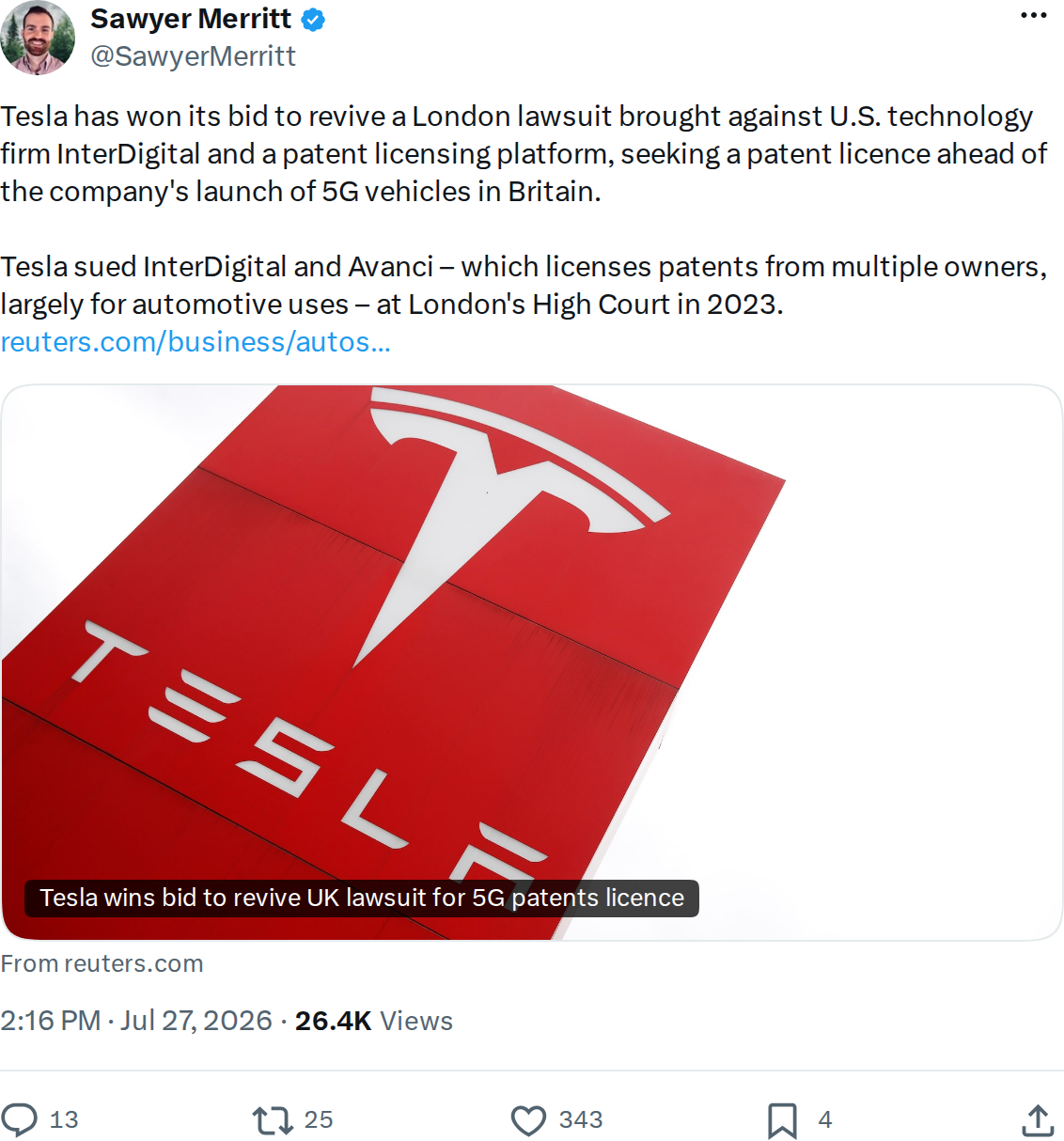
Tesla scored a unanimous victory at the UK Supreme Court on Monday, winning the right to revive its London lawsuit against U.S. technology firm InterDigital and patent licensing platform Avanci. The case centers on whether Tesla can force a court determination of fair licensing terms for 5G patents — a fight that directly shapes the cost of connecting future Tesla vehicles to 5G networks in Britain.

How We Got Here
Tesla first filed suit at London's High Court in 2023, challenging the licensing terms Avanci offers automakers for access to a global pool of 5G standard essential patents (SEPs). Avanci's current rate for a 5G vehicle license is $32 per vehicle — more than double the $15 per vehicle rate it charges for 4G. Tesla's position is that this rate does not meet the FRAND standard: Fair, Reasonable, and Non-Discriminatory terms that SEP holders are legally obligated to offer.
The initial High Court ruling in 2024 went against Tesla, with the court dismissing its claim for a FRAND determination while allowing a separate patent revocation challenge to proceed. Tesla's appeal to the Court of Appeal was also rejected. The company then escalated to the UK Supreme Court, drawing support from interveners including the Computer & Communications Industry Association (CCIA) and the Motion Picture Association — both of which have a stake in how courts treat SEP licensing globally.
What the Supreme Court Actually Decided
The Supreme Court's July 27 ruling resolves two critical legal questions that had blocked Tesla's case from moving forward.
First, the court held that UK courts do have jurisdiction to hear claims for declarations regarding whether rates and terms for global pools of SEPs are FRAND. This is significant: Avanci's license covers patents from multiple countries bundled into a single global rate, and a key defense argument was that UK courts had no business adjudicating terms for patents held worldwide. The Supreme Court rejected that argument.
Second, and perhaps more consequentially for the broader industry, the court ruled that patent owners are not released from their FRAND obligations simply by participating in a patent pool or licensing platform. In other words, routing patents through Avanci does not insulate InterDigital from its individual commitment to license on fair terms. That principle, if it holds through further proceedings, could have implications well beyond Tesla and well beyond the automotive sector.
Avanci Vehicle President Laurie Fitzgerald pushed back, stating the company respectfully disagreed with the ruling and continues to believe Tesla's underlying claims are without merit. The case now returns to the High Court for substantive proceedings on whether the $32 rate is actually FRAND.
The Numbers Behind the Dispute
| Detail | Value |
|---|---|
| Avanci 5G license rate (per vehicle) | $32 |
| Avanci 4G license rate (per vehicle) | ~$15 |
| Premium over 4G rate | More than 2× |
| Original lawsuit filed | 2023, London High Court |
| High Court ruling | 2024 — dismissed Tesla's FRAND claim |
| Supreme Court ruling | July 27, 2026 — unanimous for Tesla |
Why This Matters Beyond Tesla
The automotive industry is in the middle of a generational connectivity upgrade. As vehicles add cellular modems for over-the-air updates, navigation, remote access, and eventually vehicle-to-infrastructure communication, SEP licensing costs become a real line item in the bill of materials for every connected car sold. The $32-per-vehicle figure Avanci is seeking may sound modest in isolation, but multiplied across millions of vehicles and stacked alongside other licensing fees, it adds up — and automakers have been quietly watching this case as a potential precedent.
The Supreme Court's ruling that patent pool participation does not extinguish individual FRAND obligations is the kind of principle that IP lawyers across the tech and automotive industries will be parsing carefully. It potentially makes it harder for SEP holders to use licensing platforms as a shield against FRAND scrutiny — a dynamic that extends to smartphones, IoT devices, and any product category where cellular connectivity is now standard.
For Tesla specifically, the ruling clears the path to get a UK court to actually examine whether $32 per vehicle is fair. That hearing is still ahead, and Avanci has made clear it will contest the underlying rate claim. But Tesla's legal team has now won the right to make the argument — after losing at two lower court levels — and that alone is a meaningful shift in the litigation's trajectory.
Related Gear
Gear up your Tesla with tested, custom-fit BASENOR accessories — shop Tesla accessories →
Sources & reporting notes
The links below identify the material source records used for this report.
- @SawyerMerritt on X (2026-07-27T14:16:40.000Z) — Direct source
Source links are preserved as published or accessed. See our editorial standards and corrections policy.
The BASENOR Editorial Desk covers Tesla, SpaceX, and related technology, curating reporting from primary sources — official accounts, regulatory filings, and software release data. Every article passes source-record and fact-checking review before publication. About the newsroom.
This report was curated by the BASENOR Editorial Desk from the sources listed above. Read our editorial standards or email editorial@basenor.com to report an error.