📌 UPDATE — April 3, 2026
Tesla Japan has put concrete numbers behind its expansion ambitions: the company plans to grow its retail footprint from 35 stores to at least 60, and is targeting the title of Japan's largest imported car brand by as early as 2027. The push is backed by sustained investment in store and service center coverage, as well as staff training over the past two years. The announcement adds a clear retail-growth target to the broader infrastructure and supply-chain commitments already outlined by Elon Musk, signaling that Tesla's Japan strategy is accelerating on the customer-facing side as well.

via @SawyerMerritt · Apr 3, 2026
30-Second Brief
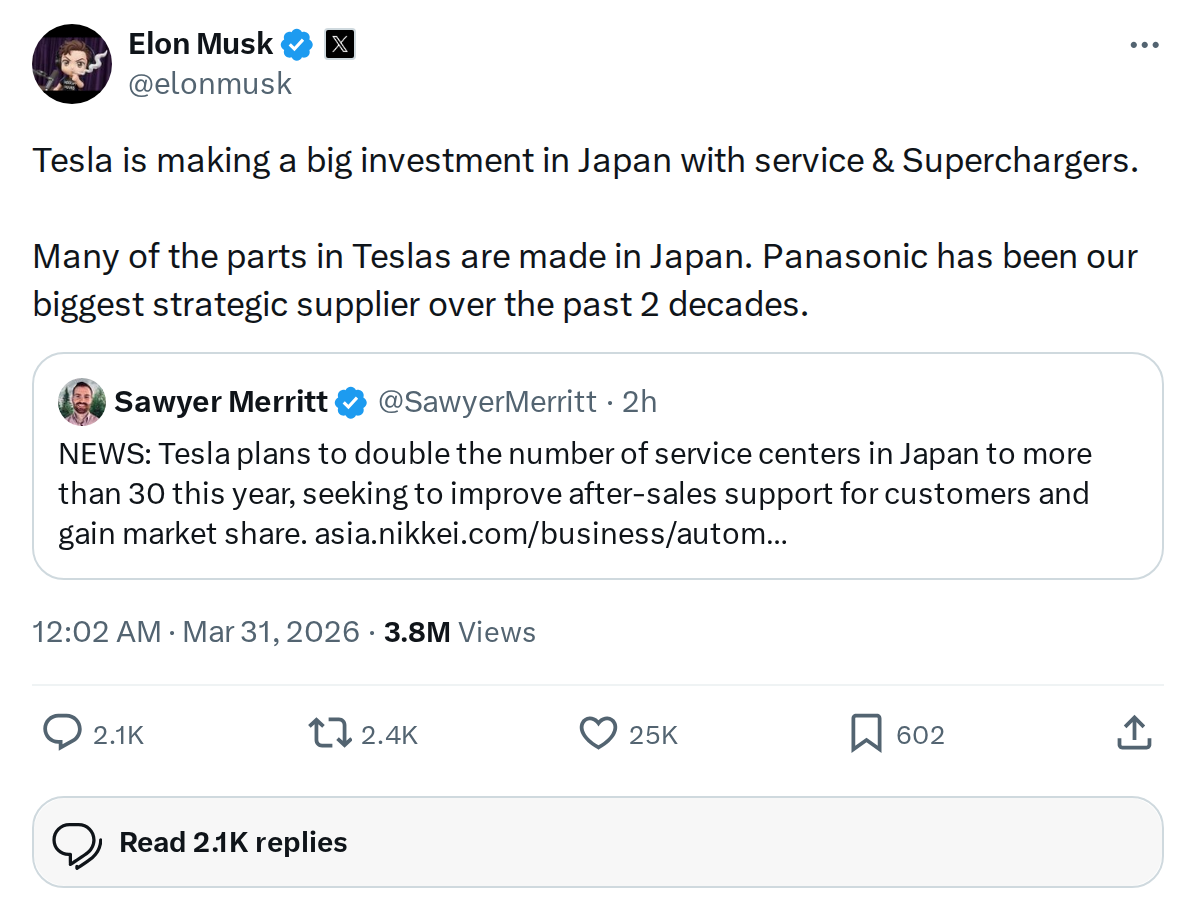
The News: Elon Musk announced Tesla is making a significant investment in Japan, expanding its service center and Supercharger network while acknowledging Japan's deep role in Tesla's supply chain — including a two-decade partnership with Panasonic.
Why It Matters: Japan-based Tesla owners are about to see dramatically better service access and charging infrastructure. And for all Tesla owners globally, this signals that the supply chain underpinning every vehicle just got more strategic attention.
Source: @elonmusk on X
Tesla's Big Japan Investment: Superchargers, Service Centers, and the Panasonic Partnership Explained
Tesla is going all-in on Japan. On March 30, 2026, Elon Musk confirmed that Tesla is making a major investment in the country — with a direct focus on expanding service infrastructure and the Supercharger network. But buried in the same announcement is something even more significant for every Tesla owner worldwide: a frank acknowledgment of just how deeply Japan is woven into Tesla's supply chain.

📊 Key Figures
| Metric | Value | Context |
|---|---|---|
| Service Centers (current) | ~15 | Targeting 30+ by end of 2026 |
| Retail Stores (current) | 23 | Targeting 50 by end of 2026, 100 long-term |
| Panasonic Supplier Tenure | 20+ years | Tesla's largest strategic supplier |
| Panasonic 4680 Investment | ~¥80B (~$705M) | Wakayama Factory, Japan |
| Panasonic 4680 Capacity Target | <10 GWh/year | ~150,000 vehicles annually |
| FSD (Supervised) Japan Launch | End of 2026 | Public road testing began Aug 2025 |
More Than a Charging Rollout — This Is a Full Market Commitment
Tesla's relationship with Japan has historically been complicated. The country is home to some of the world's most loyal domestic car buyers and deeply entrenched legacy automakers. Tesla's previous Japan strategy leaned heavily on online-only sales — a model that worked in the US but created friction in a market that still values in-person retail and service relationships.
That's changing fast. According to verified reports, Tesla plans to more than double its service center footprint in Japan to over 30 locations by the end of 2026. On the retail side, the company is targeting 50 stores by end of 2026 — up from 23 today — with a longer-term ambition of 100 locations nationwide. This shift to a hybrid physical-and-digital model is a direct response to what Japanese consumers actually want.
The Supercharger expansion runs parallel to this. Tesla reached its 50th Supercharger station in Japan back in October 2022, and the current investment signals a meaningful acceleration of that buildout — critical in a market where range anxiety and charging access remain top purchase barriers.
Panasonic: The 20-Year Partnership Every Tesla Owner Benefits From
Musk's callout of Panasonic wasn't a throwaway line. It's a reminder that the battery in your Tesla — and many of the components around it — have Japanese engineering at their core. Panasonic has been Tesla's largest strategic supplier for over two decades, a relationship that predates most of Tesla's current product lineup.
The partnership is now entering a new chapter. Panasonic is investing approximately ¥80 billion (roughly $705 million USD) to establish 4680 lithium-ion battery cell production at its Wakayama Factory in western Japan. The facility targets a production rate of under 10 gigawatt-hours per year — enough to supply batteries for approximately 150,000 vehicles annually. Panasonic Energy's CTO Shoichiro Watanabe has indicated the company is working to build a pipeline of 2 terawatt-hours of battery and raw material supplies for Tesla over the longer term.
The 4680 cell format is central to Tesla's next-generation vehicle cost and performance roadmap. Having a dedicated production line for these cells in Japan — backed by a supplier with two decades of institutional knowledge — is a meaningful supply chain advantage, not just a headline.
What Else Is Coming to Japan in 2026
The service and Supercharger investment doesn't exist in isolation. Tesla has also confirmed that Full Self-Driving (Supervised) is officially targeted for launch in Japan by the end of 2026. Public road testing with the Model 3 began in August 2025 and has since expanded to include the Model Y. Additionally, Tesla Powerwall 3 became officially available in Japan as of March 10, 2026 — extending Tesla's energy product reach into the Japanese home energy market.
Taken together, this is a coordinated market push: better service access, more charging infrastructure, new energy products, and an autonomous driving rollout — all converging in 2026.
🔭 The BASENOR Take
Timeline: Investment announced March 30, 2026. Service center and store expansion targets set for end of 2026. FSD (Supervised) Japan launch also targeted for end of 2026.
Impact Level: 🟠 High — for Japan-based owners, this is transformational. For global owners, it reinforces supply chain stability and Tesla's 4680 battery roadmap.
Confidence: 🟢 High — confirmed directly by Elon Musk and corroborated by multiple verified sources including Panasonic's own investment disclosures.
Analysis: Tesla entering Japan more aggressively makes strategic sense right now. The Japanese EV market is still relatively underpenetrated compared to Europe and China, and Tesla's brand recognition there is strong even if its physical presence has lagged. Doubling service centers and expanding retail is the table-stakes move to convert interest into purchases. The Panasonic shoutout, meanwhile, is diplomatically savvy — acknowledging Japan's economic contribution to Tesla's success is exactly the kind of relationship-building that matters in a market where trust and reciprocity carry real weight. Watch for formal announcements on specific Supercharger locations and service center openings in the coming months.
📰 Deep Dive
Japan represents one of the more nuanced bets in Tesla's global expansion playbook. Unlike markets where Tesla could grow primarily through word-of-mouth and online sales, Japan demands a physical presence — both for cultural reasons and because the charging infrastructure gap has historically been a real deterrent. Musk's announcement addresses both sides of that equation simultaneously.
The Panasonic dimension adds a layer of strategic depth that goes beyond PR. The 4680 cell is not just a battery — it's the foundation of Tesla's structural battery pack design, which reduces manufacturing complexity and vehicle weight. Having Panasonic produce these at scale in Japan, with a dedicated ¥80 billion facility, means Tesla is securing a geographically diversified supply chain for its most critical next-gen component. That matters in a world where supply chain concentration risk has become a board-level concern across the auto industry.
For Japan-based Tesla owners specifically, the near-term impact is straightforward: more places to get your car serviced, more places to charge, and — by end of year — the prospect of FSD (Supervised) on Japanese roads. For the broader Tesla owner community, this is a signal that the 4680 battery supply chain is maturing on schedule, which has downstream implications for vehicle pricing and production volume globally.
One number worth watching: Panasonic's pipeline target of 2 terawatt-hours of battery and raw material supply. At current Tesla production rates, that represents multiple years of battery supply. If Panasonic executes on that pipeline, it meaningfully de-risks Tesla's battery supply for the foreseeable future — and Japan sits at the center of that equation.
Related Gear
Gear up your Tesla with tested, custom-fit BASENOR accessories — shop Tesla accessories →
Sources & reporting notes
The links below identify the material source records used for this report.
- @elonmusk on X (2026-03-30T16:02:23.000Z) — Direct source
- @SawyerMerritt on X (2026-04-03T14:29:53.000Z) — Direct source
- @SawyerMerritt on X (2026-04-03T14:29:54.000Z) — Direct source
Source links are preserved as published or accessed. See our editorial standards and corrections policy.
The BASENOR Editorial Desk covers Tesla, SpaceX, and related technology, curating reporting from primary sources — official accounts, regulatory filings, and software release data. Every article passes source-record and fact-checking review before publication. About the newsroom.
This report was curated by the BASENOR Editorial Desk from the sources listed above. Read our editorial standards or email editorial@basenor.com to report an error.