A wrongful death lawsuit filed in Harris County, Texas last week is shaping up to be one of the most legally significant challenges Tesla has faced over its driver-assistance systems. The case targets the core of how Tesla has defended itself in Autopilot and FSD-related accidents for years — and a landmark Florida verdict suggests that defense is no longer bulletproof.

The Texas Case
On June 19, 2026, a Tesla Model 3 crashed into a Katy, Texas home, killing 76-year-old Martha Avila. The driver told authorities the vehicle was operating in Autopilot mode at the time. Five days later, on June 24, the family filed a wrongful death suit in Harris County District Court against both Tesla and the driver, seeking over $1 million in compensatory damages plus punitive damages.
The lawsuit's allegations go well beyond a simple product defect claim. According to court filings, the family alleges that Tesla's Autopilot and FSD systems suffered from defective design, failed to detect obstacles, inadequately monitored driver engagement, and failed to warn users about system limitations. The complaint also raises the possibility of sudden unintended acceleration.
Tesla's public response follows a familiar script: the driver "manually overrode self-driving by pressing the accelerator." That framing places full responsibility on the human at the wheel. It's a defense Tesla has leaned on repeatedly — but it's exactly the argument a Florida jury rejected less than a year ago.
Why the Florida Verdict Changes the Calculus
In August 2025, a Miami federal jury found Tesla 33% liable for a fatal 2019 Autopilot crash that killed 22-year-old Naibel Benavides Leon. The jury awarded $243 million in total damages — including $200 million in punitive damages — after concluding that Tesla's marketing and its "weak, steering-torque-based driver monitoring fostered a false sense of what the car could do." A federal judge upheld that judgment in February 2026.
That verdict matters because of what the jury was asked to evaluate. Rather than simply determining whether the driver made a mistake, jurors examined whether Tesla's system design and marketing had conditioned the driver to trust the technology beyond its actual capabilities. The distinction is critical: it shifts the legal question from "did the driver fail?" to "what caused the driver to fail?"
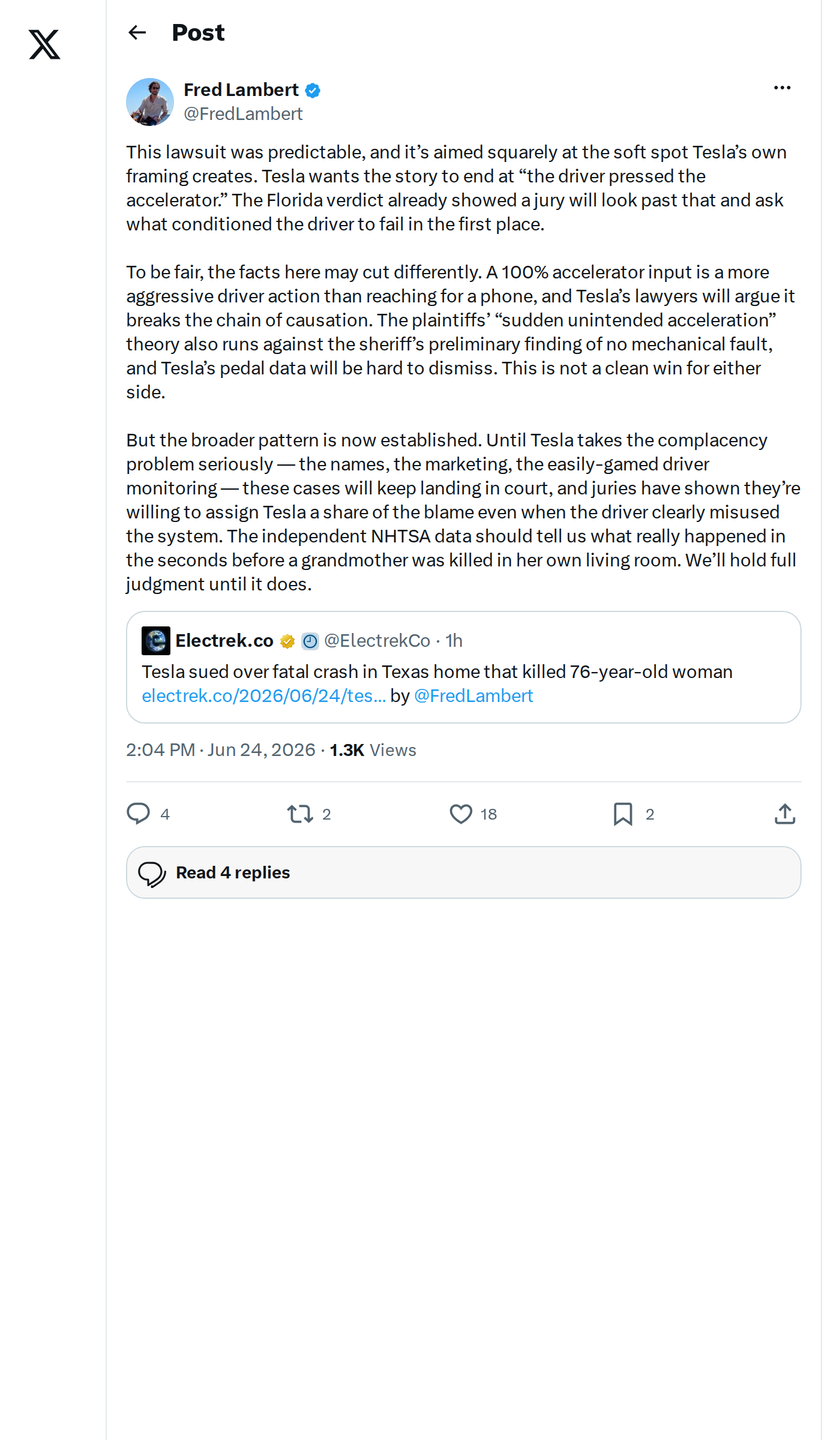
As Fred Lambert noted on X, the new Texas lawsuit is "aimed squarely at the soft spot Tesla's own framing creates." Tesla's insistence that accidents end at driver error becomes legally vulnerable the moment a plaintiff can show the system itself shaped driver behavior.
A Pattern of Mounting Legal Pressure
The Texas case doesn't exist in isolation. Tesla is currently navigating a broad and expanding legal landscape around its driver-assistance claims:
- Netherlands collective action: Over 7,100 participants had joined a collective action by June 2026, challenging Tesla's FSD promises for Hardware 3 vehicles. Elon Musk acknowledged in Q1 2026 that Hardware 3 cannot achieve unsupervised autonomous driving due to memory bandwidth limitations.
- China consumer lawsuit: Ten car owners filed suit seeking over 3.95 million yuan ($583,000), alleging misleading advertising and fraud over FSD features that lack Chinese regulatory approval. The first hearing was held June 1, 2026.
- California DMV ruling: The California DMV previously ruled that Tesla's "Autopilot" and "Full Self-Driving" marketing constituted false advertising. Tesla filed a counter-lawsuit against the DMV in February 2026. The company has since rebranded the feature as "Full Self-Driving (Supervised)."
- Purchase agreement changes: Allegations have surfaced that Tesla quietly altered FSD purchase agreements from 2016 to 2024 to include "supervised" language that was not present at the time of original sale.
Taken together, these cases suggest a coordinated shift in how plaintiffs' attorneys are approaching Tesla litigation — moving away from individual accident claims and toward a systemic argument about how the company designed, marketed, and communicated the limits of its technology.
The Core Legal Theory: Conditioning to Fail
The phrase "conditioned to fail" is doing significant legal work in these cases. The argument is not that Autopilot or FSD caused a crash directly, but that the systems — through their design and Tesla's marketing — trained drivers to behave in ways that made accidents more likely. A driver who has used Autopilot for thousands of miles on highways may respond differently to an unexpected situation than one who has never used it. If that behavioral conditioning can be demonstrated, Tesla's "the driver pressed the accelerator" defense becomes a much harder sell to a jury.
The Florida verdict demonstrated that at least one jury found this argument compelling enough to assign Tesla one-third of the liability in a fatal crash. The Texas lawsuit will test whether that reasoning can be replicated in a different jurisdiction, with a different set of facts.
For Tesla owners, the practical implications are less immediate than the legal ones — but the broader trajectory is worth watching. How courts ultimately define the boundaries of driver responsibility in vehicles with advanced assistance systems will shape what these features look like, how they're marketed, and what disclosures accompany them for years to come.
Related Gear
Gear up your Tesla with tested, custom-fit BASENOR accessories — shop Tesla accessories →
Sources & reporting notes
The links below identify the material source records used for this report.
- @FredLambert on X (2026-06-24T14:04:44.000Z) — Direct source
Source links are preserved as published or accessed. See our editorial standards and corrections policy.
The BASENOR Editorial Desk covers Tesla, SpaceX, and related technology, curating reporting from primary sources — official accounts, regulatory filings, and software release data. Every article passes source-record and fact-checking review before publication. About the newsroom.
This report was curated by the BASENOR Editorial Desk from the sources listed above. Read our editorial standards or email editorial@basenor.com to report an error.