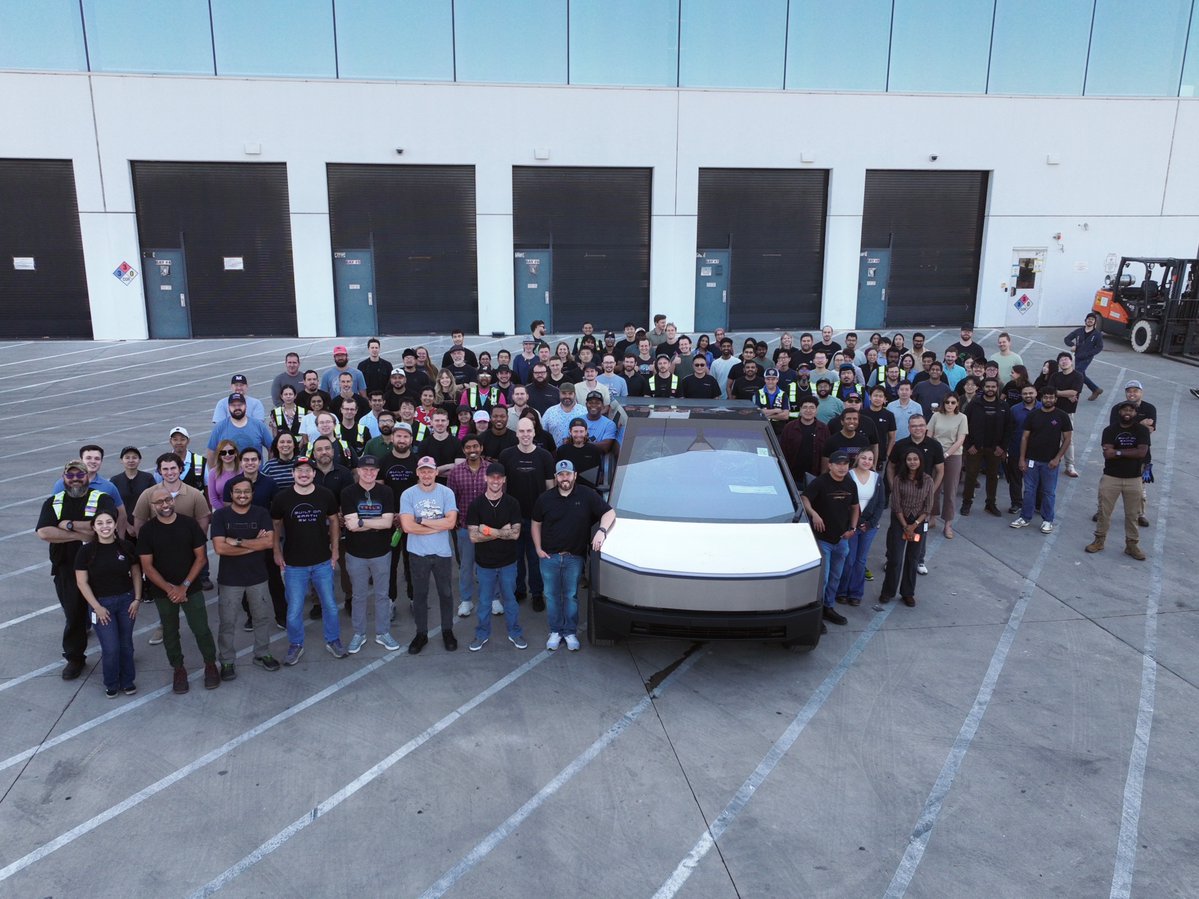
Tesla has quietly hit a milestone years in the making. The company's official Cybertruck account confirmed late Thursday that the first Cybertrucks are now being built with 4680 battery cells containing lithium refined at Tesla's own Gulf Coast Lithium Refinery in South Texas — the first time a major automaker has shipped a production vehicle powered by lithium it processed itself.
It's a small announcement in tweet form, but a significant one in industrial terms. Tesla has spent more than a decade dependent on Chinese, Australian, and Chilean lithium refiners for the single most cost-sensitive material in its battery packs. As of this week, that supply chain now has a domestic first link — and it runs from Robstown, Texas to Giga Texas in Austin.

What Tesla Actually Announced
The Cybertruck account's post was characteristically brief: "First Cybertruck made with 4680 cells containing lithium from our Gulf Coast Lithium Refinery." Whole Mars Catalog amplified the news minutes later, framing it as confirmation that "Tesla's lithium refinery is now supplying lithium for use in production 4680 cells."
What that single sentence packs in is the completion of a loop Tesla has been building since Elon Musk broke ground on the Corpus Christi–area facility in May 2023. Lithium from the refinery is being converted into battery-grade lithium hydroxide, shipped to Tesla's 4680 cell production lines in Austin, and installed into Cybertrucks built at the same Giga Texas complex.
The Refinery, By the Numbers
The Gulf Coast Lithium Refinery officially commenced operations in January 2026 and reached full ramp by July 2026, according to Tesla and reporting from Electrek. Tesla claims it is now the largest facility of its kind in North America.
| Metric | Value |
|---|---|
| Location | Robstown, Texas (near Corpus Christi) |
| Operational since | January 2026 (full ramp July 2026) |
| Initial capacity | ~30 GWh / yr (~20,000 metric tons lithium hydroxide) |
| Planned expansion | 50 GWh / yr (~1M EVs worth) |
| Total investment | > $1 billion |
| Process | Acid-free / alkaline leach |
The process is what makes the facility unusual. Instead of the sulfuric-acid-heavy refining used across most of the industry, Tesla uses an acid-free alkaline leach method that, per the company, reduces emissions by roughly 30% and cuts reagent costs by about 60%. The main byproduct is anhydrite — a non-hazardous mineral that can be sold into the construction industry rather than stored as waste.
Why Tesla Wanted This Loop Closed
Lithium hydroxide is the most volatile line item on a battery cell's bill of materials. Contract prices swung from roughly $10/kg in 2020 to over $80/kg at the 2022 peak, then collapsed back below $15/kg through 2024. Every one of those swings has landed on Tesla's gross margin, because the company was buying refined material on global spot and contract markets.
Owning the refinery does two things. First, it insulates Tesla from the price whiplash — the marginal cost of turning spodumene concentrate into hydroxide is far more stable than the market price of the finished product. Second, it satisfies increasingly strict domestic-content rules under the Inflation Reduction Act. Vehicles that source critical minerals processed in the United States or a free-trade partner country qualify for the full $7,500 EV tax credit. Cybertruck buyers stand to benefit directly.
The 4680 Side of the Equation
The cell going into these Cybertrucks isn't just any 4680. On Tesla's Q4 2025 earnings call in January 2026, the company confirmed that both the anode and cathode for its Austin-built 4680 cells now use a dry electrode process — the manufacturing breakthrough Tesla has been chasing since acquiring Maxwell Technologies in 2019. The 2026 "Generation 3" 4680 (sometimes called the Cybercell in internal materials) has reached 300 Wh/kg energy density, enough to give the pack a roughly 15% range bump without any change to physical dimensions.
All Cybertruck production models since January 2026 use Tesla-manufactured 4680 cells. Adding Gulf Coast lithium to that stack means the Cybertruck is now, by a wide margin, the most vertically integrated vehicle Tesla has ever shipped — refined lithium, dry-electrode cathodes and anodes, cells, packs, and vehicles all originating within Texas.
What Tesla Owners Should Take From This
For current Cybertruck owners: nothing changes about your truck. The cells and pack chemistry are the same generation you already have. The difference is in the supply chain feeding new production units off the Austin line as of this week.
For prospective buyers: the domestic-content story matters. As the IRA rules tighten each year — the domestic critical-mineral threshold rose to 60% for 2026 and steps up 10 points annually through 2029 — Tesla is one of the few automakers now positioned to keep the full $7,500 credit intact rather than watch it phase out. That's a durable pricing advantage that competitors relying on Chinese-refined lithium will struggle to match.
For the broader battery industry: this is a proof point. Refining lithium at scale in the United States has been treated as economically impossible for years because Chinese refiners hold a roughly 65% global share and enormous scale advantages. Tesla's alkaline-leach approach — if the emissions and reagent-cost numbers hold up under independent review — reopens the question of whether Western refining can be competitive without permanent subsidy.
What to Watch Next
Three signals worth tracking over the next two quarters. First, whether Tesla begins routing Gulf Coast lithium into Model Y and Model 3 cells at Giga Texas — Cybertruck is a low-volume vehicle, and the refinery's capacity vastly exceeds Cybertruck's needs. Second, Tesla's Q3 2026 shareholder letter and earnings call, where the company is expected to break out battery-material cost per kWh for the first time now that the loop is closed. Third, the pace of the 50 GWh expansion; capacity beyond 30 GWh is what turns this from a Cybertruck story into a fleet-wide story.
For now, the significance is symbolic as much as operational. A vehicle rolled off an assembly line today with lithium in its cells that was, until recently, spodumene rock. Every step in between happened inside Tesla — a first for the American auto industry.
Related Gear
Gear up your Cybertruck with tested, custom-fit BASENOR accessories — shop Cybertruck accessories →
Sources & reporting notes
The links below identify the material source records used for this report.
- @cybertruck on X (2026-09-04T22:31:21.000Z) — Direct source
- @wholemars on X (2026-09-04T22:40:56.000Z) — Direct source
Source links are preserved as published or accessed. See our editorial standards and corrections policy.
The BASENOR Editorial Desk covers Tesla, SpaceX, and related technology, curating reporting from primary sources — official accounts, regulatory filings, and software release data. Every article passes source-record and fact-checking review before publication. About the newsroom.
This report was curated by the BASENOR Editorial Desk from the sources listed above. Read our editorial standards or email editorial@basenor.com to report an error.