Tesla has published a new blog post detailing a lithium recovery pilot program at its Texas refinery — and the ambitions go well beyond lithium. The company is targeting closed-loop recovery for graphite, nickel, and cobalt too, backed by recovery rates that are already among the highest in the industry. Here's what the announcement actually says, and what it means for Tesla owners and the broader EV supply chain.

Where exactly is this pilot happening?
The new lithium recovery technology is being piloted at Tesla's Texas facility, which supports the company's lithium refinery near Robstown, Texas. That refinery reached full operational capacity in May 2026 and has been confirmed as fully ramped as of July 2026. Tesla also held its inaugural Lithium Day 2026 event at the Robstown site on July 16, making this announcement a natural next chapter in that facility's story.
What does 'closed-loop recovery' actually mean?
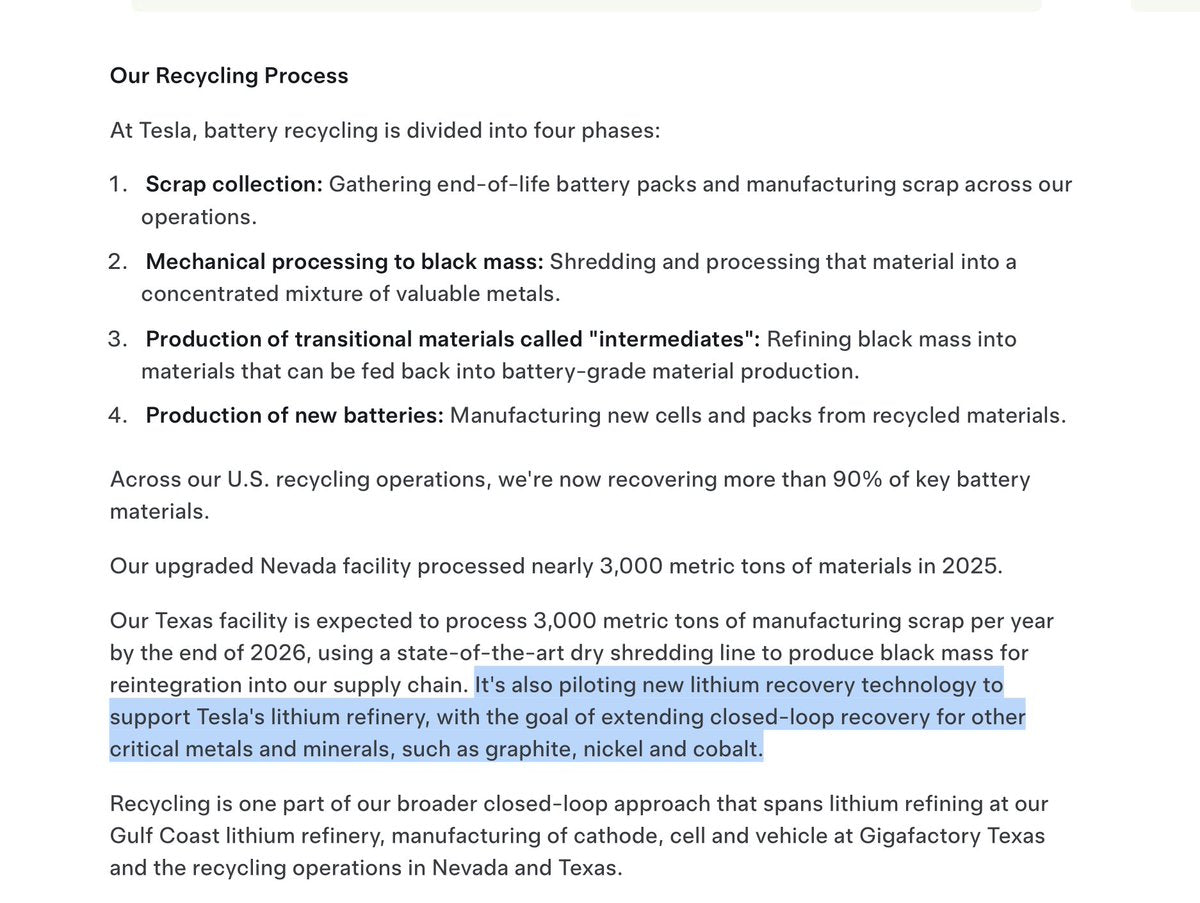
Closed-loop recovery means the materials extracted from end-of-life or manufacturing-scrap batteries are refined and fed directly back into new battery production — rather than sold off or discarded. Tesla's goal is to extend this loop beyond lithium to cover graphite, nickel, and cobalt, the other critical minerals that make up a modern lithium-ion cell. In practice, it means a battery pack's raw materials could cycle through multiple vehicle lifetimes without ever leaving Tesla's supply chain.
How good are Tesla's recovery rates right now?
Already strong. According to Tesla, its U.S. recycling operations are recovering more than 90% of key battery materials — specifically nickel and cobalt. Its advanced hydrometallurgical recycling processes are capable of achieving recovery rates of up to 98% for metals including lithium, nickel, cobalt, and copper. The Texas facility is projected to process 3,000 metric tons of manufacturing scrap per year by end of 2026, using a dry shredding line to produce black mass for reintegration into the supply chain.
How much battery material is Tesla actually recycling?
The scale is significant. In 2025, Tesla recycled over 14,000 metric tons of battery material through a combination of in-house processing and third-party partners — a 20% increase over 2024. That volume is roughly equivalent to the materials needed for approximately 46,000 long-range battery packs. Tesla's upgraded Nevada facility alone processed nearly 3,000 metric tons in 2025, equivalent to the battery material in around 9,000 Model Y RWD vehicles.
Is Tesla doing anything new on the process side?
Yes. Tesla has filed a patent (application number WO2026048253A1) for a battery recycling process designed to recover high-purity battery materials for new cathodes. The process reportedly uses water vapor condensation, reuse systems, and heat-recovery loops — aiming to cut CO2 emissions and improve efficiency compared to traditional acid-based methods. The Texas refinery also incorporates closed-loop water systems that are expected to reduce total water discharge by approximately 80%.
What does this mean for Tesla owners specifically?
Tesla maintains a policy that no battery should end up in a landfill — 100% of decommissioned packs are recycled. For owners, that means when your battery eventually reaches end of life, it enters a recovery chain that is becoming increasingly efficient. More practically, a mature closed-loop system reduces Tesla's dependence on raw material spot markets, which historically drive price volatility. If the pilot scales as intended, it strengthens the economics of future battery production and, by extension, vehicle pricing stability.
The pilot is still early-stage, and Tesla hasn't published a timeline for when closed-loop recovery for graphite, nickel, and cobalt will reach full commercial scale. But with the Robstown refinery already fully ramped and a patent in the pipeline, the infrastructure to make it real is clearly being built out — not just announced.
Related Gear
Gear up your Tesla with tested, custom-fit BASENOR accessories — shop Tesla accessories →
Sources & reporting notes
The links below identify the material source records used for this report.
- @SawyerMerritt on X (2026-08-14T19:42:56.000Z) — Direct source
- @SawyerMerritt on X (2026-08-14T19:42:56.000Z) — Direct source
Source links are preserved as published or accessed. See our editorial standards and corrections policy.
The BASENOR Editorial Desk covers Tesla, SpaceX, and related technology, curating reporting from primary sources — official accounts, regulatory filings, and software release data. Every article passes source-record and fact-checking review before publication. About the newsroom.
This report was curated by the BASENOR Editorial Desk from the sources listed above. Read our editorial standards or email editorial@basenor.com to report an error.