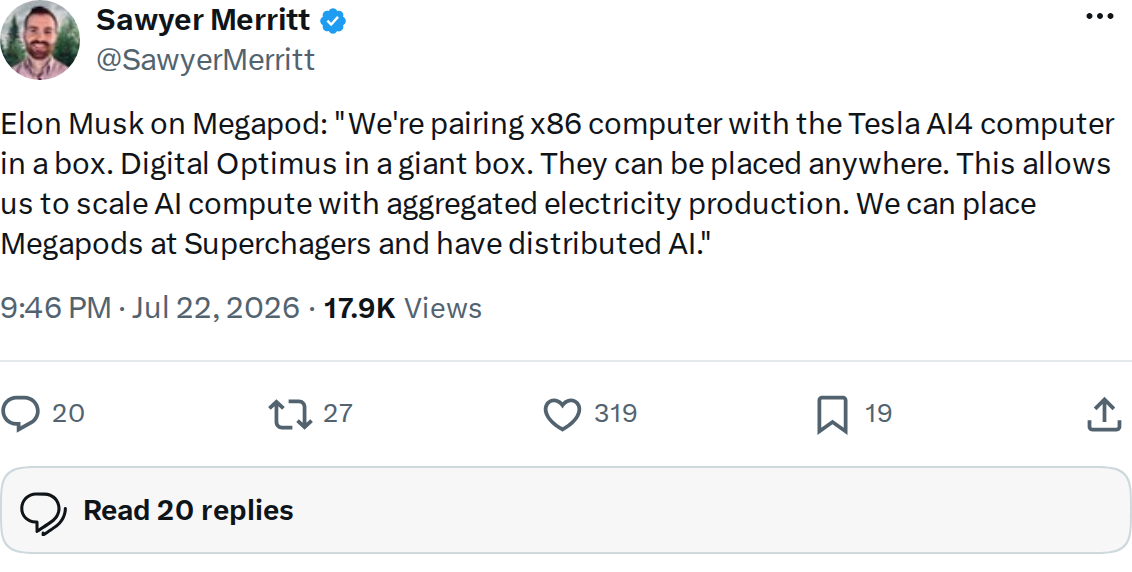
Elon Musk has publicly detailed the concept behind Tesla's newest AI infrastructure play: the Megapod, a modular compute box that pairs standard x86 servers with Tesla's in-house AI4 inference chips. In remarks shared by Sawyer Merritt, Musk described it as a 'Digital Optimus in a giant box' — a self-contained unit that can be dropped anywhere Tesla already has power infrastructure, most notably its Supercharger network.
The framing matters. Rather than build brand-new data centers, Tesla appears ready to piggyback its AI compute ambitions on the roughly 7 GW of grid capacity already provisioned to its global Supercharger footprint, much of which sits idle when cars aren't plugged in.

What Musk Actually Said
Per Merritt's quote, Musk's pitch was compact: 'We're pairing x86 computer with the Tesla AI4 computer in a box. Digital Optimus in a giant box. They can be placed anywhere. This allows us to scale AI compute with aggregated electricity production. We can place Megapods at Superchargers.'
Three ideas are packed into that quote. First, the hardware is hybrid — general-purpose x86 CPUs handle orchestration and workload logic, while Tesla's AI4 silicon does the inference heavy lifting. Second, the form factor is deliberately portable: 'giant box' language echoes the Megapack energy storage product, suggesting a similar shipping-container-style deployment model. Third, and most strategically, the siting logic is inverted from traditional data-center planning. Instead of building compute near cheap power, Tesla plans to drop compute wherever it already has power — and its power footprint is already national.
Why Superchargers Are the Unlock
Tesla operates more than 7,000 Supercharger stations globally, with aggregate grid capacity estimated around 7 GW, according to public reporting on the Megapod trademark filing. That capacity is provisioned for peak charging demand, but at most hours of the day, most stations run well below their electrical ceiling. A Megapod parked next to a Supercharger cabinet can soak up that idle headroom for AI inference workloads without requiring new substation buildout or utility interconnection queues — the bottleneck that has stalled hyperscaler data-center expansion across the U.S.
This is the same insight that has driven Musk's repeated public comments about grid interconnection being the real constraint on AI, not chips. Tesla, uniquely, already owns the interconnections.
How Megapod Connects to Digital Optimus
Musk's 'Digital Optimus in a giant box' shorthand isn't marketing garnish — it's a direct reference to the Digital Optimus (also branded 'Macrohard') project he announced in March 2026 as a joint Tesla/xAI effort. Digital Optimus is pitched as an AI agent capable of executing complex office workflows, running on the AI4 chip. Musk has previously stated Tesla intends to deploy 'millions of dedicated Digital Optimus units in the field at Superchargers,' and the Megapod appears to be the physical vessel that makes that promise deployable.
In other words: the humanoid Optimus robot handles physical labor, Digital Optimus handles cognitive labor, and Megapod is the hardware chassis that runs Digital Optimus at scale.
Key Figures
| Item | Detail |
|---|---|
| USPTO Trademark Filing | Serial 99893717, filed June 18, 2026 |
| Compute Architecture | x86 CPU + Tesla AI4 inference chip |
| AI4 Chip Cost | ~$650 per unit |
| Supercharger Stations (global) | 7,000+ |
| Aggregate Supercharger Grid Capacity | ~7 GW (largely idle off-peak) |
| Cortex 2.0 Phase 1 | 250 MW, expected online April 2026 |
Sources: USPTO trademark filing 99893717, energynewsbeat.co, and public reporting on Tesla's AI infrastructure roadmap.
The Trademark Language Is Revealing
Tesla's June 2026 USPTO filing for 'MEGAPOD' describes it as 'modular data center hardware systems for artificial intelligence computing, comprised of computer servers, computer hardware for artificial intelligence processing, computer networking hardware, electrical power distribution units, and cooling systems, sold as a unit.'
That's a full-stack description: compute, networking, power distribution, and cooling — sold as a single SKU. The 'sold as a unit' phrasing is notable. It suggests Tesla may not just deploy Megapods internally but sell them, positioning the product as a Megapack-style commercial offering for enterprises that want turnkey AI infrastructure without the multi-year siting and interconnection process.
Where This Fits in Tesla's Broader AI Stack
Megapod is one piece of a rapidly expanding AI infrastructure posture. The Cortex 2.0 training supercomputer's first phase (250 MW) was expected online in April 2026, according to public reporting. The Terafab initiative, launched March 21, 2026, targets in-house fabrication of next-generation AI5 chips — with full-scale fab investment estimated at $20-30 billion. And the AI5 chip itself, currently produced by Samsung and TSMC, is the compute backbone for both the Cybercab and Optimus Gen 3.
Read together, the pattern is clear: Tesla is vertically integrating every layer of its AI stack — silicon design, fabrication, training compute, and now distributed inference deployment. Megapod is the last-mile piece, the thing that gets compute physically close to where it's needed.
What to Watch Next
- First Megapod deployment: Musk indicated Megapods can be placed at Superchargers, but no timeline or pilot site has been publicly named. A first-site announcement is the near-term signal to watch.
- Utility approvals: Running inference workloads at Supercharger sites will likely require updated interconnection agreements with local utilities. Any state PUC filings would be an early tell.
- AI5 transition: Musk specified AI4 in the current pitch. Whether next-generation Megapods shift to AI5 silicon — and how quickly — will determine the product's compute density trajectory.
- Commercial availability: The trademark's 'sold as a unit' language raises the question of whether Tesla will offer Megapod externally, potentially as an enterprise AI infrastructure product.
Editor's View
The most interesting thing about Megapod isn't the hardware — it's the siting strategy. Every hyperscaler in the world is currently fighting for grid interconnections and waiting years for new substations. Tesla quietly built the largest privately-owned high-capacity charging network on Earth, and it turns out those interconnections are just as valuable for AI compute as they are for cars. That's a genuinely differentiated moat, and one that no competitor can replicate by writing a check.
🤖 Tracking Tesla's humanoid robot? See every Optimus production milestone and appearance in our Tesla Optimus Tracker.
Related Gear
Gear up your Tesla with tested, custom-fit BASENOR accessories — shop Tesla accessories →
Sources & reporting notes
The links below identify the material source records used for this report.
- @SawyerMerritt on X (2026-07-22T21:46:51.000Z) — Direct source
Source links are preserved as published or accessed. See our editorial standards and corrections policy.
The BASENOR Editorial Desk covers Tesla, SpaceX, and related technology, curating reporting from primary sources — official accounts, regulatory filings, and software release data. Every article passes source-record and fact-checking review before publication. About the newsroom.
This report was curated by the BASENOR Editorial Desk from the sources listed above. Read our editorial standards or email editorial@basenor.com to report an error.