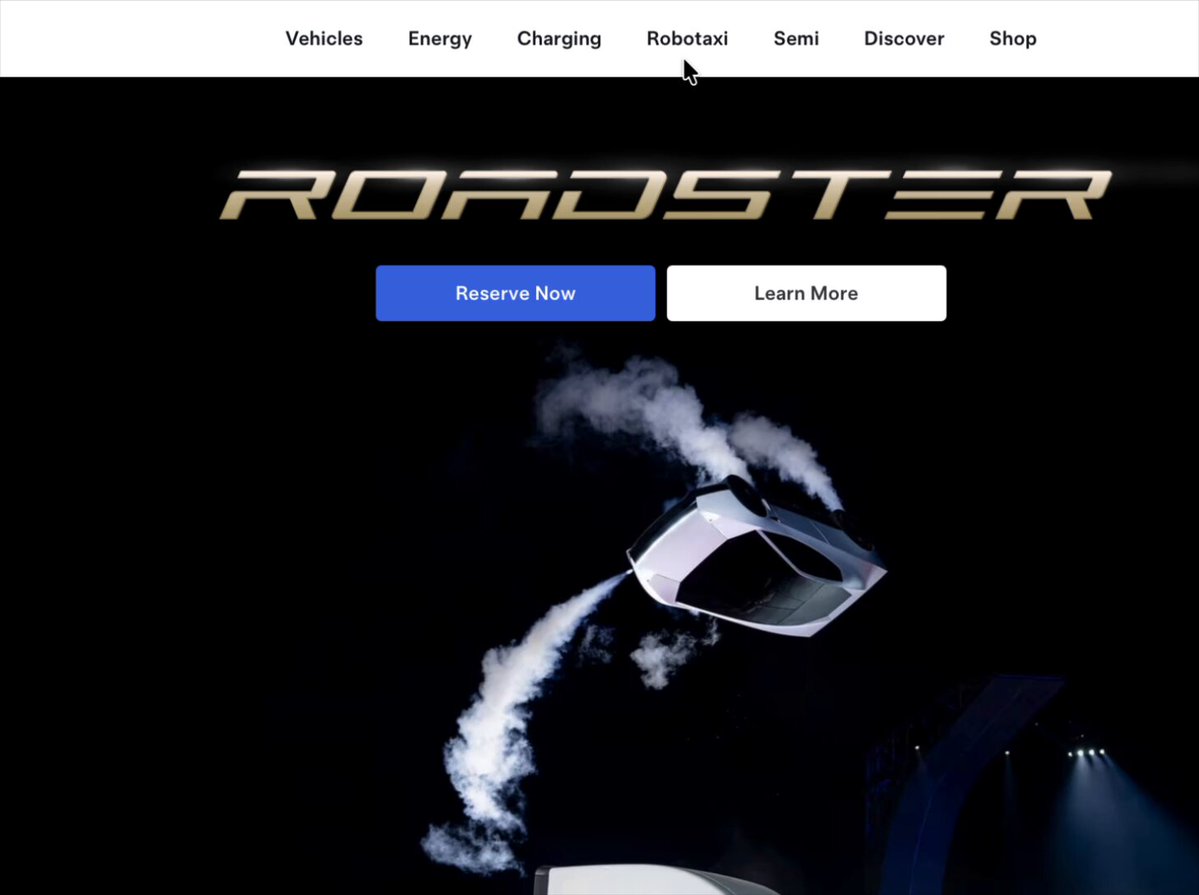
Tesla has quietly but deliberately reorganized its official website to put its next chapter front and center. The homepage now opens with the Tesla Roadster, while dedicated top-level navigation sections for the Robotaxi and Tesla Semi have been added — a layout shift that reflects where the company is actually placing its bets heading into 2027 and beyond.

Three Products, One Clear Message
Website navigation isn't accidental at a company as deliberate as Tesla. Giving Robotaxi and Semi their own top-level sections — alongside the existing consumer vehicle lineup — signals that Tesla no longer treats these as future concepts to be buried in a sub-menu. They're primary products, and the site now reflects that.
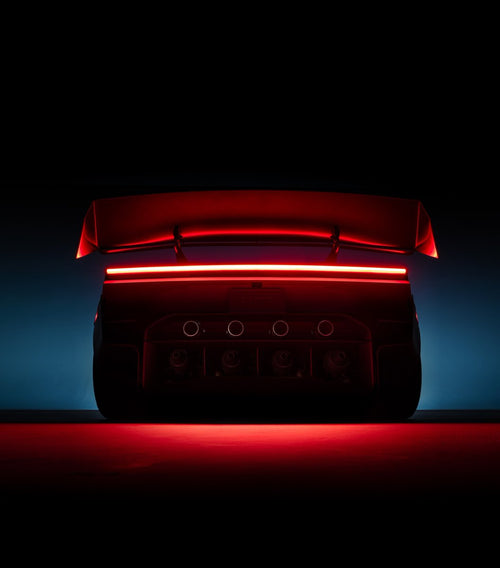
The Roadster placement is equally pointed. Putting it as the first thing a visitor sees on the homepage is a statement of intent: this is the halo vehicle Tesla wants defining its brand right now. The second-generation Roadster was unveiled on October 15, 2026, at a SpaceX test site in McGregor, Texas, where it demonstrated flight capabilities using SpaceX thrusters. Three configurations were announced — Performance (0-60 in under 1.6 seconds, 300+ mile range), Thrust (0-60 in under 0.9 seconds using rocket-assisted acceleration), and an invite-only single-seat Rocket variant that isn't approved for public road use. Production is expected to begin in 2028, with the car currently on display at the Petersen Automotive Museum in Los Angeles through October 27.
Robotaxi: From Pilot to Platform
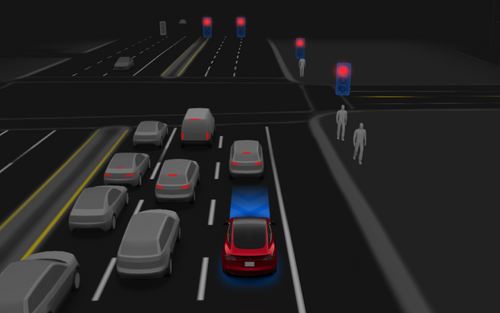
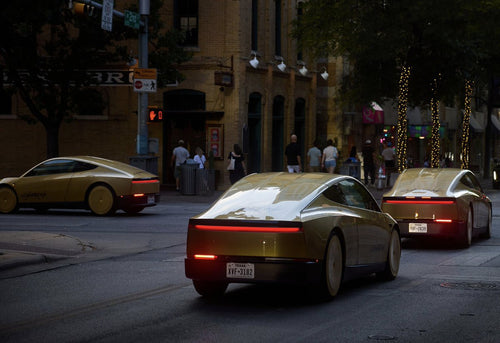
The dedicated Robotaxi section at tesla.com/robotaxi arrives as the service is moving from limited pilot to genuine commercial operation. According to Tesla's own safety report published October 21, 2026, Robotaxis had logged over 3.1 million unsupervised miles across six cities — Austin, Dallas, Houston, Miami, Orlando, and Tampa — with zero reported safety incidents involving injuries, airbag deployments, or pedestrians and cyclists struck. That same day, Tesla confirmed unsupervised Cybercab rides for the general public will launch in Dallas in November 2026. Purpose-built Cybercab vehicles joined the Austin fleet on September 3.
Expansion cities including Las Vegas, Jacksonville, Phoenix, and San Antonio are in the pipeline. Giving the Robotaxi service its own navigation slot puts it on equal visual footing with Model 3 and Model Y — a significant upgrade from its previous positioning as a news item rather than a product category.
Semi: Mass Production, Now With a Proper Homepage
The Tesla Semi section formalizes what's already underway in Sparks, Nevada. Mass production and deliveries officially began at a Semi Rollout event on September 24, 2026, at the dedicated Sparks factory, which is designed for up to 50,000 vehicles annually. The Long Range model offers 500 miles at 82,000 lbs gross combined weight with 1.2 MW charging capability, priced at $290,000. The Standard Range covers 325 miles and runs approximately $260,000. Tesla's Semi webpage explicitly markets the truck as "ready for autonomy," pointing toward eventual FSD integration for commercial freight.
Tesla has also announced an expanding network of Semi Service Centers offering same-day support for common repairs — infrastructure that signals Tesla is serious about fleet operators, not just early adopters.
What the Navigation Tells Us
Homepage real estate and top-level navigation are among the most contested decisions at any consumer tech company. Tesla's choice to elevate Robotaxi, Semi, and Roadster simultaneously suggests the company is managing a deliberate brand transition: from a consumer EV maker to a multi-product platform spanning personal transport, autonomous mobility, and commercial freight.
For existing Tesla owners, the practical implication is straightforward — the company's engineering and software resources are increasingly being deployed across a wider product surface. FSD improvements that benefit Robotaxi operations will likely flow back into personally-owned vehicles, and the Semi's autonomy roadmap runs on the same stack. The website update is cosmetic, but the strategy it reflects is anything but.
🚕 Following the Robotaxi rollout? See every operating city, launch date and announced market in our Tesla Robotaxi Tracker.
Related Gear
Gear up your Tesla with tested, custom-fit BASENOR accessories — shop Tesla accessories →
Sources & reporting notes
The links below identify the material source records used for this report.
- @SawyerMerritt on X (2026-10-25T05:48:31.000Z) — Direct source
Source links are preserved as published or accessed. See our editorial standards and corrections policy.
The BASENOR Editorial Desk covers Tesla, SpaceX, and related technology, curating reporting from primary sources — official accounts, regulatory filings, and software release data. Every article passes source-record and fact-checking review before publication. About the newsroom.
This report was curated by the BASENOR Editorial Desk from the sources listed above. Read our editorial standards or email editorial@basenor.com to report an error.