📌 UPDATE — August 17, 2026
Tesla's Director of Autopilot, Ashok Elluswamy, offered a vivid new framing for the personal robo-car experience, stating owners can now have "James Bond as your personal driver." The comment underscores Tesla's confidence in FSD as a genuinely personal, high-capability autonomous system — not just a fleet robotaxi product. Separately, Tesla booster Whole Mars Catalog highlighted a core competitive moat: Tesla's system remains the only self-driving AI trained on billions of miles of real-world driving data, a dataset advantage that grows with every mile its fleet accumulates. Together, these statements from an official Tesla engineering lead and a prominent community voice represent a notable escalation in how Tesla is publicly positioning FSD's maturity.
@aelluswamy · Aug 17, 2026
"You can have James Bond as your personal driver."

👍 606 · 🔁 61 · 👁 27,155
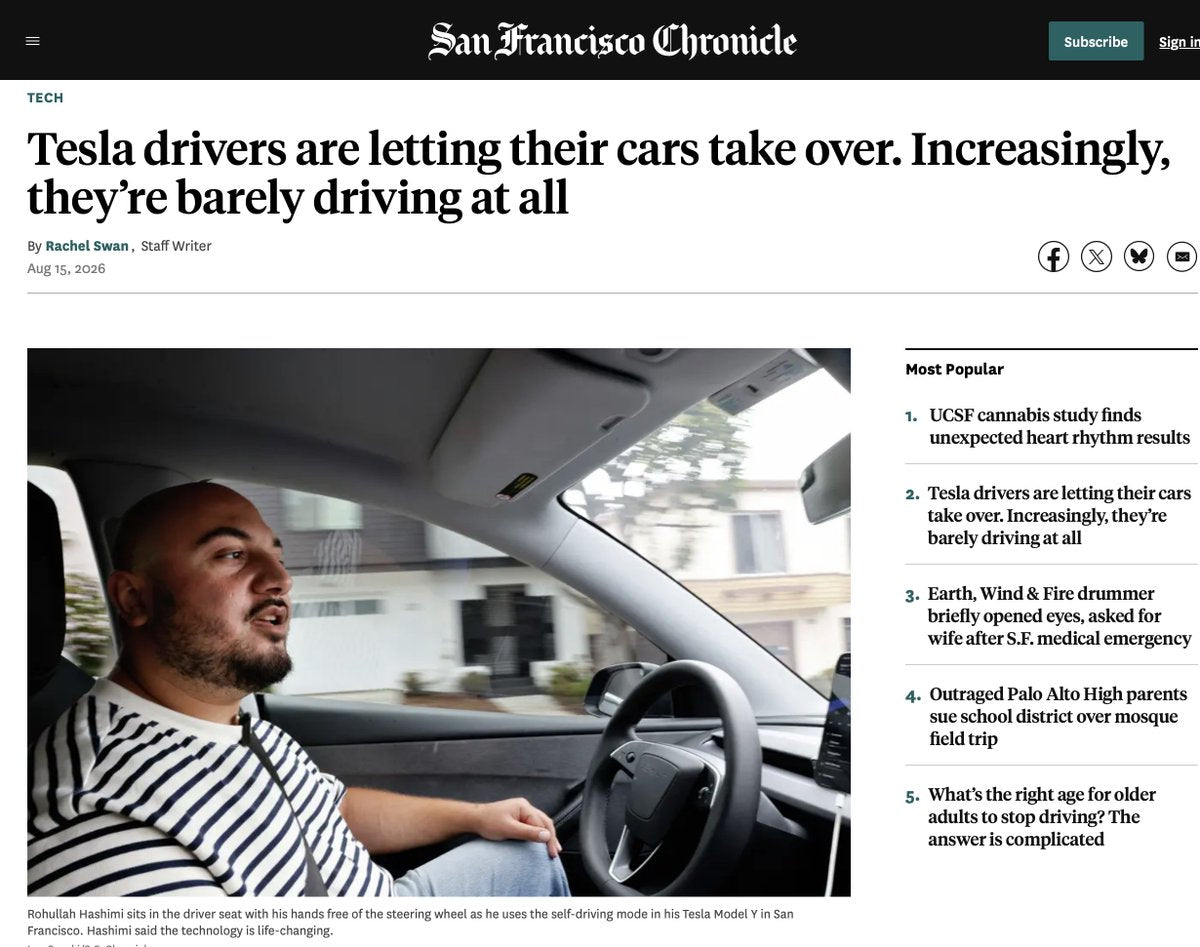
Something has quietly shifted on public roads. A growing number of vehicles are now driving themselves not as part of a commercial ride-hail fleet, but as privately owned cars that sleep in home garages at night and navigate autonomously during the day. It's a distinction that matters — and it's exactly the future Tesla CEO Elon Musk has been describing for years.

The Distinction That Changes Everything
Most public discussion about self-driving cars centers on regulated commercial services — robotaxis operating under specific state permits, with defined geofences and oversight requirements. Those are real, but they represent a narrow slice of what's actually happening.
What Sawyer Merritt flagged on August 15 is a different phenomenon: privately owned vehicles, running FSD, handling real-world commutes and errands without human intervention. These aren't demonstration vehicles or test fleets. They're the cars parked in suburban driveways across the country. The regulatory framework governing them is fundamentally different from commercial autonomous services, and the scale is orders of magnitude larger.
This is the vision Musk has articulated consistently: not a world where you hail an autonomous car, but one where your own car becomes autonomous. The robotaxi is a business model; the personal robo-car is a lifestyle shift.
The Numbers Behind the Shift
The scale of Tesla's FSD deployment makes this transition plausible in a way it simply wasn't two years ago. According to available data, active FSD subscriptions reached 1.48 million globally by the end of June 2026 — a 56% increase year-over-year and a 15.6% jump from the prior quarter alone. Roughly 200,000 new subscribers joined in Q2 2026.
That subscriber base is accumulating real-world miles at a rate that would have seemed implausible not long ago. As of late July 2026, Tesla's FSD system had logged over 12 billion cumulative miles, with the fleet adding approximately 27 million miles per day during June. Tesla's internal metrics claim the system is twice as safe as manual driving, measured by miles between collisions — a figure that, if accurate, has significant implications for how regulators and insurers approach privately operated autonomous vehicles.
| Metric | Value | Timeframe |
|---|---|---|
| Active FSD subscriptions | 1.48 million | End of Q2 2026 |
| YoY subscription growth | +56% | Q2 2026 vs Q2 2025 |
| Cumulative FSD miles | 12 billion+ | As of July 22, 2026 |
| Daily FSD miles (fleet) | ~27 million/day | June 2026 |
| New Q2 2026 subscribers | ~200,000 | Q2 2026 |
Software Catching Up to the Vision
The hardware and software story has also matured considerably. As of August 2026, Tesla is running two parallel FSD tracks: v14.1 Lite for Hardware 3 vehicles, which began rolling out to early access members around August 8-9 on firmware 2026.21.6, and v14.3.7 for Hardware 4 equipped cars. The gap between what HW3 and HW4 vehicles can do continues to narrow with each release cycle, which matters because the vast majority of FSD subscribers are still on HW3 hardware.
The subscription model itself shifted in February 2026, when Tesla eliminated the one-time purchase option. FSD is now $99 per month, or $49 per month for owners who previously purchased Enhanced Autopilot. That pricing structure — recurring revenue tied directly to capability improvements — gives Tesla a financial incentive to keep pushing the software forward aggressively. Musk has stated the subscription price is expected to rise as the system moves closer to full autonomy, which means early subscribers are effectively locking in the lowest rates they'll ever see.
Commercial and Personal: Two Tracks, One Destination
The commercial robotaxi program and the personal robo-car phenomenon are running in parallel, not in sequence. Tesla's robotaxi service launched in Austin in June 2025 with human safety supervisors, and by Q2 2026 had expanded to seven major U.S. metros. Cybercab production began at Gigafactory Texas in Q2 2026, with factory-integrated Starlink hardware included. Musk has stated publicly that he expects a dramatic increase in fully driverless robotaxi operations — without safety monitors — in the second half of 2026, initially across Texas cities.
But the personal fleet is already larger by orders of magnitude. Nearly 1.5 million active subscribers means nearly 1.5 million privately owned vehicles capable of driving themselves, on roads that weren't designed with autonomous operation in mind, in weather and traffic conditions that no geofenced robotaxi service has to handle. That's the real-world stress test — and according to Tesla's own data, the fleet is passing it at scale.
Musk's longer-range projection — that roughly 90% of all distance driven will be handled by AI within five to ten years — looks less like a prediction and more like an extrapolation of a trend already underway. The personal robo-car isn't a concept anymore. For a meaningful slice of Tesla owners, it's a Tuesday morning commute. For our ongoing FSD coverage, the question is no longer whether this transition happens — it's how fast the rest of the fleet catches up.
🚕 Following the Robotaxi rollout? See every operating city, launch date and announced market in our Tesla Robotaxi Tracker.
Related Gear
Gear up your Tesla with tested, custom-fit BASENOR accessories — shop Tesla accessories →
Sources & reporting notes
The links below identify the material source records used for this report.
- @SawyerMerritt on X (2026-08-15T22:17:29.000Z) — Direct source
Source links are preserved as published or accessed. See our editorial standards and corrections policy.
The BASENOR Editorial Desk covers Tesla, SpaceX, and related technology, curating reporting from primary sources — official accounts, regulatory filings, and software release data. Every article passes source-record and fact-checking review before publication. About the newsroom.
This report was curated by the BASENOR Editorial Desk from the sources listed above. Read our editorial standards or email editorial@basenor.com to report an error.