📌 UPDATE — August 7, 2026
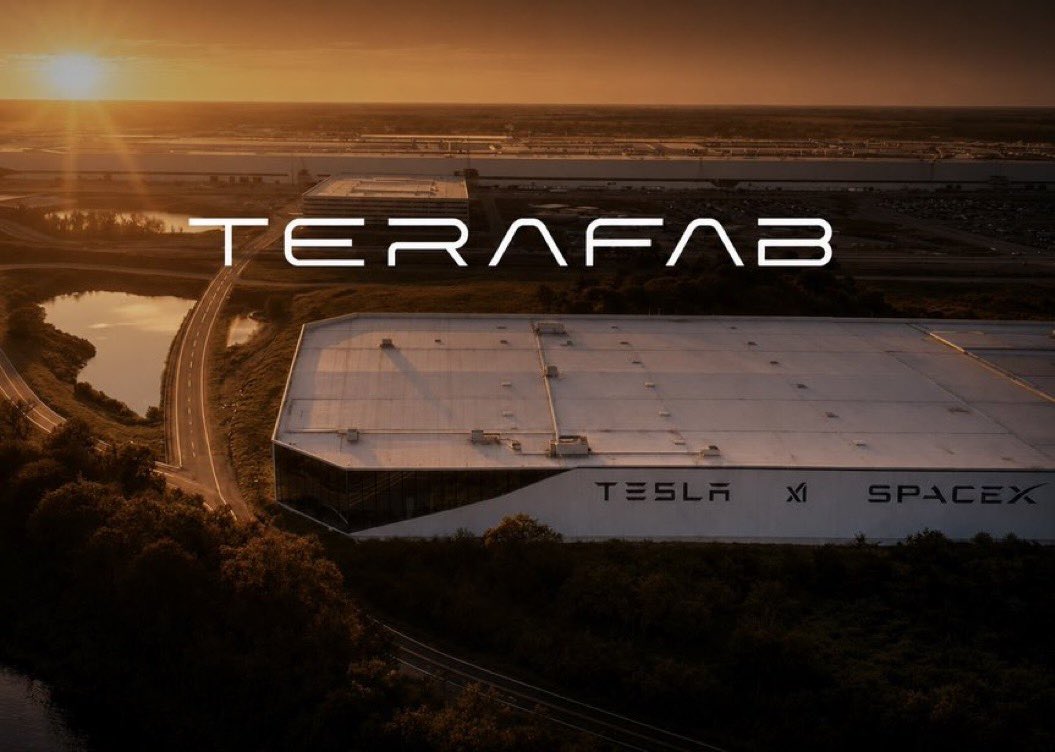
Elon Musk has revealed the staggering scale of the planned Terafab facility, posting on X that it will be 50 times the size of the Pentagon when complete. For context, the Pentagon spans roughly 6.5 million square feet — meaning Terafab would clock in at an almost incomprehensible ~325 million square feet, making it by far the largest building complex ever constructed. Musk offered no timeline or phased build-out details alongside the claim, but the sheer figure underscores Tesla's ambition to vertically integrate AI chip manufacturing at a scale that dwarfs any existing semiconductor fab on the planet.

— @elonmusk, Aug 7 2026 · 317 likes · 244K views
📌 UPDATE — August 6, 2026
Tesla's Terafab ambitions are accelerating fast: the company has now posted 36 job openings tied to the project, signaling a meaningful ramp-up in advanced semiconductor manufacturing operations. The listings span highly specialized process engineering roles — including Lithography, Dry Etch, Plating, and Epitaxy — alongside environmental health and safety positions such as an Industrial Hygienist, EHS Manager, and Environmental Engineer for Air Quality. The breadth of these roles suggests Tesla is moving beyond early-stage planning and into active fab buildout, with cleanroom-class process disciplines now being staffed in earnest. The environmental and safety hires in particular point to a physical facility coming online, not just R&D groundwork.
@SawyerMerritt · Aug 6, 2026
"Tesla now has 36 job openings listed for Terafab: Industrial Hygienist, Sr. Process Engineer Lithography, Sr. Process Engineer Dry Etch, Sr. Process Engineer Plating, Sr. Process Engineer Epitaxy, EHS Manager, Environmental Engineer Air Quality, Equipment…"
📌 UPDATE — August 6, 2026
Elon Musk has offered the first concrete — if rough — breakdown of how Terafab's AI compute output would be allocated across his ventures. Replying to @teslaownersSV, Musk estimated approximately 25% of Terafab's compute would go to Tesla Optimus and the remaining 75% to AI spacecraft. The lopsided split signals that while Optimus is a major beneficiary, the bulk of Terafab's output is earmarked for what appears to be a SpaceX-adjacent AI initiative rather than Tesla's robotics program alone.
Musk was careful to caveat the figures as a "very approximate guess," so these proportions should not be treated as firm commitments. Still, it's the clearest public signal yet of how Terafab's resources are expected to flow — and it underscores that Tesla is not the sole, or even primary, destination for the fab's AI compute.
"My very approximate guess is that Terafab AI compute output would be ~25% for Tesla Optimus and ~75% for AI spacecraft" — @elonmusk, Aug 6 2026
Elon Musk posted a single word on X this afternoon: "Terafab." No caption, no explanation — just the name of Tesla's most ambitious manufacturing bet yet. For anyone tracking the company's long-term strategy, that one word carries a lot of weight.

What Terafab Actually Is
Terafab isn't a factory in the traditional Tesla sense. According to the project's official announcement in March 2026, it's a large-scale semiconductor fabrication plant — a chip fab — designed to bring advanced AI silicon production in-house across Musk's companies. The goal is vertical integration at a scale the industry hasn't seen from a non-legacy chipmaker: one facility supplying custom silicon to Tesla, SpaceX, and xAI simultaneously.
Musk unveiled the project on March 21, 2026, at the defunct Seaholm Power Plant in Austin, Texas — a location choice that felt deliberately symbolic. The site itself is a monument to industrial-era energy production; Terafab is being positioned as its successor for the AI era.
Why This Matters Beyond the Hype
The strategic logic is straightforward but the execution is anything but. Tesla already designs its own AI training chips (the Dojo D1) and inference hardware (the HW4/FSD chip), but it has always relied on TSMC for fabrication. That dependency creates lead times, allocation risk, and margin compression — problems that compound as Tesla scales Optimus production, expands its Dojo supercomputer cluster, and feeds xAI's Grok infrastructure.
A captive fab changes that calculus entirely. If Terafab delivers on its premise, Tesla could control the full stack from chip design through wafer production — the kind of vertical integration that has defined the company's approach to batteries, motors, and software. The difference is that semiconductor fabrication is orders of magnitude more capital-intensive and technically demanding than anything Tesla has attempted in manufacturing before.
The demand signal is real. xAI's Grok models require enormous compute, SpaceX's Starlink constellation is expanding its onboard processing needs, and Tesla's autonomous driving ambitions — from FSD to the Cybercab fleet — are fundamentally chip-constrained. A shared fab serving all three entities could spread the fixed cost of a multi-billion-dollar facility across a combined demand base that few standalone chip customers can match.
What Today's Post Signals
A single-word post from Musk — no link, no context — typically means one of two things: either something is imminent and he's seeding anticipation, or he's responding to something in his feed that's already circulating. With 847,000 views in under three hours, the post has clearly landed. Whether it precedes a formal update, a groundbreaking announcement, or simply reflects a moment of focus on the project isn't yet clear.
What is clear is that Terafab hasn't faded into the background since its March announcement. The project remains a live, active priority — and Musk's habit of telegraphing major moves through minimalist posts means this one is worth watching closely.
Related Gear
Gear up your Tesla with tested, custom-fit BASENOR accessories — shop Tesla accessories →
Sources & reporting notes
The links below identify the material source records used for this report.
- @elonmusk on X (2026-08-04T13:39:45.000Z) — Direct source
Source links are preserved as published or accessed. See our editorial standards and corrections policy.
The BASENOR Editorial Desk covers Tesla, SpaceX, and related technology, curating reporting from primary sources — official accounts, regulatory filings, and software release data. Every article passes source-record and fact-checking review before publication. About the newsroom.
This report was curated by the BASENOR Editorial Desk from the sources listed above. Read our editorial standards or email editorial@basenor.com to report an error.