📌 UPDATE — July 28, 2026
Tesla's unified V14 rollout is accelerating: FSD (Supervised) v14.3.6 and v14 Lite are now reaching the 6th and 7th batches of vehicles under software update 2026.20.6.11, confirming the single-build approach is working as intended across both HW4/AI4 and HW3/AI3 hardware. Release notes for v14.3.6 remain unchanged from prior batches. Separately, FSD v14.3.5 is now rolling out in Australia and New Zealand, marking a significant international expansion of the V14 branch.


📌 UPDATE — July 23, 2026
Tesla's unified V14 rollout is picking up pace: FSD (Supervised) v14.3.6 and v14 Lite are now reaching a third batch of vehicles via software update 2026.20.6.11. The release confirms the unified architecture in action — both HW3/AI3 and HW4/AI4 vehicles are receiving the same build simultaneously. No changes were made to the v14.3.6 release notes in this wave, suggesting Tesla is focused on expanding coverage rather than pushing new feature changes. If you haven't received the update yet, this third batch rollout means more vehicles are being greenlit — check your Tesla app for a pending install.

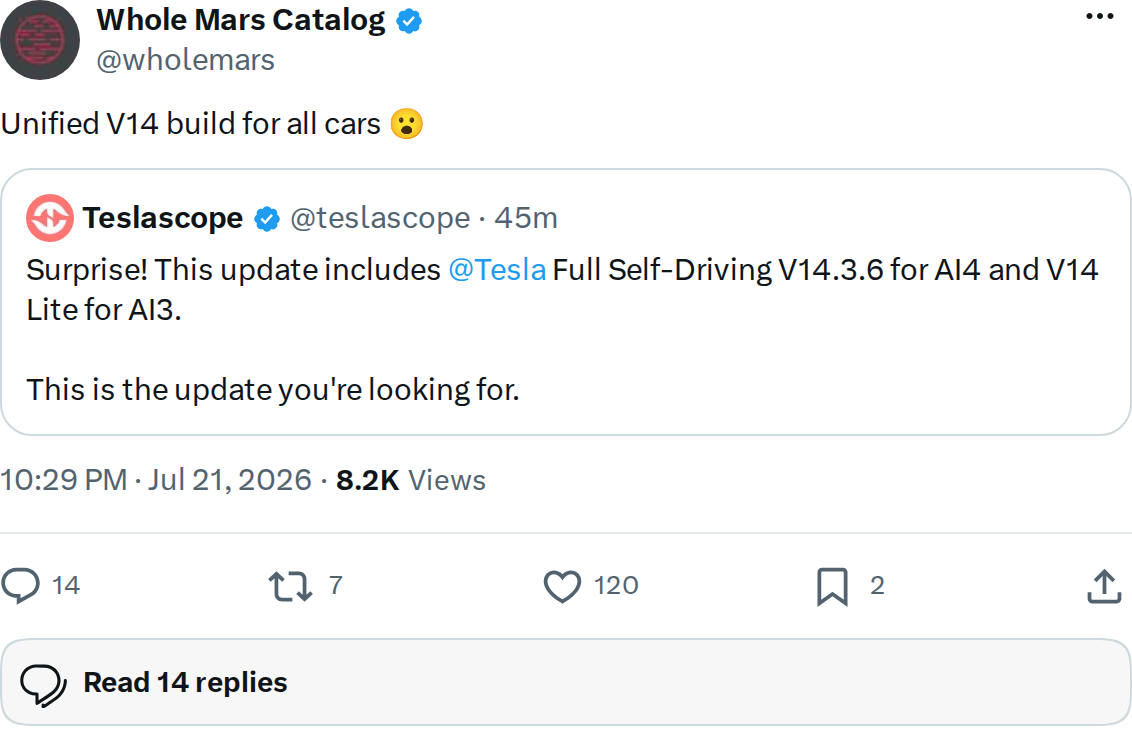
A brief but significant post from Whole Mars Catalog on July 21 flagged something Tesla hasn't formally announced: the company is working toward a unified V14 build for all cars. That's a meaningful architectural statement — and it has real implications for the tens of thousands of owners still running Hardware 3. Here's what we know and what it means for your vehicle.

What exactly is a "unified build"?
Historically, Tesla has maintained separate software branches for different hardware generations. Hardware 3 (HW3/AI3) and Hardware 4 (HW4/AI4) vehicles have run distinct builds because the underlying compute platforms are fundamentally different. A unified build means Tesla is engineering a single software package that can deploy across both hardware generations — the same codebase, the same release, just scaled to the capabilities of each chip. Think of it like a single app that runs on both an older and a newer phone, rather than two entirely separate apps maintained by two separate teams.
Why does this matter for HW3 owners?
It's the clearest signal yet that Tesla is not abandoning its older hardware fleet. HW3 vehicles — which include a large portion of Model 3, Model Y, Model S, and Model X cars delivered before late 2023 — have been running FSD v14 Lite, a compressed and optimized version of the full v14 neural net model engineered to fit within HW3's compute constraints. According to previous reporting, Tesla's Director of AI Ashok Elluswamy confirmed during the Q1 2026 earnings call that FSD v14 Lite was targeted for a late June 2026 rollout to North American HW3 vehicles. Deployment of build 2026.20.6.10 began with a small group of early access drivers on June 29, and on July 20 Elluswamy posted that a wider release was imminent. A unified build architecture is what makes that kind of parallel deployment sustainable at scale.
What's the difference between FSD v14 full and FSD v14 Lite?
FSD v14 full runs on HW4 (AI4) hardware, which carries significantly more on-board compute. FSD v14 Lite is a distilled version of the same underlying model — same training data, same end-to-end neural net approach, but compressed to run efficiently on HW3's more limited chip. The driving behavior and feature set are expected to be closely aligned; the difference is in how much raw inference capacity the car can throw at any given moment. HW4 vehicles are currently receiving FSD v14.3.5 via software update 2026.20.6.6, while HW3 vehicles are receiving 2026.20.6.10 — the version numbers themselves suggest these are parallel branches of the same parent build.
What does "unified" actually change in practice?
For owners, the most tangible benefit is release cadence parity. When Tesla ships a new FSD improvement, a unified build means HW3 and HW4 vehicles should receive updates on roughly the same timeline rather than HW3 owners waiting weeks or months for a ported version. It also reduces the engineering overhead of maintaining two divergent codebases — fewer bugs introduced by branch divergence, and a cleaner path to pushing fixes fleet-wide. For Tesla's development team, it's a significant simplification that should accelerate iteration.
Does this mean HW3 gets everything HW4 gets?
Not necessarily. A unified build doesn't erase hardware capability gaps — it just means the software is structured to handle both. Features that require HW4's additional cameras, sensors, or raw compute will still be gated to HW4 vehicles. What changes is the underlying architecture: rather than Tesla writing HW3 features separately, HW3 support becomes a first-class consideration within the same development pipeline. Owners on HW3 should expect to see FSD improvements land faster and more consistently, but hardware-dependent features like certain Autopilot camera configurations will remain HW4-exclusive.
How do I know which hardware my Tesla has?
Go to Controls → Software → Additional Vehicle Information on your touchscreen. Look for the "Autopilot computer" field — it will read either "Full Self-Driving Computer" (HW3/AI3) or "Full Self-Driving Computer (Revision 2.0)" or similar HW4 designation. You can also check via the Tesla app under your vehicle's software details. If you purchased your car before approximately late 2023, you are likely on HW3 unless you paid for a hardware upgrade.
The move toward a unified V14 build is less of a feature announcement and more of a structural commitment — Tesla is architecting its software so that the entire active fleet moves together. For the millions of owners on HW3 who have been watching HW4 vehicles receive FSD improvements first, that's a meaningful shift in how the pipeline works. The wider rollout of 2026.20.6.10 to HW3 vehicles in the coming days will be the first real-world test of whether that unified architecture delivers on its promise.
Related Gear
Gear up your Tesla with tested, custom-fit BASENOR accessories — shop Tesla accessories →
Sources & reporting notes
The links below identify the material source records used for this report.
- @wholemars on X (2026-07-21T22:29:13.000Z) — Direct source
Source links are preserved as published or accessed. See our editorial standards and corrections policy.
The BASENOR Editorial Desk covers Tesla, SpaceX, and related technology, curating reporting from primary sources — official accounts, regulatory filings, and software release data. Every article passes source-record and fact-checking review before publication. About the newsroom.
This report was curated by the BASENOR Editorial Desk from the sources listed above. Read our editorial standards or email editorial@basenor.com to report an error.