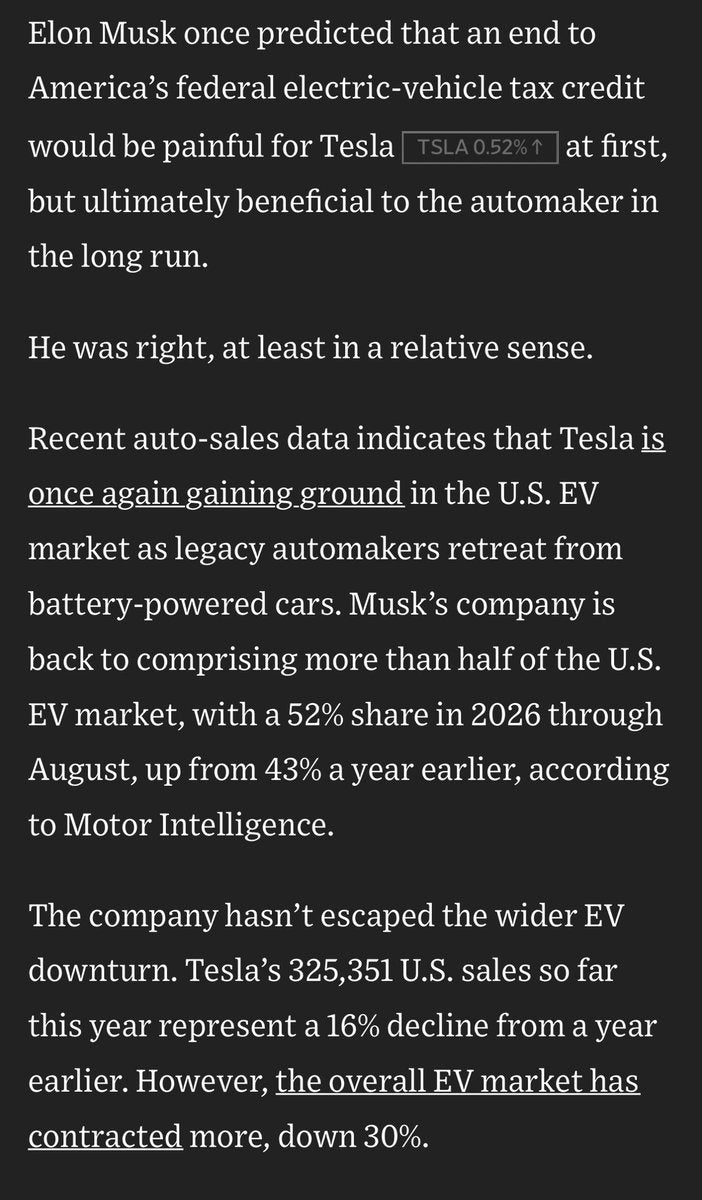
When the federal EV tax credit expired on September 30, 2025, critics warned it would devastate EV adoption. What actually happened tells a more complicated story — one that appears to vindicate a long-held Tesla argument about who those incentives were really serving. According to Motor Intelligence data, Tesla's US market share has climbed to 52% through the first eight months of 2026, up from 43% during the same period in 2025. Here are the five numbers that explain how we got here.

1. 59% — Tesla's Market Share Spike in Q4 2025
The credits expired hard on September 30, 2025 — no phase-out, no grace period. The immediate aftermath was striking. In Q4 2025, Tesla's US EV market share jumped to 59%, its highest reading since 2023, according to industry data. The overall US EV market simultaneously contracted: EV penetration fell to 5.7% of total vehicle sales in Q4 2025, down from 10.5% the prior quarter. The tax credit's removal didn't just shift market share — it shrank the pie, and Tesla ended up with a much larger slice of a smaller whole.
2. 30% — How Much the Broader EV Market Contracted
Through the first eight months of 2026, total US EV sales fell roughly 30% year-over-year, according to background research citing Motor Intelligence. That's a significant demand destruction signal. Legacy automakers who had been building out EV lineups with heavy reliance on the $7,500 incentive to close the price gap against Tesla found themselves exposed. Several pulled back production targets or shifted resources. The contraction wasn't uniform — it hit subsidy-dependent nameplates hardest.
3. 16% — Tesla's Own Sales Decline, in Context
Tesla wasn't immune. US sales fell approximately 16% year-over-year through August 2026. That number looks rough in isolation — but set against the 30% market-wide contraction, it's actually the mechanism behind the share gain. Tesla lost fewer sales than the competition. Its vertically integrated cost structure, direct-sales model, and lack of dealer markup gave it more pricing flexibility than legacy brands that needed the credit to hit competitive price points. A smaller absolute number can still represent a bigger relative position.
4. 54.2% — Q1 2026 Share, the First Full Post-Credit Quarter
In Q1 2026 — the first complete quarter with no federal EV subsidy in place — Tesla delivered an estimated 117,300 vehicles in the United States, capturing 54.2% of the EV market. That figure confirmed the Q4 2025 spike wasn't a one-quarter anomaly. Legacy automaker EV programs that had been gaining ground through 2024 and into 2025 stalled once the $7,500 subsidy was no longer available to offset sticker price disadvantages. The structural competitiveness gap, which the credit had been partially masking, snapped back into view.
5. 52–55% — Where Tesla Stands Today
As of September 12, 2026, Tesla holds approximately 52% of the US EV market year-to-date through August, per Motor Intelligence data cited in background research. Cox Automotive puts the estimate slightly higher, around 55%. Either figure represents a meaningful recovery from the 43% share Tesla held during the same period in 2025, when the credit was still active and competitors were using it aggressively to close the gap. The range between the two estimates reflects the inherent difficulty in tracking a fragmented market in near-real-time, but the directional story is consistent across sources.
What the Credit Was Actually Doing
The data supports a reading that the Inflation Reduction Act's EV incentives functioned partly as a competitive subsidy for legacy automakers trying to match Tesla on price — not primarily as a tool to accelerate overall EV adoption. When the credit disappeared, so did much of the artificial price competitiveness it was funding. Tesla, which had already spent years driving its own costs down, was better positioned to absorb the shock. The broader EV market's 30% contraction suggests the incentives were propping up demand that wasn't yet organically sustainable at current price levels. Whether that's an argument for or against the policy depends on your theory of how markets develop — but the market share numbers are what they are.
Related Gear
Gear up your Tesla with tested, custom-fit BASENOR accessories — shop Tesla accessories →
Sources & reporting notes
The links below identify the material source records used for this report.
- @wholemars on X (2026-09-13T16:34:59.000Z) — Direct source
Source links are preserved as published or accessed. See our editorial standards and corrections policy.
The BASENOR Editorial Desk covers Tesla, SpaceX, and related technology, curating reporting from primary sources — official accounts, regulatory filings, and software release data. Every article passes source-record and fact-checking review before publication. About the newsroom.
This report was curated by the BASENOR Editorial Desk from the sources listed above. Read our editorial standards or email editorial@basenor.com to report an error.