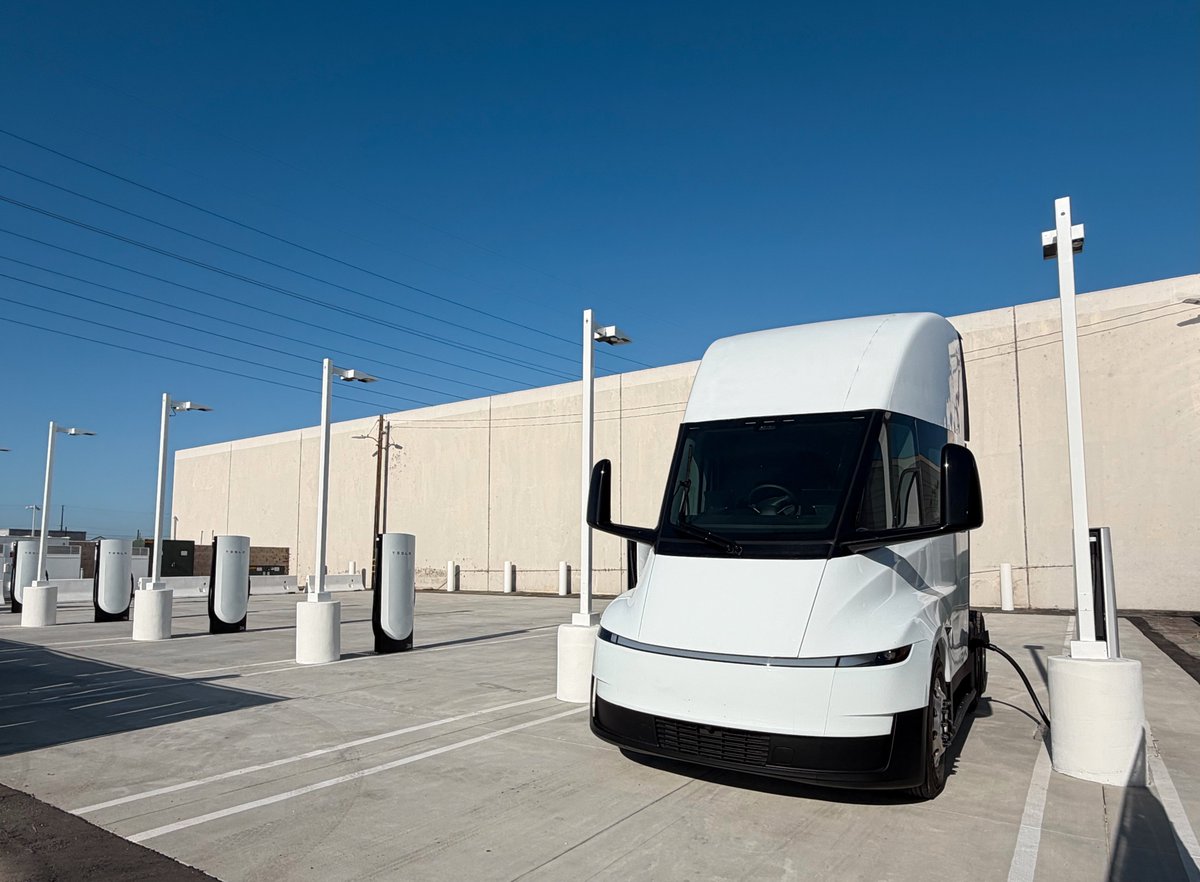
Tesla has opened its second publicly accessible Megacharger station, this time in Vernon, California — a dense industrial corridor just south of downtown Los Angeles. The site adds six high-power stalls to a network that, until recently, had only one publicly available location. For fleet operators running Tesla Semis in Southern California, the timing and geography here are worth paying close attention to.

1. This is only the second public Megacharger in existence
Tesla's Megacharger network has been operational in limited form for a while, but most sites have been factory-adjacent or private — accessible only to Tesla's own Semi fleet. The first publicly accessible station opened in Ontario, California in March 2026. Vernon is the second. That's a deliberately slow rollout for a commercial trucking network, and it signals Tesla is still in the early infrastructure-building phase rather than a broad deployment push.
2. Six stalls, each capable of up to 1.2MW
The Vernon site matches the spec profile seen at the Bloomington, California Megacharger that opened in July 2026 — six stalls, each delivering up to 1.2 megawatts of power. To put that in practical terms: a Tesla Semi Long Range can add roughly 300 miles of range in about 30 minutes at those speeds, according to verified specs. That's approximately 60% of its 500-mile range restored in a single half-hour stop — a meaningful number for time-sensitive freight operations.

3. Vernon is a strategic industrial location
Vernon isn't a random pick. The city is one of the most concentrated industrial zones in Southern California — warehouses, distribution centers, food processing plants, and logistics hubs are packed into roughly five square miles. Fleets running last-mile and regional haul routes through the LA basin pass through or near Vernon constantly. Placing a Megacharger here targets exactly the operators most likely to be evaluating or already running Tesla Semis on commercial duty cycles.
4. The MCS connector is an open industry standard
Tesla's Megachargers use the Megawatt Charging System (MCS) connector — an open industry standard, not a proprietary Tesla plug. The MCS standard supports charging speeds up to 3.75MW, meaning Tesla's current 1.2MW hardware is operating well below the ceiling the protocol allows. That headroom matters: as Semi battery technology and grid capacity improve, the same connector infrastructure could theoretically support significantly faster charging without a hardware swap at the vehicle level.
5. The broader network is still in early build-out
As of earlier this year, Tesla had roughly 64 Megacharger locations marked as "coming soon" on its interactive map, with California slated for 17 planned sites. Tesla has also partnered with Pilot Travel Centers to bring Megacharger stalls to select truck stop locations across California, Georgia, Nevada, New Mexico, and Texas — with initial sites expected by summer 2026. The Vernon opening is one data point in what is shaping up to be a more aggressive second half of the year for Semi infrastructure, with Tesla targeting approximately 46 Megacharger stations by early 2027.
Two public Megachargers down, dozens more planned. The Vernon site confirms that Tesla is clustering early public infrastructure around Southern California's industrial core — a logical starting point given Semi production ramping at Gigafactory Nevada and the density of commercial freight activity in the region. How quickly the rest of those 64 planned locations come online will determine whether the Semi becomes a viable option for operators running routes beyond the current coverage footprint.
Related Gear
Gear up your Tesla with tested, custom-fit BASENOR accessories — shop Tesla accessories →
Sources & reporting notes
The links below identify the material source records used for this report.
- @SawyerMerritt on X (2026-08-21T01:01:32.000Z) — Direct source
- @wholemars on X (2026-08-21T01:11:04.000Z) — Direct source
Source links are preserved as published or accessed. See our editorial standards and corrections policy.
The BASENOR Editorial Desk covers Tesla, SpaceX, and related technology, curating reporting from primary sources — official accounts, regulatory filings, and software release data. Every article passes source-record and fact-checking review before publication. About the newsroom.
This report was curated by the BASENOR Editorial Desk from the sources listed above. Read our editorial standards or email editorial@basenor.com to report an error.