
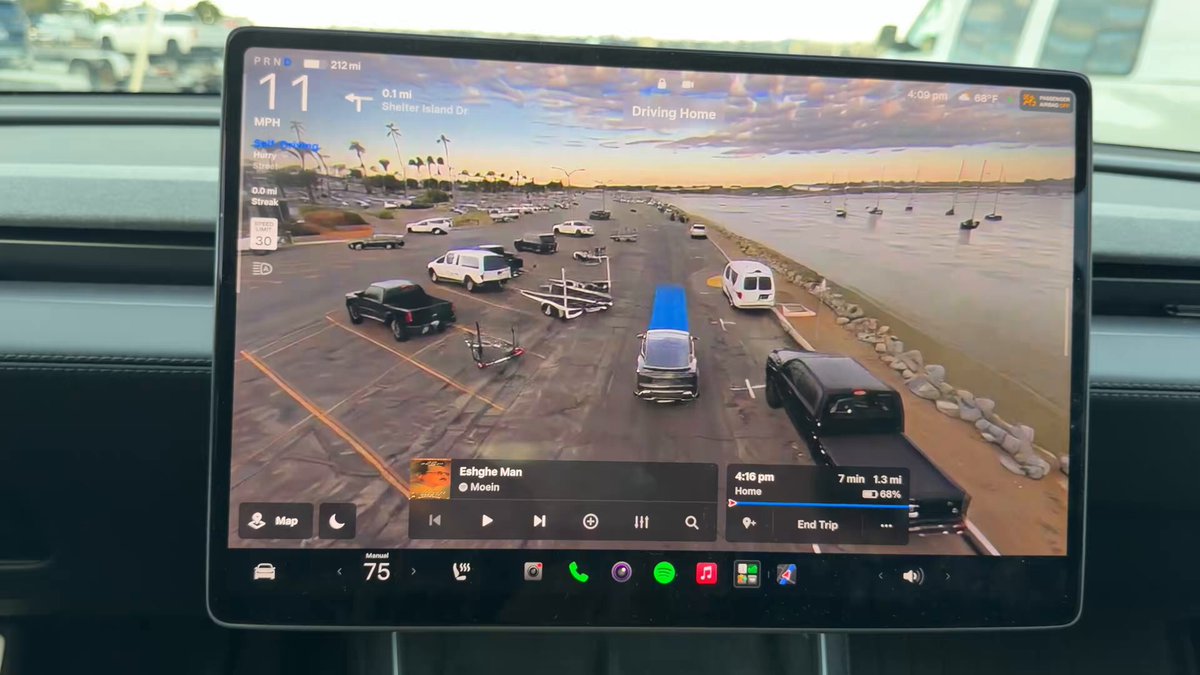
Tesla's Full Self-Driving v15 is turning heads — not just for what it can drive, but for what it can show. The new Reality View feature generates a real-time AI rendering of the world around the car, and early footage from the limited rollout is giving owners their clearest look yet at how dramatically the in-cabin experience has changed.

What Reality View Actually Is
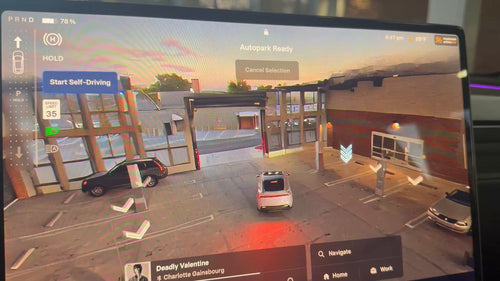
Reality View isn't a map overlay or a cleaned-up camera feed. According to Tesla, it's a generative overhead driving visualization — an end-to-end AI system that synthesizes what the car's sensors see into a live, photorealistic rendering viewed from a virtual camera positioned above the vehicle. Grass, trees, buildings, road textures: all of it is generated in real time, not pulled from a database of pre-mapped tiles.
That distinction matters. Previous FSD visualizations used explicit model signals — discrete objects like cones, boxes, and lane lines — to represent the world. Reality View collapses that pipeline into a single unified output, which is why early testers have described the environmental texturing as "incredibly detailed" and "very impressive." Elon Musk has compared the interface to a video game, noting it "re-renders reality with chevrons in the sky for turns."
Beyond the aesthetics, Reality View is functional. It displays the car's planned route with directional arrows, marks intended parking spots with pins, and communicates the vehicle's intent in a way that previous visualizations simply couldn't. Drivers can also switch between a fullscreen view and a map overlay depending on preference. For a deeper breakdown of what it means specifically for parking, see Reality View's five key parking details.
The Hardware Divide
There's a significant catch: Reality View is exclusive to vehicles equipped with Hardware 4 (HW4, also called AI4). Cars running the older Hardware 3 will receive a separate branch — v14.3 Lite — rather than v15. That means the feature split isn't just about software eligibility; it reflects a genuine architectural gap between the two hardware generations.
The computational footprint is smaller than you might expect for something this visually rich. Tesla states that Reality View uses half of one AI4 TRIP accelerator — less total compute than the prior visualization system it replaces. That efficiency is part of what makes the end-to-end approach viable at scale.
The initial release — firmware 2026.38.6.11 — began reaching Early Access Program members on November 21, 2026. A broader rollout is expected alongside Tesla's annual Holiday Update in December 2026. For the full technical breakdown of what else changed in v15, including the new front bumper camera integration, see our FSD v15 and the front bumper camera coverage. The original feature introduction is also covered in our Reality View explainer from launch day.
Why This Matters Beyond the Visuals
It would be easy to frame Reality View as a cosmetic upgrade — a prettier screen for the same underlying driving system. That framing misses the point. The shift from explicit object signals to a generative, unified visualization reflects the same architectural philosophy driving FSD v15 as a whole: fewer hand-coded rules, more learned representation of the world.
When the car renders a photorealistic coastal cliff or a tree-lined street in real time, it's demonstrating that its internal model of the environment is rich enough to reconstruct that scene visually. The rendering is, in a sense, a window into how the car is actually perceiving its surroundings — not a separate graphics layer bolted on top. That's a meaningful signal about where Tesla's autonomy stack is headed, and it's why footage like the coastal scenery clip above has resonated well beyond the usual FSD enthusiast crowd.
Whether the wider December rollout delivers the same visual fidelity across diverse environments — urban grids, highway interchanges, low-light conditions — will be the real test of how production-ready this system is.
📋 Tracking Tesla software? See every firmware, FSD and app version in one place in our Tesla Software Update Tracker.
Related Gear
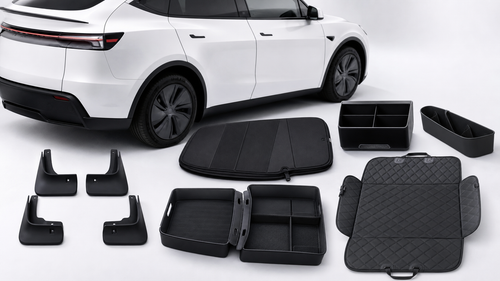
Gear up your Tesla with tested, custom-fit BASENOR accessories — shop Tesla accessories →
Sources & reporting notes
The links below identify the material source records used for this report.
- @TeslaNewswire on X (2026-11-23T08:45:19.000Z) — Direct source
Source links are preserved as published or accessed. See our editorial standards and corrections policy.
The BASENOR Editorial Desk covers Tesla, SpaceX, and related technology, curating reporting from primary sources — official accounts, regulatory filings, and software release data. Every article passes source-record and fact-checking review before publication. About the newsroom.
This report was curated by the BASENOR Editorial Desk from the sources listed above. Read our editorial standards or email editorial@basenor.com to report an error.