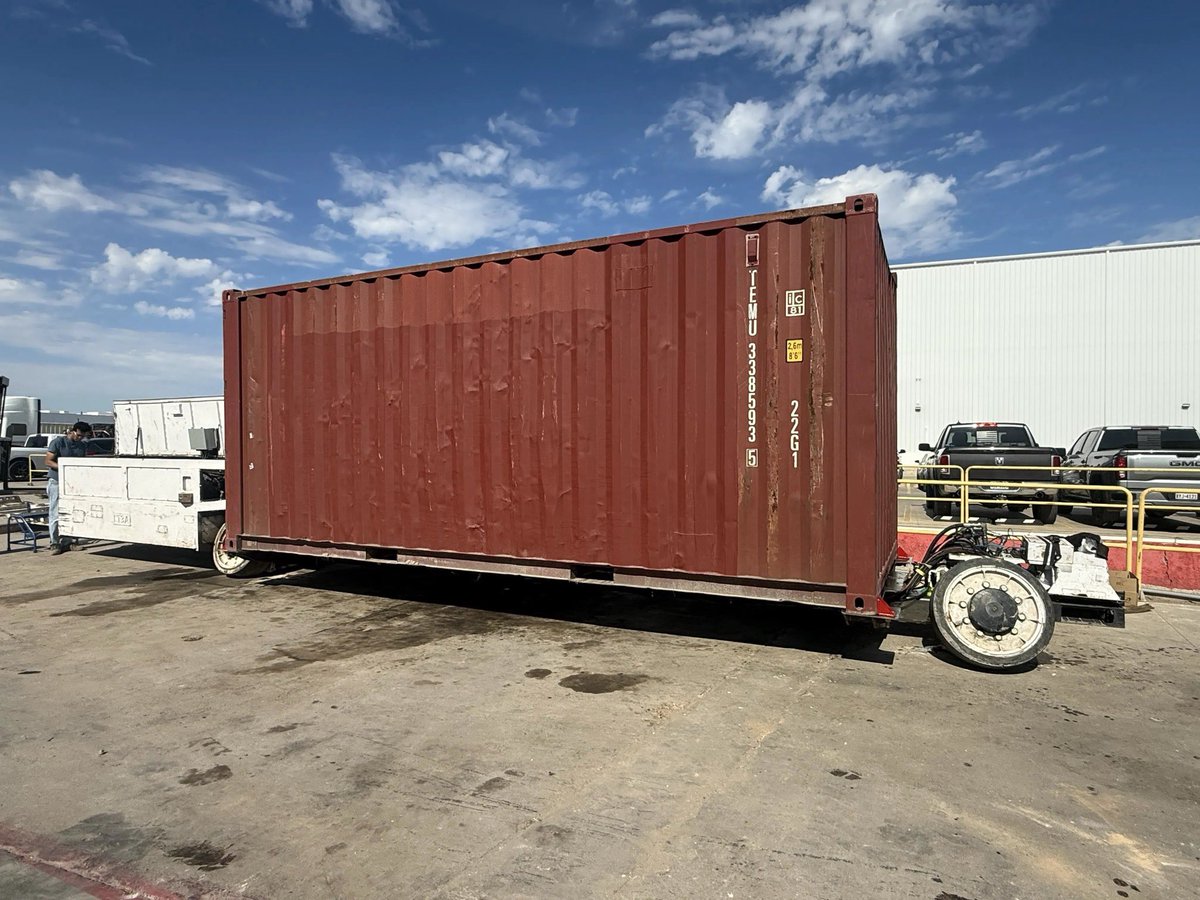
The Boring Company just expanded what its tunnels are for. On October 19, 2026, the company announced it has modified its Prufrock Liner Truck — a vehicle already built around Tesla Model 3 batteries and drive units — to carry a standard 20-foot shipping container underground. It's an early but concrete signal that TBC sees freight as a real use case, not just passenger pods.

What exactly is the Prufrock Liner Truck?
The Prufrock Liner Truck is a support vehicle designed to work alongside TBC's Prufrock tunnel boring machines. It was already built using Tesla Model 3 batteries and drive units — making it an all-electric vehicle purpose-built for underground operation. For this freight test, TBC modified the truck's bed to accept a standard 20-foot intermodal shipping container, the same format used in global sea and rail freight.
Why does it use Tesla Model 3 components?
TBC and Tesla share the same parent company in Elon Musk, and the two organizations have a documented history of sharing technology. Tesla's Model 3 powertrain components are mature, mass-produced, and well-understood — which makes them a practical choice for a custom industrial vehicle that needs to be reliable in a confined underground environment. Using proven drive units and battery packs also reduces development risk compared to sourcing bespoke hardware.
What does a standard 20-foot container mean in practice?
A 20-foot shipping container — known in logistics as a TEU (Twenty-foot Equivalent Unit) — is one of the most common cargo formats in global trade. It can hold roughly 10-11 standard pallets and is used to move everything from electronics to industrial parts. The fact that TBC's modified truck can carry one without modification to the container itself means the system is, in principle, compatible with existing freight supply chains from day one.
Where is this being tested, and when does it go live?
TBC has not disclosed the specific tunnel location being used for these tests, nor has it announced a timeline for commercial freight operations. The October 19 announcement was framed as a demonstration of capability — a proof of concept rather than a service launch. No target customers or operational routes have been named publicly.
What does this mean for the tunnel network's business model?
Until now, TBC's public-facing tunnel projects — most notably the Las Vegas Convention Center Loop — have focused on moving people in Tesla vehicles. Adding freight transport opens a second revenue stream that doesn't depend on passenger volume or ride-sharing economics. Underground freight could appeal to logistics operators in dense urban areas where surface-level delivery is slow and expensive, though TBC has not yet outlined pricing or capacity targets for such a service.
Does this have any direct relevance to Tesla owners?
Not immediately. This is a commercial infrastructure play by a separate company that happens to use Tesla drivetrain components. But it does reinforce the broader durability and versatility of Tesla's Model 3 powertrain — the same battery and motor architecture in millions of consumer vehicles is now being stress-tested in an industrial freight application. That's a meaningful real-world endorsement of the platform's engineering margins.
Whether freight becomes a meaningful part of TBC's business will depend on how this testing phase goes and whether the company can secure commercial contracts. For now, the modified Prufrock Liner Truck is the clearest evidence yet that TBC is thinking well beyond the passenger loop concept it launched with.
Related Gear
Gear up your Tesla with tested, custom-fit BASENOR accessories — shop Tesla accessories →
Sources & reporting notes
The links below identify the material source records used for this report.
- @boringcompany on X (2026-10-19T23:37:01.000Z) — Direct source
Source links are preserved as published or accessed. See our editorial standards and corrections policy.
The BASENOR Editorial Desk covers Tesla, SpaceX, and related technology, curating reporting from primary sources — official accounts, regulatory filings, and software release data. Every article passes source-record and fact-checking review before publication. About the newsroom.
This report was curated by the BASENOR Editorial Desk from the sources listed above. Read our editorial standards or email editorial@basenor.com to report an error.