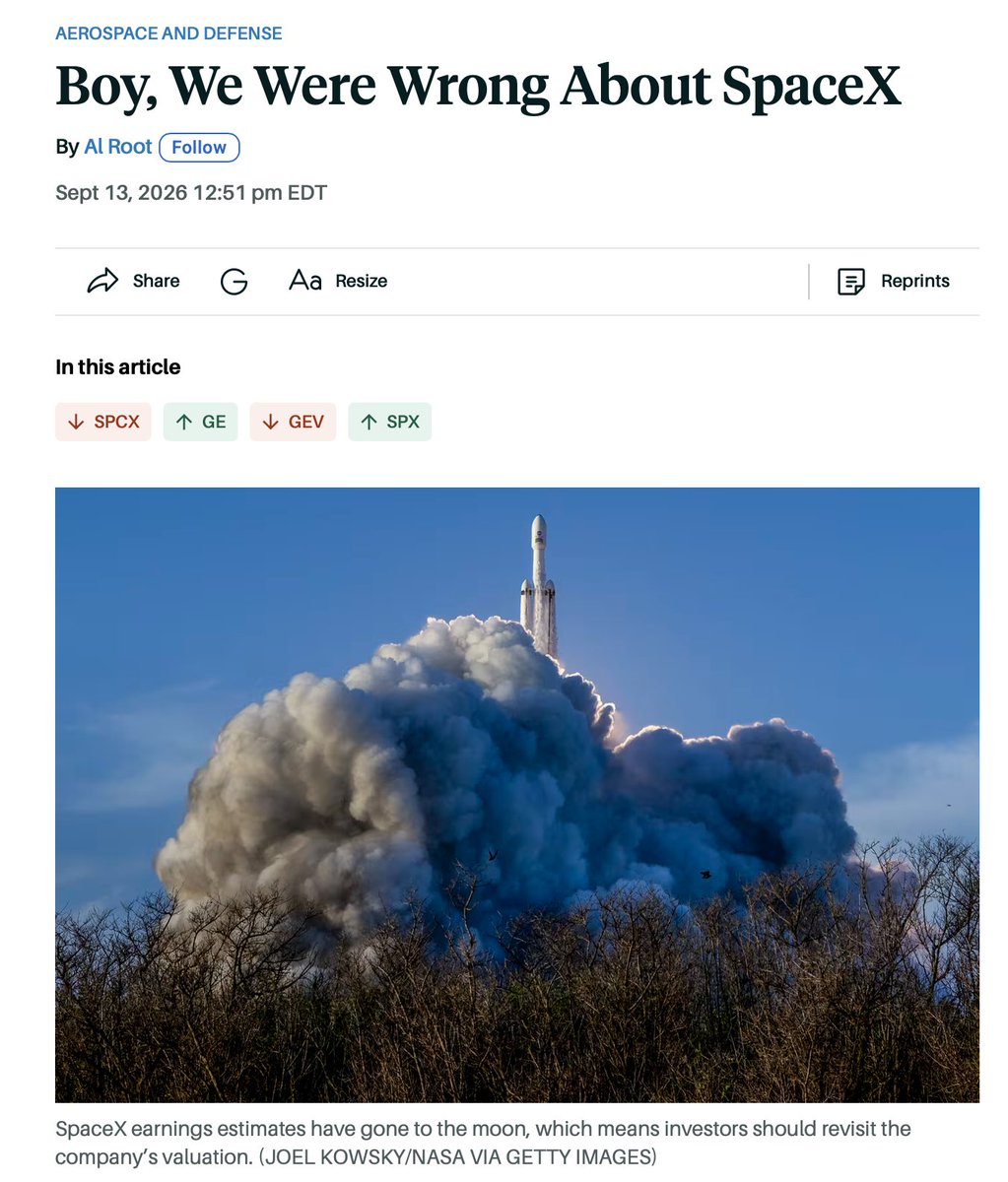
When SpaceX completed its all-stock acquisition of xAI in February 2026, the dominant take was skeptical: SpaceX shareholders were overpaying to rescue a money-losing AI startup. Seven months later, Barron's is walking that back — and the underlying numbers explain why the conventional wisdom got this one badly wrong.

1. $7.8 Billion — Combined Revenue in a Single Quarter
SpaceX's Q2 2026 total revenues hit $7.8 billion, a 92% increase year-over-year, according to the company's August financials. To put that in context: SpaceX's total capital expenditures were $4.4 billion for the entire year of 2023. The combined entity is now generating nearly twice that figure in revenue every three months. This is the headline number behind Barron's reversal — revenue simply accelerated faster than analysts had modeled when the deal closed.
2. 247% — The AI Segment's Year-Over-Year Revenue Growth
The division now operating as SpaceXAI — the rebranded xAI, which became SpaceX's AI arm in July 2026 — generated $2.56 billion in Q2 2026 revenue, up from $737 million in the same quarter a year prior. That 247% growth rate is what's shifting the narrative. Major cloud services agreements with customers including Anthropic and Google are driving the bulk of that revenue. The unit that was dismissed as a cash drain is now the company's fastest-growing segment by a wide margin.
3. $41.1 Billion — Projected Annual AI Compute Revenue by December 2026
According to reporting from September 10, 2026, SpaceX's AI compute capacity deals are on track to generate over $3.4 billion per month — more than $41 billion annualized — by year-end. That figure includes a newly confirmed deal worth $1.11 billion per month (roughly $13.3 billion annually) with billing starting December 1, and a multi-year Google Cloud arrangement generating approximately $920 million per month through June 2029. This is the forward-looking figure that most dramatically reframes xAI's contribution to the combined business.
4. $250 Billion — What xAI Was Valued at in the Deal, and Why It Now Looks Like a Bargain
The February merger valued xAI at $250 billion against SpaceX's $1 trillion, creating a combined entity initially worth roughly $1.25 trillion. The cynical read at the time: SpaceX was absorbing a startup burning $6.36 billion in operating losses annually (xAI's full-year 2025 figure) at an inflated price. The revised read, as Whole Mars Catalog noted this weekend, is that most of the present value of the combined business is now traceable to the AI side — a claim that would have seemed implausible at signing.
5. $1.75–$2 Trillion — The IPO Target Valuation
SpaceX is actively pursuing a public offering, with a target valuation of $1.75 trillion to over $2 trillion, according to recent reporting. That range represents a 40–60% premium over the combined entity's implied $1.25 trillion valuation at merger close just seven months ago. The AI compute revenue pipeline — not Starlink, not launches — appears to be the primary driver of that uplift. Whether the IPO timeline accelerates now that the financial story has become easier to tell is the question investors are watching most closely.
The broader takeaway is a familiar one in tech M&A: the market tends to price deals on trailing financials, while the acquirer is betting on a forward curve that isn't visible yet. In this case, the forward curve on AI infrastructure demand arrived faster than even SpaceX's internal projections suggested. The $100 billion annualized revenue run rate the company is targeting by end of 2026 — driven largely by neocloud and AI services — would have seemed like science fiction when the deal was announced. Right now, it looks like a live possibility. For our SpaceX coverage, that trajectory is worth watching closely.
Sources & reporting notes
The links below identify the material source records used for this report.
- @SawyerMerritt on X (2026-09-13T21:03:03.000Z) — Direct source
- @wholemars on X (2026-09-13T21:21:31.000Z) — Direct source
Source links are preserved as published or accessed. See our editorial standards and corrections policy.
The BASENOR Editorial Desk covers Tesla, SpaceX, and related technology, curating reporting from primary sources — official accounts, regulatory filings, and software release data. Every article passes source-record and fact-checking review before publication. About the newsroom.
This report was curated by the BASENOR Editorial Desk from the sources listed above. Read our editorial standards or email editorial@basenor.com to report an error.