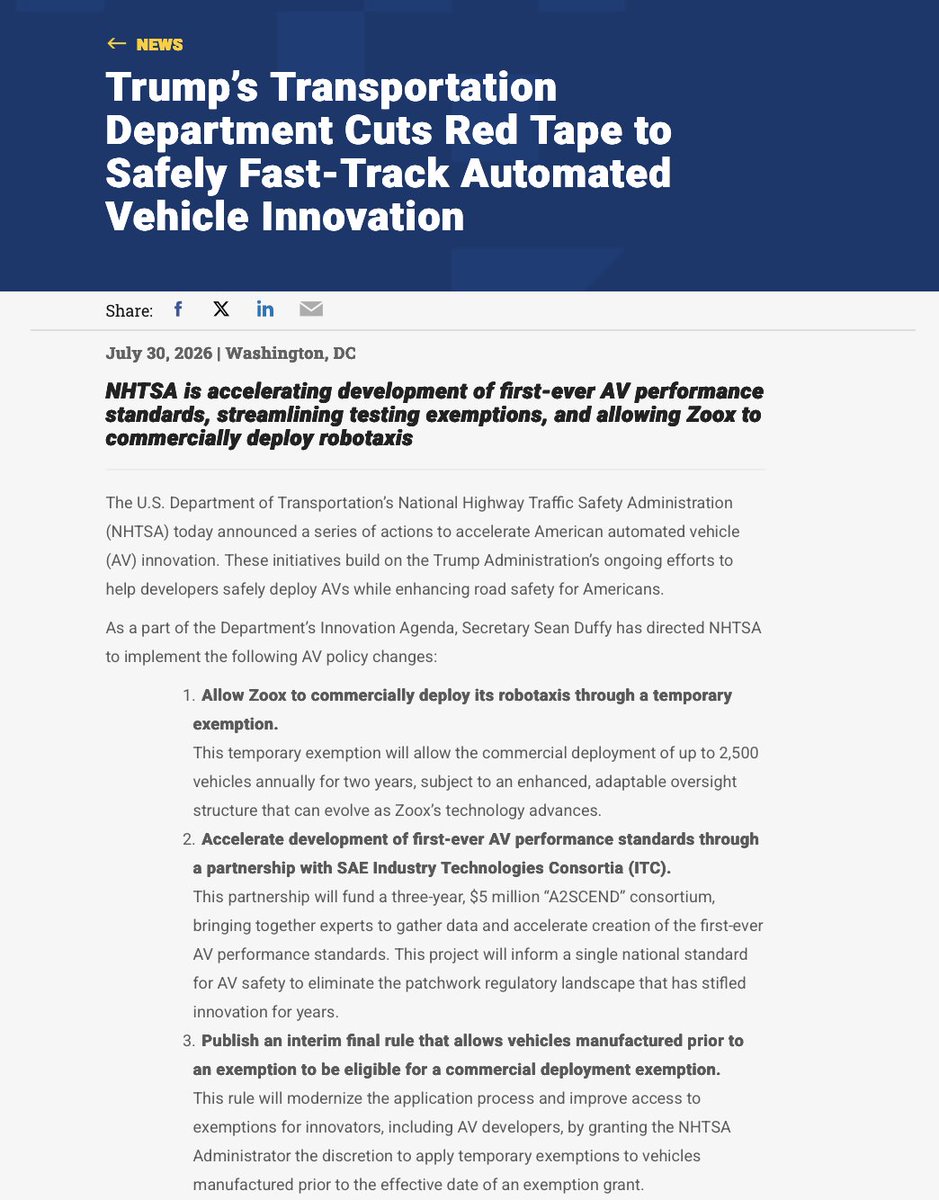
The Trump Administration on July 30, 2026 announced a coordinated push to 'cut red tape and accelerate American automated vehicle innovation,' with Transportation Secretary Sean Duffy directing the National Highway Traffic Safety Administration (NHTSA) to overhaul how the federal government regulates self-driving cars. The centerpiece: accelerating development of the first-ever national AV performance standards — a foundation the industry has been asking Washington to build for nearly a decade.
For Tesla, which has bet its next chapter on Full Self-Driving, Cybercab, and a scaled Robotaxi network, this is arguably the most consequential regulatory shift of the year. It moves the country closer to a single federal rulebook and away from the state-by-state patchwork that has slowed commercial AV deployment.

What NHTSA Announced
According to NHTSA's own release, the agency is rolling out four distinct actions simultaneously. Taken individually, each is meaningful. Taken together, they represent the most active week of AV policymaking the agency has had.
1) First-ever national AV performance standards. NHTSA is partnering with SAE Industry Technologies Consortia (ITC) on a three-year, $5 million program called A2SCEND to gather real-world data and draft the country's first federal AV safety performance standards, according to NHTSA. The goal is a single national benchmark — replacing the current reality where AV rules effectively vary by state.
2) Zoox commercial deployment exemption. NHTSA has granted Amazon-owned Zoox a temporary exemption allowing commercial deployment of up to 2,500 robotaxis per year for two years, according to NHTSA. It is the kind of exemption Tesla will almost certainly seek for the Cybercab, which lacks a steering wheel and pedals and therefore cannot comply with several existing Federal Motor Vehicle Safety Standards (FMVSS) written for human-driven cars.
3) Interim final rule on pre-exemption vehicles. NHTSA published an interim final rule making vehicles manufactured before an exemption is granted eligible for commercial deployment exemptions — a technical fix, but one that removes a real bureaucratic barrier for manufacturers building AV fleets ahead of approvals.
4) Streamlined Part 555 exemption process. The application pathway used for AV-related exemptions is being updated, with NHTSA soliciting public feedback on how to make it faster and more predictable.
Key Figures
| Item | Detail |
|---|---|
| A2SCEND consortium funding | $5 million over 3 years |
| Zoox robotaxi exemption cap | Up to 2,500 vehicles/year for 2 years |
| DOT 2026 rulemakings modernizing FMVSS for AVs | 8 rulemakings touching 10 standards |
| BUILD America 250 Act (H.R. 8870) | $580B, 5 years; first federal framework for autonomous commercial motor vehicles |
| FMVSS deregulatory rules published June 3, 2026 | 14 final rules removing obsolete regulatory text |
Sources: NHTSA announcements, DOT unified rulemaking agenda (July 7, 2026), and the House Transportation and Infrastructure Committee vote of 62-2 advancing H.R. 8870 on May 22, 2026.
How We Got Here
Today's announcement did not happen in isolation. It is the culmination of a steady buildup across the spring and early summer:
- June 3, 2026 — NHTSA published 14 final rules stripping obsolete text out of the FMVSS, part of a coordinated deregulatory initiative.
- June 17-29, 2026 — NHTSA withdrew its proposed AV STEP voluntary evaluation program, signaling the administration wanted a leaner, less voluntary approach. A proposed rule to codify Standing General Order 2021-01 (crash reporting for AVs and SAE Level 2 systems) is still pending, according to Sidley.
- July 7, 2026 — DOT released its 2026 unified rulemaking agenda listing eight separate rulemakings intended to modernize ten FMVSS to accommodate autonomous vehicles, including FMVSS Nos. 111 (rear visibility), 126 (electronic stability control), 201 (occupant protection), and 208 (occupant crash protection).
- July 28, 2026 — Rep. Kevin Mullin (CA-15) introduced the AV Emergency Response Coordination Act, addressing how first responders interact with driverless vehicles.
- July 30, 2026 — Today's NHTSA package.
The direction is unambiguous: Washington is moving from ad-hoc exemptions toward an actual federal framework.
What It Means for Tesla
Three concrete implications for Tesla owners and shareholders.
Cybercab's regulatory runway just got shorter. The Zoox exemption is the template. A commercial deployment exemption capped at thousands of vehicles per year, granted while permanent AV performance standards are still being drafted, is exactly the mechanism Tesla will need for a steering-wheel-less Cybercab. The streamlined Part 555 process announced today is designed to make that pathway faster.
FSD's regulatory ceiling is being raised — slowly. The pending codification of Standing General Order 2021-01 means crash reporting requirements aren't going away, but the modernization of FMVSS 126 (stability control) and 208 (crash protection) around AV use cases is exactly the kind of update that lets driver-out systems clear compliance hurdles they currently trip on.
A national framework beats a state patchwork. Tesla's Robotaxi service has been rolling out city by city because AV rules are effectively state-by-state. A federal performance standard, even one three years away, gives Tesla — and every AV operator — a single target to build toward rather than 50.

Not everyone thinks the pace is enough. Longtime FSD tester Whole Mars Catalog called today's actions 'a great set of steps toward a national autonomous driving framework' but argued the administration needs to 'move much faster' and lock in a federal framework before the 2026 midterms — a political window that closes fast.
What to Watch Next
Four signals worth tracking over the next several months:
- The first A2SCEND draft standards. A three-year timeline suggests initial working drafts could surface in late 2026 or 2027.
- Additional Part 555 exemptions. The Zoox grant sets a precedent. Watch for whether Waymo, Tesla, or others file — and how quickly NHTSA moves on them.
- SGO 2021-01 codification. If NHTSA finalizes the pending rule, crash-reporting obligations for Level 2 systems like Autopilot and FSD (Supervised) become permanent, not administrative.
- The BUILD America 250 Act. H.R. 8870 cleared committee 62-2. If it passes the House and Senate, it would create the first federal regulatory framework for autonomous commercial motor vehicles — a huge deal for Tesla Semi and any future autonomous freight ambitions.
A national AV framework will not arrive by the end of the summer. But for the first time in years, the federal government is publicly committing to build one — and Tesla, whose next decade depends on autonomy at scale, has more to gain from that than any other automaker in America.
🚕 Following the Robotaxi rollout? See every operating city, launch date and announced market in our Tesla Robotaxi Tracker.
Related Gear
Gear up your Tesla with tested, custom-fit BASENOR accessories — shop Tesla accessories →
Sources & reporting notes
The links below identify the material source records used for this report.
- @SawyerMerritt on X (2026-07-30T14:28:20.000Z) — Direct source
- @SawyerMerritt on X (2026-07-30T14:28:21.000Z) — Direct source
- @wholemars on X (2026-07-30T14:50:05.000Z) — Direct source
Source links are preserved as published or accessed. See our editorial standards and corrections policy.
The BASENOR Editorial Desk covers Tesla, SpaceX, and related technology, curating reporting from primary sources — official accounts, regulatory filings, and software release data. Every article passes source-record and fact-checking review before publication. About the newsroom.
This report was curated by the BASENOR Editorial Desk from the sources listed above. Read our editorial standards or email editorial@basenor.com to report an error.