X Money has released a comprehensive public breakdown of its financial service limits, covering every major transaction type from ACH transfers to cash deposits. The figures reveal a system built to accommodate both high-volume users and everyday transactions — with some notable asymmetries between deposit methods that are worth understanding before you move serious money through the platform.

The Full Limit Structure
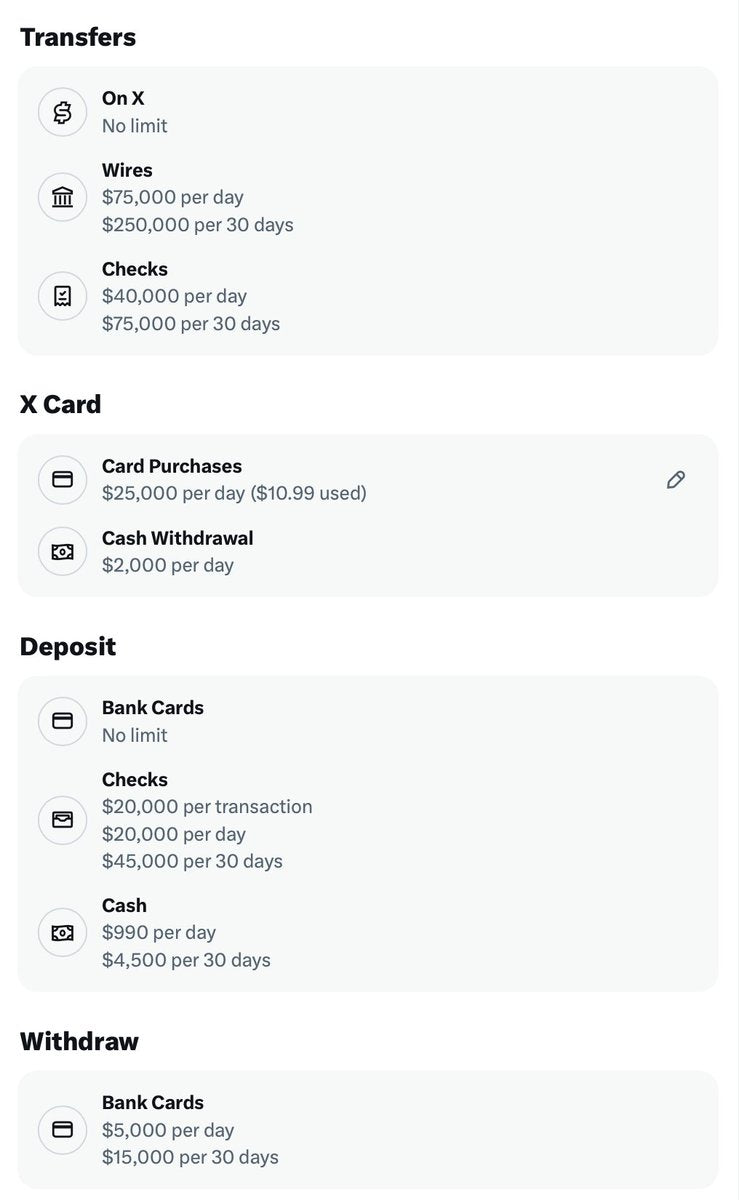
According to the published specifications, the limits break down across four deposit channels and several transfer and spending categories. The headline number is the ACH ceiling: $10 million per day with no monthly cap, and $2 million per individual transfer. That puts X Money in territory typically reserved for business banking and treasury operations — not consumer payment apps.
| Transaction Type | Per Transaction | Daily | 30-Day |
|---|---|---|---|
| ACH Deposit | $2,000,000 | $10,000,000 | No limit |
| Bank Card Deposit | No limit | No limit | No limit |
| Check Deposit | $20,000 | $20,000 | $45,000 |
| Cash Deposit | — | $990 | $4,500 |
| Wire Transfer (Out) | — | $75,000 | $250,000 |
| Check Transfer/Payment | — | $40,000 | $75,000 |
| X Card Spending | — | $25,000 | — |
| X Card Cash Withdrawal | — | $2,000 | — |
| Internal X Platform Transfers (P2P) | No limit | No limit | No limit |
What the Numbers Actually Signal
The $990 daily cash deposit ceiling is not arbitrary — it sits just below the $1,000 threshold that typically triggers additional financial reporting requirements in the United States. That's a standard compliance design choice, not a technical limitation. The same logic applies to the $4,500 monthly cash cap.
More strategically interesting is the unlimited bank card deposit tier. Removing the ceiling there lowers friction for users who want to fund their X Money wallet quickly without waiting for ACH settlement windows. Combined with the unlimited P2P transfer capability within the platform, X is clearly prioritizing velocity for money that stays inside the ecosystem.
The wire transfer limits — $75,000 daily and $250,000 over 30 days — are more conservative by comparison, which is typical for newer financial service entrants still building their compliance and fraud infrastructure. According to background research, these limits apply specifically to Premium+ subscribers, who can also apply for higher limits if their use case requires it.
Context: Where X Money Stands
X Money has been positioning itself as a full-stack financial layer on top of the social platform since Elon Musk first outlined the "everything app" vision. Publishing explicit, detailed limits is a maturation signal — it's the kind of transparency that regulators, enterprise users, and fintech-savvy consumers expect before committing to a platform for meaningful financial activity.
The $10 million daily ACH ceiling, in particular, is a direct play for business accounts and high-net-worth users. Most consumer-facing payment apps cap ACH deposits in the low thousands. Advertising a $10M ceiling is less about the average user and more about signaling institutional-grade infrastructure to the segment that moves real volume.
Whether X Money can convert that signal into actual adoption at scale remains the open question. Limits are table stakes — trust, regulatory standing, and seamless UX are what close the gap between a published spec sheet and a platform people actually route their finances through.
Sources & reporting notes
The links below identify the material source records used for this report.
- @SawyerMerritt on X (2026-07-27T20:13:28.000Z) — Direct source
Source links are preserved as published or accessed. See our editorial standards and corrections policy.
The BASENOR Editorial Desk covers Tesla, SpaceX, and related technology, curating reporting from primary sources — official accounts, regulatory filings, and software release data. Every article passes source-record and fact-checking review before publication. About the newsroom.
This report was curated by the BASENOR Editorial Desk from the sources listed above. Read our editorial standards or email editorial@basenor.com to report an error.