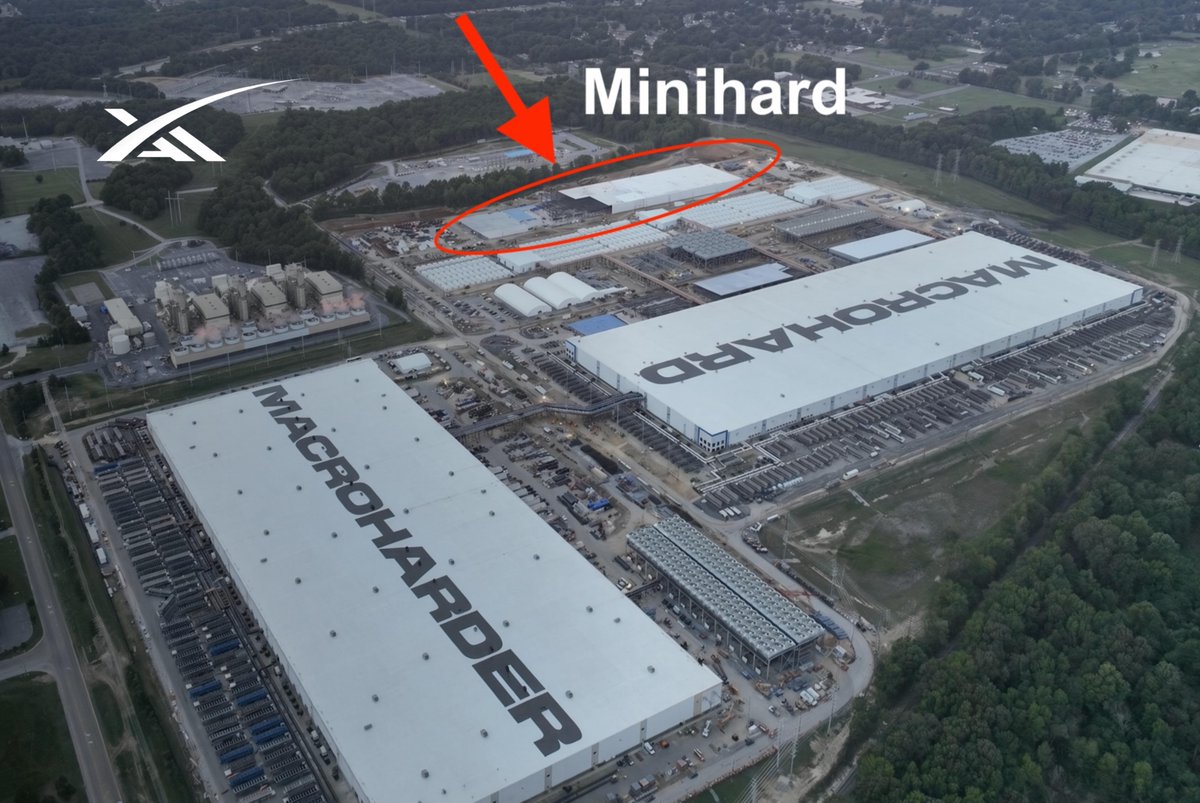
xAI is expanding its compute footprint in the American South with a new multibillion-dollar data center in Tennessee — a facility revealed in the company's latest presentation and nicknamed 'Minihard.' Despite the diminutive name, the site is anything but small: it is being built to house roughly 220,000 Nvidia GB300 GPUs, the same headline count as xAI's larger 'Macroharder' building already visible in the company's site renderings.
The disclosure, shared publicly by Sawyer Merritt on X, gives outside observers their first clear picture of how Elon Musk's AI company plans to scale beyond its original Memphis footprint — and how quickly xAI is moving to keep pace with rivals racing to stand up frontier-model training clusters.

What Was Announced
According to the presentation clip circulated by Merritt, the smaller building visible in xAI's site layout is the new 'Minihard' facility. It sits alongside 'Macroharder,' the company's larger existing building. Both structures are designed to house 220,000 Nvidia GB300 GPUs each — Nvidia's newest Blackwell Ultra generation, purpose-built for large-model training and inference.
The naming convention — Macroharder and Minihard — is quintessentially Musk, but the underlying strategy is straightforward: replicate the compute unit rather than reinvent it. Building two matching 220,000-GPU halls is faster than designing a single monolithic facility twice the size, and it gives xAI redundancy plus the ability to bring capacity online in phases.
Why Tennessee
xAI's compute expansion has been anchored in the Greater Memphis area, spanning sites in Memphis, Tennessee, and across the state line in Southaven, Mississippi. The region offers three things AI data centers desperately need right now: available industrial power, land at scale, and permitting timelines that move faster than California or the Pacific Northwest.
xAI's original Memphis 'Colossus' cluster — the company's first flagship training facility — was stood up at record speed in 2024, and the company has publicly leaned into that speed advantage as a competitive weapon. Minihard appears to be a continuation of that playbook: pick a friendly jurisdiction, secure power, and pour concrete before rivals finish their environmental impact statements.
Key Figures
| Metric | Minihard | Macroharder |
|---|---|---|
| GPU count | 220,000 Nvidia GB300 | 220,000 Nvidia GB300 |
| Location | Tennessee | Tennessee |
| Investment | Multibillion-dollar (per source) | Not disclosed |
| Relative size | Smaller building footprint | Larger building footprint |
The most interesting number in that table is that both halls are being designed to the same 220,000-GPU spec despite very different physical footprints. That suggests Minihard is running denser rack configurations, more aggressive liquid cooling, or a different power-per-rack profile than its sibling — an engineering optimization xAI has not yet detailed publicly.
What GB300 Actually Delivers
The Nvidia GB300 (Blackwell Ultra) is the successor to the GB200 platform and is Nvidia's current flagship for AI training workloads. Each GB300 combines Blackwell Ultra GPUs with Grace CPUs on a shared coherent memory fabric, and Nvidia sells them in NVL72 rack-scale configurations. Filling a building with 220,000 of them puts xAI in the same weight class as the largest publicly known training clusters being built by hyperscalers.
Two 220,000-GPU halls running in tandem would give xAI roughly 440,000 GB300 GPUs in Tennessee alone — before counting the original Colossus cluster or any Southaven capacity. That is the kind of scale required to train frontier models beyond Grok's current generation and to serve inference for the growing suite of xAI products embedded across Tesla vehicles, the X platform, and Musk's other ventures.
The Broader Context
xAI's aggressive infrastructure buildout comes as every major AI lab — OpenAI, Anthropic, Google DeepMind, Meta — is locked in a race to secure GPUs, power contracts, and land. The bottleneck has shifted decisively away from chip availability and toward electrical substations, cooling water, and grid interconnect queues. Companies that can move fastest through permitting and construction win the next model generation.
xAI's advantage, at least on paper, is vertical integration with Musk's other operations. Tesla supplies Megapack energy storage that has already been deployed to buffer the Memphis Colossus site. SpaceX contributes engineering discipline on rapid industrial builds. And the company's willingness to spin up on-site natural gas generation has drawn both praise for speed and scrutiny from local air-quality regulators — a tension likely to follow Minihard as construction ramps.
What to Watch Next
Several specific signals will indicate how quickly Minihard moves from rendering to operational cluster:
- Power interconnect filings with the Tennessee Valley Authority and local utilities, which will reveal the true megawatt draw of the site.
- On-site energy storage deployments — Tesla Megapack installations at Colossus were a leading indicator of when compute went live.
- Nvidia earnings commentary, where xAI shipments are increasingly called out as a material customer segment.
- Grok model release cadence, which is the ultimate proof point that the compute is being used, not just built.
Editor's View
Two matching 220,000-GPU buildings in the same state is not just a data center — it is a statement of intent. xAI is telling the market it plans to compete at the very top of the compute leaderboard, and it is willing to spend multibillion-dollar increments to get there. For Tesla owners, the connection is more direct than it might seem: the same infrastructure powering Grok also underpins the AI voice assistant rolling out inside Tesla vehicles, and eventually the training runs behind Optimus and future FSD architectures. When xAI adds a building, Tesla's software roadmap gets a little more headroom.
Related Gear
Gear up your Tesla with tested, custom-fit BASENOR accessories — shop Tesla accessories →
Sources & reporting notes
The links below identify the material source records used for this report.
- @SawyerMerritt on X (2026-08-12T01:31:43.000Z) — Direct source
Source links are preserved as published or accessed. See our editorial standards and corrections policy.
The BASENOR Editorial Desk covers Tesla, SpaceX, and related technology, curating reporting from primary sources — official accounts, regulatory filings, and software release data. Every article passes source-record and fact-checking review before publication. About the newsroom.
This report was curated by the BASENOR Editorial Desk from the sources listed above. Read our editorial standards or email editorial@basenor.com to report an error.