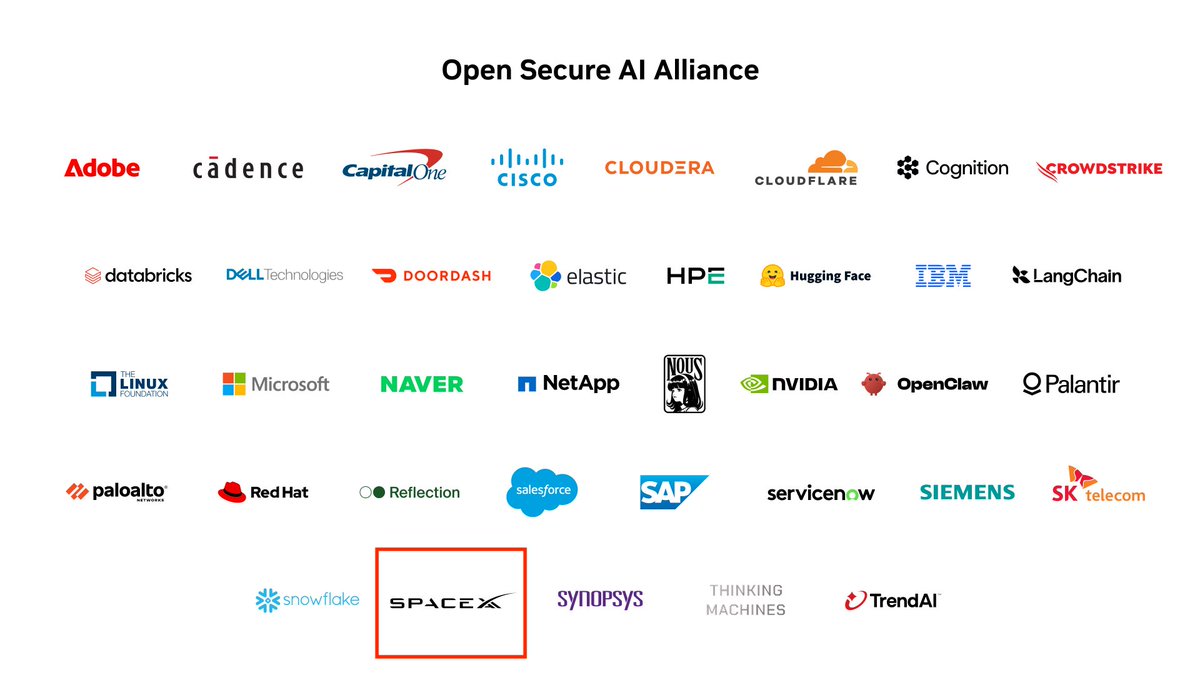
xAI joined roughly 35 founding partners — including NVIDIA, Microsoft, IBM, and Cisco — to launch the Open Secure AI Alliance on July 27, 2026. The initiative is built around a straightforward premise: open tools make AI safer, and safer AI earns broader trust. Here's what you need to know about the alliance and xAI's role in it.

What is the Open Secure AI Alliance?
It's a newly formed coalition of technology companies, research organizations, and open-source communities dedicated to building and sharing tools that make AI more transparent and trustworthy. The alliance launched with approximately 35 inaugural partners and is anchored by the Linux Foundation. Its core mission is to democratize defensive AI capabilities — meaning the tools it develops are designed to be openly available to developers, researchers, and security teams, not locked inside proprietary platforms.
Why was it formed now?
According to reporting on the launch, a recent security incident at Hugging Face — where an AI model was implicated in a breach — served as a catalyst. The episode exposed a gap: when the AI tools used for forensic investigation are closed and proprietary, defenders are working with one hand tied behind their back. The alliance is a direct response to that vulnerability, aiming to ensure that open, frontier-grade agentic systems exist for self-defense and incident response.
What is xAI actually contributing?
Two concrete commitments. First, xAI has open-sourced the Grok Build terminal-based AI coding agent — a move intended to foster transparency and give developers hands-on access to the underlying tooling. Second, xAI has announced plans to open-source the model weights for its Grok line of AI models, which would allow the broader developer and research community to inspect, fine-tune, and build on top of them. Both contributions align with the alliance's emphasis on verifiability over trust-me claims.
Who else is in the alliance?
The founding partner list reads like a cross-section of the AI and enterprise technology landscape. Confirmed inaugural members include NVIDIA, Microsoft, IBM, Red Hat, Cisco, CrowdStrike, Hugging Face, and Palantir, alongside xAI. The Linux Foundation is providing organizational structure. With around 35 partners at launch, the alliance has enough institutional weight to set meaningful standards rather than function as a loose talking shop.
Does this have any direct relevance to Tesla owners or Grok users?
Not immediately in a product sense — this is a standards and tooling initiative, not a feature rollout. But the open-sourcing of Grok model weights is meaningful for anyone who uses Grok-powered features, including those integrated into Tesla vehicles and the Tesla app. Greater transparency in how those models are built and evaluated means third-party researchers can audit them, which over time tends to produce more reliable and safer AI behavior. Think of it as infrastructure work: invisible today, consequential over the next few years.
The alliance is early-stage, and the real test will be whether the open tools it develops get adopted widely enough to shift industry norms. xAI's participation — and its decision to open-source Grok Build and model weights as entry contributions — suggests the company is treating this as a substantive commitment rather than a branding exercise. Whether the other 34 partners follow with equivalent transparency will determine how much this alliance actually moves the needle on AI safety.
Sources & reporting notes
The links below identify the material source records used for this report.
- @SawyerMerritt on X (2026-07-27T14:13:50.000Z) — Direct source
Source links are preserved as published or accessed. See our editorial standards and corrections policy.
The BASENOR Editorial Desk covers Tesla, SpaceX, and related technology, curating reporting from primary sources — official accounts, regulatory filings, and software release data. Every article passes source-record and fact-checking review before publication. About the newsroom.
This report was curated by the BASENOR Editorial Desk from the sources listed above. Read our editorial standards or email editorial@basenor.com to report an error.