📌 UPDATE — June 15, 2026
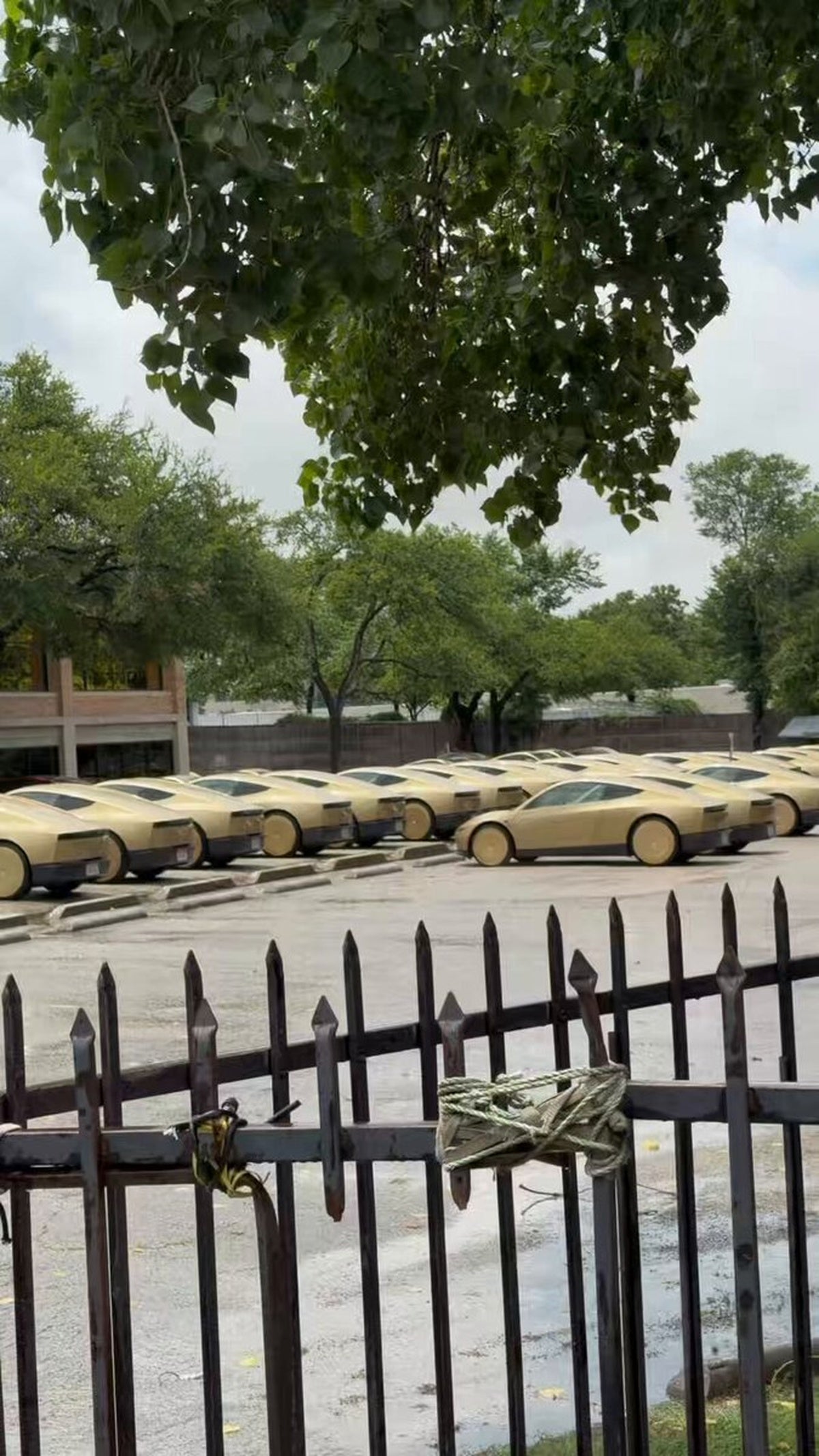
The Dallas Cybercab count has already surpassed the ~40 figure reported at publication — visual confirmation now shows more than 50 Cybercabs at the Dallas robotaxi hub. This fits a broader picture of explosive nationwide scaling: with the one-year anniversary of Tesla's robotaxi launch just one week away, the fleet has grown from 11 supervised vehicles in a single city to 725 cars across Austin, Dallas, Houston, and Silicon Valley — a 66-fold increase in under a year. At launch, there were zero unsupervised rides; today the network spans four major metro areas and is still expanding.
@wholemars · Jun 15, 2026
"They started with 11 supervised cars in one city. Now they have 725 cars across Austin, Dallas, Houston, and Silicon Valley. The fleet grew 66x larger in less than one year."
View on X →

50+ Cybercabs at the Dallas hub — via @TeslaNewswire
📌 UPDATE — June 14, 2026
Tesla's Cybercab rollout is spreading beyond Dallas — 7 Cybercabs have now been spotted in Las Vegas, Nevada, confirming that the fleet expansion is actively reaching multiple US cities simultaneously. This sighting adds Las Vegas to the growing list of markets where Tesla is staging autonomous vehicles ahead of a broader ride-hailing launch. The multi-city buildup suggests Tesla is moving toward a coordinated national activation rather than a single-market pilot.

@TeslaNewswire · June 14, 2026
"7 Tesla Cybercabs spotted in Las Vegas, Nevada! The Cybercab fleet continues to grow across multiple US cities."
📌 UPDATE — June 10, 2026
Tesla's Texas robotaxi footprint has grown well beyond the ~40 Cybercabs spotted in Dallas. State registration records now show 69 vehicles officially registered as Unsupervised Robotaxis in Texas, confirming the fleet has expanded rapidly in recent weeks. The jump from the initial staging numbers to 69 registered units signals that Tesla is actively onboarding vehicles into its autonomous fleet at pace — not just preparing for a soft launch, but potentially gearing up for a meaningful commercial rollout. With registrations climbing this quickly, a significant scale-up of the Texas Robotaxi service could be imminent.
@TeslaNewswire · June 10, 2026
🔥 Tesla has now registered 69 vehicles as Unsupervised Robotaxis in Texas! The fleet has grown rapidly in recent weeks, suggesting a significant scale-up could be just around the corner.

📌 UPDATE — June 9, 2026
Tesla's driverless Robotaxi fleet in Texas has grown to 59 vehicles, up from the ~40 Cybercabs previously staged in Dallas. The expansion confirms that fleet activation is well underway, with Tesla continuing to scale its autonomous ride-hailing presence in the region at a notable pace. The jump from ~40 to 59 units represents roughly a 47% increase, signaling aggressive deployment momentum. No additional operational details have been officially disclosed by Tesla at this time.

via @wholemars · June 9, 2026
Tesla's Cybercab rollout in Texas is accelerating faster than most expected. Approximately 40 purpose-built Cybercabs have been spotted staged at a dedicated robotaxi hub in Dallas — a dramatic jump from the handful of units operating in the city just weeks ago. The phrase used by observers says it all: they're 'ready to be awakened.'

From Three Cars to Forty
The scale of this staging is striking in context. As recently as May 2026, Dallas was home to roughly three Cybercabs as part of a combined 25-vehicle fleet spread across Austin, Dallas, and Houston. The jump to approximately 40 units in Dallas alone represents more than a 10x increase in local Cybercab presence in under a month.
Tesla launched its unsupervised robotaxi service in Dallas and Houston on April 18, 2026, initially using Model Y vehicles. The service area in Dallas covers an estimated 30–35 square miles, including Highland Park, Uptown, and downtown. The Cybercab fleet staged now appears poised to supplement — and eventually replace — those Model Y units as the primary vehicle for the service.
The Infrastructure Behind the Fleet
The Dallas staging isn't happening in a vacuum. Tesla is converting a 24-acre property in Irving, a Dallas-Fort Worth suburb, into its first purpose-built robotaxi fleet center. The facility is designed for dispatch, servicing, cleaning, and repairs, with 212 dedicated parking spaces for autonomous vehicles. That kind of purpose-built infrastructure signals Tesla isn't treating Dallas as a test market — it's treating it as a flagship deployment city.
The regulatory environment has also cleared. A Texas law that took effect May 28, 2026 formally authorizes commercial autonomous vehicle operators and explicitly permits vehicles without steering wheels or pedals — directly accommodating the Cybercab's design. Tesla no longer needs to navigate legal gray areas in the state; the path is open.
What the Cybercab Actually Is
For those less familiar: the Cybercab is a two-seat vehicle with no steering wheel and no pedals, built exclusively for autonomous operation. It runs on Tesla's Hardware 5 (AI5) platform with a vision-only sensor suite and supports wireless inductive charging. Elon Musk has stated a target retail price under $30,000, though the vehicles staged in Dallas are fleet units, not consumer purchases. The first production Cybercab rolled off the line at Gigafactory Texas on February 17, 2026, with continuous production ramping through April.
The FSD v15 Dependency
There's one important caveat to the 'ready to be awakened' framing. Aggressive Cybercab fleet expansion for full public use is understood to be tied to the release of FSD Version 15, which is anticipated in late 2026 to early 2027. Tesla VP of AI Ashok Elluswamy has indicated the Cybercab will 'soon' join the active robotaxi fleet in Austin — suggesting the software unlock, not the hardware, is the remaining gating factor.
That makes the Dallas staging a calculated pre-position. Tesla is getting vehicles in place, infrastructure built, and regulatory clearance secured so that when FSD v15 is ready, the fleet can go live without delay. Forty cars sitting in a Dallas lot isn't a bottleneck — it's a launch pad.
📋 Tracking Tesla software? See every firmware, FSD and app version in one place in our Tesla Software Update Tracker.
🚕 Following the Robotaxi rollout? See every operating city, launch date and announced market in our Tesla Robotaxi Tracker.
Related Gear
Gear up your Tesla with tested, custom-fit BASENOR accessories — shop Tesla accessories →
Sources & reporting notes
The links below identify the material source records used for this report.
- @TeslaNewswire on X (2026-06-08T05:39:01.000Z) — Direct source
- @wholemars on X (2026-06-09T05:07:40.000Z) — Direct source
- @TeslaNewswire on X (2026-06-10T04:58:43.000Z) — Direct source
- @TeslaNewswire on X (2026-06-14T16:00:18.000Z) — Direct source
- @wholemars on X (2026-06-15T17:11:28.000Z) — Direct source
- @TeslaNewswire on X (2026-06-15T17:10:57.000Z) — Direct source
Source links are preserved as published or accessed. See our editorial standards and corrections policy.
The BASENOR Editorial Desk covers Tesla, SpaceX, and related technology, curating reporting from primary sources — official accounts, regulatory filings, and software release data. Every article passes source-record and fact-checking review before publication. About the newsroom.
This report was curated by the BASENOR Editorial Desk from the sources listed above. Read our editorial standards or email editorial@basenor.com to report an error.